Take the inner product with in . The reciprocal basis condition gives . Expanding instead in the basis proves the reciprocal-basis coordinate transformationThus is the Gram matrix of the original basis. It is a positive-definite matrix, so this change of basis is invertible.
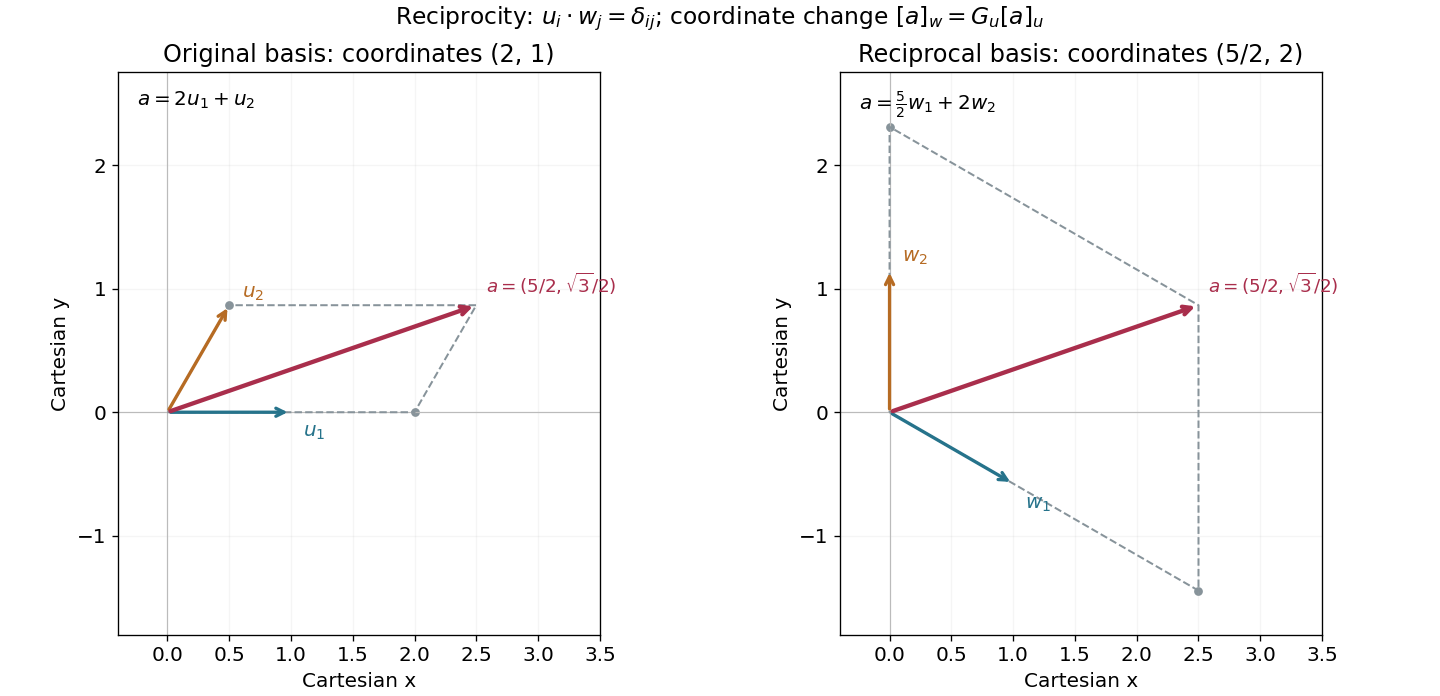
In the specified two-dimensional Cartesian frame,Solving the four dot product conditions givesThey are perpendicular to and , respectively, with lengths adjusted so the other dot product is one. Equating the Cartesian components of givesConsequentlywhich agrees entry by entry with the Gram matrix computed directly from the two unit basis vectors.

Articles by others on the same topic
There are currently no matching articles.