Adopt the convention that an inner product is linear in its second slot. Over , it is a symmetric bilinear form with , equality only for . Over , a Hermitian inner product obeysThese imply conjugate linearity in the first slot: . The strict positivity condition distinguishes an inner product from a general Hermitian form.
Expand the vector in the orthonormal basis, . Using linearity in the second slot and the Kronecker delta givesExpanding both vectors and using conjugate linearity in the first slot therefore givesAn orthonormal set that is not a basis would recover only the coordinates of the orthogonal projection onto its linear span; here the vectors span .
The two reciprocal bases satisfy . Expanding each vector in its specified basis and using real bilinearity givesThe simple sum-of-products formula holds because the two coordinate vectors use paired reciprocal bases. It does not require either basis to be orthogonal, and would generally fail if both sets of components were taken in the same nonorthogonal basis.
Take the inner product with in . The reciprocal basis condition gives . Expanding instead in the basis proves the reciprocal-basis coordinate transformationThus is the Gram matrix of the original basis. It is a positive-definite matrix, so this change of basis is invertible.
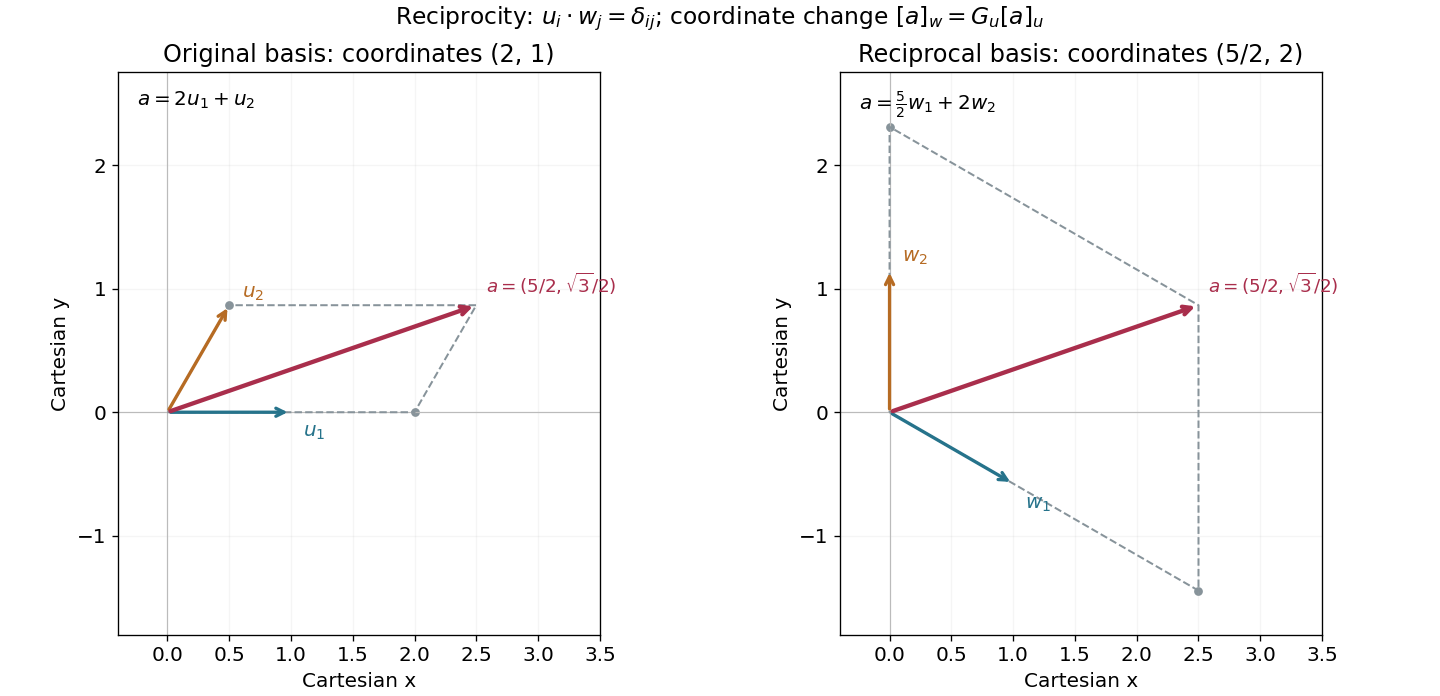
In the specified two-dimensional Cartesian frame,Solving the four dot product conditions givesThey are perpendicular to and , respectively, with lengths adjusted so the other dot product is one. Equating the Cartesian components of givesConsequentlywhich agrees entry by entry with the Gram matrix computed directly from the two unit basis vectors.

Articles by others on the same topic
There are currently no matching articles.