Assume a physical mass , spring constant , and nonnegative viscous damping parameter . The homogeneous damped harmonic oscillator has characteristic equationIts roots are . They have nonzero imaginary parts precisely when . Defining , the real oscillatory solutions areFor strictly decaying oscillations also require . The limiting case is an undamped harmonic oscillator. Equality gives critical damping with , and a larger positive gives two real decaying exponentials rather than oscillations.
Take and , and write and . Substitution of into the forced harmonic oscillator equation givesEquating the independent sine and cosine coefficients yieldsThus the required phase matching for a displacement referenced driven oscillator isFor a positive amplitude , one must also choose the correct quadrant: and . Squaring and adding the coefficient equations givesFor arbitrary forcing phase, the steady response is instead , where has the sine and cosine just specified. A change of time origin can put this displacement into , but it also changes the stated forcing phase.
The source's requested parameter list for omits ; in general it cannot be omitted. As a concrete counterexample, take and . The prescribed cosine response exists for every , but , so fixing all four listed parameters does not fix the amplitude. Likewise, with fixed , positive damping and nonzero , the second coefficient equation prevents a nonzero pure-cosine response. The forcing phase is an essential part of the condition.
In the steady periodic response, the cycle average of the mechanical energy derivative vanishes. The applied average power therefore equals the power dissipated by the viscous force:Using solution givesThe same result follows from averaging the instantaneous input power , using the response phase relative to the drive.
For positive and , rewrite this asThe last factor is at most one, with equality precisely when . Thus the power peak occurs at andThis power-resonance angular frequency is exactly ; it need not equal the angular frequency maximizing displacement amplitude. Positive damping is essential: at and exact resonance there is no bounded steady periodic response to nonzero forcing, so the divergent expression is not a finite-power solution.
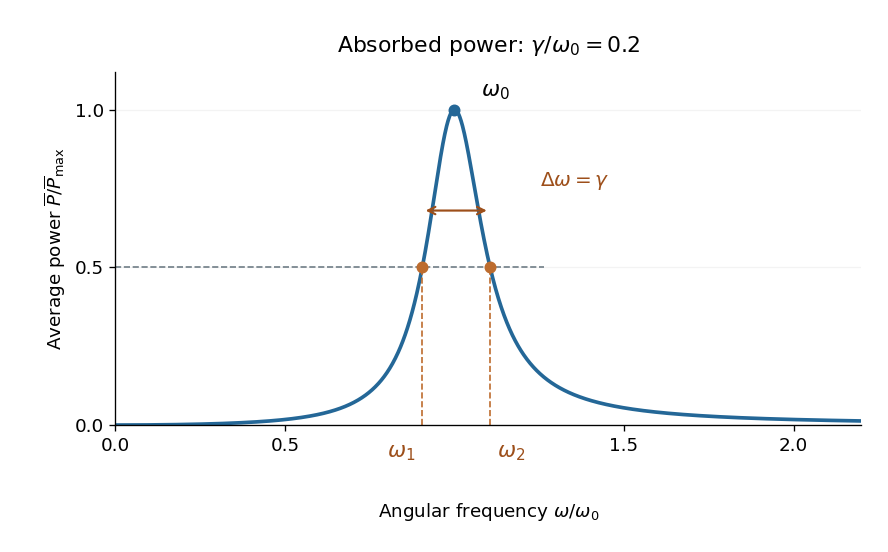
Use and the power formula from solution. Its normalized form isIt is zero at , rises to one at , and decays to zero as . The two positive half-power angular frequencies satisfyOn the low-frequency side, ; on the high-frequency side, . Solving these quadratic equations givesConsequently the frequency bandwidth of viscous oscillator power absorption obeys the stronger exact resultFor a sharp resonance, , expansion gives , which recovers the requested approximation. The exact width above assumes the constant viscous damping coefficient in this model. Although the curve is approximately symmetric near a sharp peak, the exact half-power points satisfy rather than exact symmetry about .

Articles by others on the same topic
There are currently no matching articles.