The annual bundle is named “Physics Papers 2018”, but this ordinary-sitting paper's cover is dated 12 June 2019. The year follows the cover. All twelve questions are solved, including all four choices in Section B.
Multiply numerator and denominator by the complex conjugate of the denominator:The denominator is the squared modulus .
The complex number has modulus two and principal argument . Therefore its principal complex logarithm isIf the source's logarithm means the full multivalued complex logarithm, rather than its principal value, the complete answer is with . A branch convention is necessary to obtain a unique imaginary part.
Use the principal complex logarithm at each stage of the nested complex exponentiation. Since ,This inner value is positive real, so its principal complex logarithm is . ConsequentlyOne must retain the parentheses: complex exponentiation is not associative. If all complex logarithm branches are allowed, the inner values are . Taking the outer logarithm with an independent integer branch index yields . Thus the complete multivalued set is , and the boxed answer selects its principal evaluation.
The determinant is . Thus , and its four polynomial roots areIn Cartesian form these are , , and . Their moduli are one and their complex arguments are equally spaced by . The Argand diagram is therefore a square centered at the origin, with sides parallel to the coordinate axes.
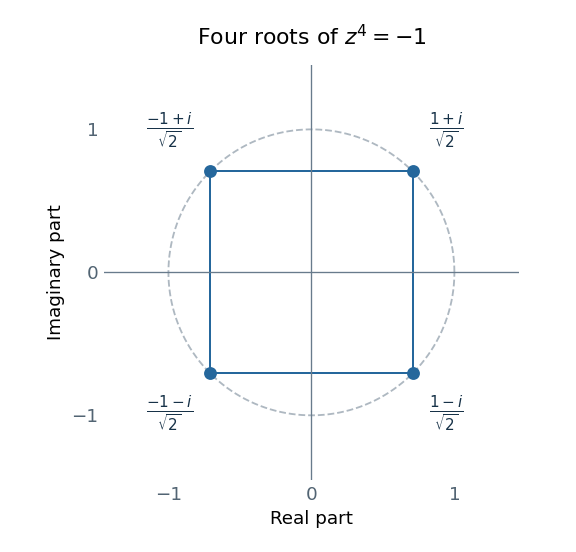
The four roots of z to the fourth equals minus one, plotted on the unit circle in the complex plane.
Details. 
The right-hand side depends on , suggesting the substitution . Then , so the ordinary differential equation becomesThe original equation is undefined at . If , this is a separable differential equation:Substituting back gives the implicit familyDifferentiating the implicit equation gives , or , verifying it on its permitted intervals.
Division by excluded the constant solution , which must be restored separately:It satisfies . Together these give all local real solutions on intervals where .
On the interval containing the initial point, divide the linear ordinary differential equation by to obtain . Its integrating factor is , givingThe initial condition gives . HenceDirect differentiation gives , so and . The coefficient of vanishes at zero; the boxed expression is the solution on the regular initial-value interval, rather than an assertion of unique continuation through zero.
A normal vector to the plane is , with Euclidean norm . For , , so the distance from a point to a plane isTo verify that this is the minimum, the displacement to the closest point on a plane is parallel to . Put and require . This gives andFor every other point on the plane, the displacement is orthogonal to . The Pythagorean theorem gives , proving minimality.
Let with , using the standard complex Hermitian inner product. ThenTaking the complex conjugate and using yields . Since ,Thus every eigenvalue of an anti-Hermitian matrix lies on the imaginary axis, including the possible zero eigenvalue; each nonzero eigenvalue is purely imaginary.
Now take and . On one hand . On the other handConsequently . Distinct eigenvalues therefore implywhich is the required orthogonality of the eigenvectors.
Write the given matrix as . Expanding its characteristic polynomial along the middle column givesThus the eigenvalues are , counted with algebraic multiplicity.
For , solving gives and . For , solving gives , with free. A convenient eigenbasis is thereforeThe last two eigenvectors span the two-dimensional eigenspace for . The three columns have determinant , so they are linearly independent and form a basis of . In particular the repeated eigenvalue causes no failure of diagonalizability here.
Apply the vector triple product identity with . This givesFor column vectors , the scalar triple product is ; replacing by gives the other coefficient. ThereforeThe signs follow the stated column convention and the cyclic invariance of the scalar triple product. No independence assumptions on the four vectors are needed.
Put . By Euler's formula, . The binomial theorem givesGroup opposite powers and use :Since , division by yieldsThis derivation is an application of the same exponential representation underlying De Moivre's theorem.
To invert the complex cosine, let and put . Since the exponential function is nonzero, , and Euler's formula gives . Multiplying by yields the quadratic equation . ThusChoosing either square root of merely exchanges the two signs. The two values have product one, so neither vanishes; taking a complex logarithm is legitimate.
For each choice of sign, all solutions of satisfy . Therefore the full inverse relation isConversely, exponentiating any displayed value recovers one root of the quadratic equation, and hence , proving completeness. With a multivalued complex logarithm, the term is already included and this is the source's compact formula for inverse cosine.
The principal inverse cosine requires compatible choices of logarithm branch, square root and sign. Both signs cannot represent that same principal function indiscriminately: at , the two principal-log values are and , whereas the principal is . Thus the printed is correct for the inverse relation, not a pair of interchangeable principal-value formulas.
By Vieta's formulas, the sum of all five polynomial roots, counted with multiplicity of a root, is minus the coefficient of divided by the leading coefficient. Hence
For a monic polynomial of degree five, Vieta's formulas give the product of its polynomial roots as times its constant coefficient. Therefore
The coefficients are real, so the supplied polynomial root has its complex conjugate as another polynomial root. Their monic polynomial factor of degree two isPolynomial division then givesThus all five polynomial roots, with multiplicity of a root, areTheir sum is and their product is , agreeing with solution and solution.
Assume a physical mass , spring constant , and nonnegative viscous damping parameter . The homogeneous damped harmonic oscillator has characteristic equationIts roots are . They have nonzero imaginary parts precisely when . Defining , the real oscillatory solutions areFor strictly decaying oscillations also require . The limiting case is an undamped harmonic oscillator. Equality gives critical damping with , and a larger positive gives two real decaying exponentials rather than oscillations.
Take and , and write and . Substitution of into the forced harmonic oscillator equation givesEquating the independent sine and cosine coefficients yieldsThus the required phase matching for a displacement referenced driven oscillator isFor a positive amplitude , one must also choose the correct quadrant: and . Squaring and adding the coefficient equations givesFor arbitrary forcing phase, the steady response is instead , where has the sine and cosine just specified. A change of time origin can put this displacement into , but it also changes the stated forcing phase.
The source's requested parameter list for omits ; in general it cannot be omitted. As a concrete counterexample, take and . The prescribed cosine response exists for every , but , so fixing all four listed parameters does not fix the amplitude. Likewise, with fixed , positive damping and nonzero , the second coefficient equation prevents a nonzero pure-cosine response. The forcing phase is an essential part of the condition.
In the steady periodic response, the cycle average of the mechanical energy derivative vanishes. The applied average power therefore equals the power dissipated by the viscous force:Using solution givesThe same result follows from averaging the instantaneous input power , using the response phase relative to the drive.
For positive and , rewrite this asThe last factor is at most one, with equality precisely when . Thus the power peak occurs at andThis power-resonance angular frequency is exactly ; it need not equal the angular frequency maximizing displacement amplitude. Positive damping is essential: at and exact resonance there is no bounded steady periodic response to nonzero forcing, so the divergent expression is not a finite-power solution.
Use and the power formula from solution. Its normalized form isIt is zero at , rises to one at , and decays to zero as . The two positive half-power angular frequencies satisfyOn the low-frequency side, ; on the high-frequency side, . Solving these quadratic equations givesConsequently the frequency bandwidth of viscous oscillator power absorption obeys the stronger exact resultFor a sharp resonance, , expansion gives , which recovers the requested approximation. The exact width above assumes the constant viscous damping coefficient in this model. Although the curve is approximately symmetric near a sharp peak, the exact half-power points satisfy rather than exact symmetry about .
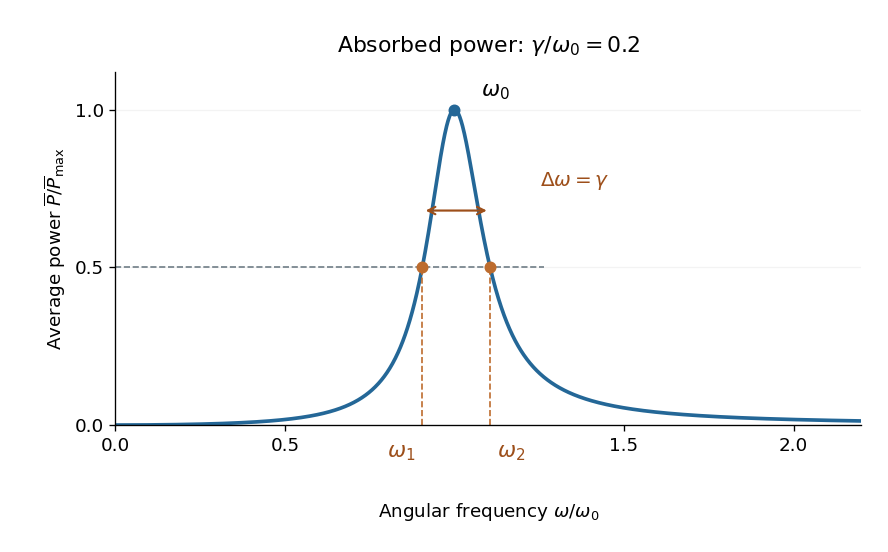
Normalized absorbed power for gamma divided by omega zero equal to 0.2. The peak and the two exact half-power frequencies are marked; their separation is gamma.
Details. 
For a finite matrix, the series defining the matrix exponential converges absolutely in any matrix norm, because . Thus the Hermitian adjoint may be taken term by term. Since ,Therefore the matrix exponential of a Hermitian matrix is Hermitian.
If is a diagonal matrix, then . Summing each entry separately givesFor the Hermitian matrix case each is real. The diagonal entry formula itself remains valid for complex diagonal entries.
The upper-triangular matrix has distinct eigenvalues , with respective eigenvectors and . ThusThe defining power series shows that the matrix exponential respects similarity. Applying solution to the diagonal factor givesAs a direct series check, for ; summing this entry divided by gives the same off-diagonal expression.
If is an matrix, the product is defined in ordinary matrix multiplication only when . Hence the defining equation of an idempotent matrix already requires equal row and column counts:Equivalently, an idempotent linear map is an endomorphism, so the same vector space is both its domain and codomain.
If the idempotent matrix is invertible, multiply on the left by its matrix inverse:Thus a nonidentity idempotent matrix must be singular; the identity itself is both invertible and idempotent.
Using ,Thus is another idempotent matrix. In fact : as linear projections, they select the complementary summands in the decomposition .
Take determinants of the idempotence equation and use multiplicativity of the determinant:Thus satisfies , provingIf the determinant is one, is invertible and solution gives . Every other idempotent matrix has zero determinant.
For real orthonormal column vectors, and . Expand using associativity of matrix multiplication:HenceMore precisely, it is the orthogonal projection onto the span of : it fixes both vectors and annihilates every vector orthogonal to both.
The transpose convention presumes real vectors, or the explicitly stated bilinear identities above. For complex vectors orthonormal in the Hermitian inner product, the correct orthogonal projection is . The printed transpose formula need not work in that setting: and are Hermitian-orthonormal, but has square , which is different from itself.
Induction from gives for every integer . Separate the zeroth term of the matrix exponential series:Therefore the exponential of an idempotent linear map isThe last form shows its action directly: it multiplies the image of a linear map of by and fixes its kernel of a linear map. No Hermiticity assumption on the idempotent matrix is needed.
Write . The two off-diagonal entries of giveor . If both vanish, is diagonal; if either is nonzero, the trace must be one. Thus the trace criterion for a two-by-two idempotent isFor the diagonal case, idempotence further forces . The stated alternative is only necessary: has trace one but its square is , so it is not idempotent. Among two-by-two matrices of trace one, the additional condition is sufficient by the Cayley-Hamilton theorem, which gives .
The linear system has the matrix formThe first equation gives . Substitute it into the second to obtain . Substitution into the third gives . ConsequentlyIt follows thatSubstitution verifies all three equations. Also , so this solution of a linear system is unique.
The characteristic polynomial of isThe corresponding eigenvectors may be chosen as and . They are linearly independent, so write . Substitution in the system of ordinary differential equations givesIndependence of the eigenvectors yields two decoupled harmonic oscillator equations. Their four integration constants give the general real solutionBoth components can be differentiated directly to verify . Orthogonality of the eigenvectors is unnecessary: diagonalizing this nonsymmetric matrix requires an invertible eigenbasis, not an orthonormal one.
In a real orthonormal basis, a matrix is a proper rotation matrix exactly when and . The first condition preserves dot products, and the second preserves orientation of a vector space.
Put , , and , so the rows of the given matrix are . Their squared Euclidean norms and pairwise dot products areThus . For the sign of its determinant, use the circulant form:This proves that it is a rotation matrix. Its fixed axis is , because each row sums to one. The rotation trace formula gives ; the skew part selects a positive angle about the unit axis .
The original triangle has edge vectors and . Its area is half the Euclidean norm of their cross product:The rotated vertices are twice the three columns of :A rotation matrix preserves lengths and the angle between the two edge vectors, so it preserves their parallelogram area. More explicitly, for a proper rotation matrix, and , so the rotated edge cross product is again . Therefore
Articles by others on the same topic
There are currently no matching articles.