Work over the reals with , and put . The algebraic equation implies andDifferentiate this identity and use ; cancellation gives . Hence , with nonzero real , and substitution gives the complete familyThere is no extra real singular branch lost in the cancellation, since . At a point with , the permitted constants satisfy , givingThese are distinct, real and nonzero, so exactly two integral curves pass through each such point. This does not contradict an Picard-Lindelöf theorem: the implicit equation permits two different slopes and is not one specified explicit first-order ordinary differential equation. Each choice of the smooth slope branch separately defines a locally unique curve.
The two real slope roots of are distinct because their discriminant is . Vieta's formulas give , so the tangent vectors and have zero scalar product. Whenever the coefficients define local solution curves, the two families are therefore orthogonal trajectories.
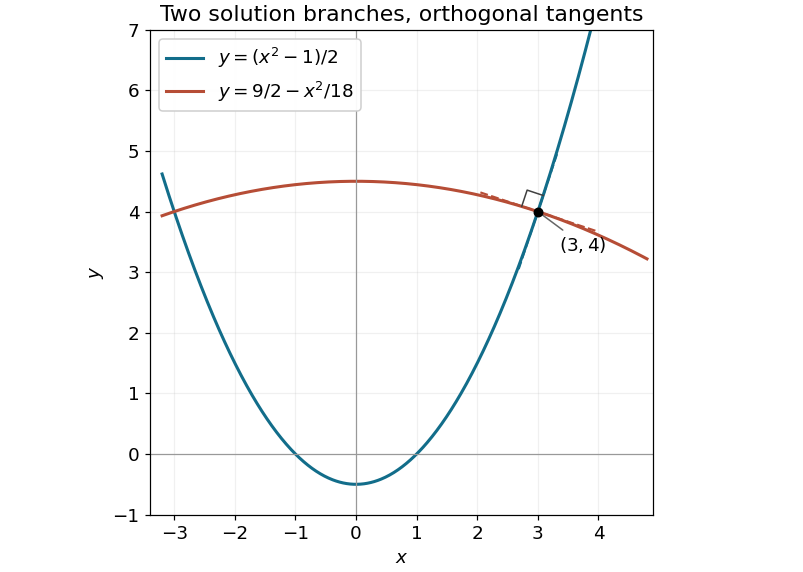
For the stated example at , the slopes are and . In the family from part a, the constants are and , givingBoth curves pass through , and verifies the right angle.

Articles by others on the same topic
There are currently no matching articles.