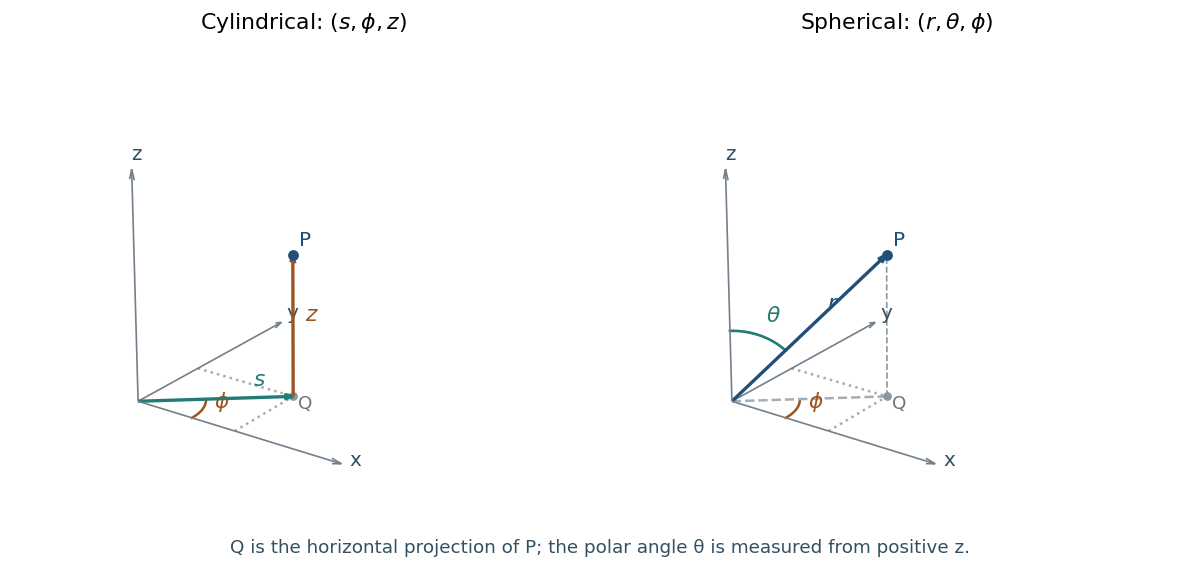
Use for cylindrical radius, to distinguish it from spherical radius . In cylindrical coordinates , the azimuthal angle is measured from positive in the horizontal plane:Here and .
In spherical polar coordinates , take as the polar angle from positive and use the same azimuthal angle :The ranges are , and . The radial direction has horizontal projection of length , which explains the extra factor in . The azimuth is undefined on the polar axis, and both angles are nonunique at the origin; these are coordinate degeneracies rather than geometric singularities.

On the unit upper hemisphere, use spherical coordinates with and . The surface mass density is , while the surface area element is . Thus the total mass isThe answer is in the mass units implicit in the specified unit radius and density law. A useful geometric check is that on the unit hemisphere equals the area element of its vertical projection onto the horizontal unit disc, whose area is .
This is a scalar surface integral, not an oriented flux. Split the whole closed surface into the bottom disc, curved side and tilted top; shared edge curves have zero surface area.
On the bottom, and the integrand is . Its integral over the symmetric disc vanishes by oddness:On the top, , so . The graph has , , giving . HenceFor the side, let and parametrize by , with . The surface area element is . ThusAdding all three pieces givesThe tilted top remains above the bottom everywhere because . The calculation is an instance of a scalar surface integral over a cylinder with one tilted cap; reversing a surface orientation would not change any of its terms.
Articles by others on the same topic
There are currently no matching articles.