Regard the planar vector field as , with no dependence on . Its curl isThus, for continuously differentiable and , the necessary and sufficient pointwise condition isTo deduce global path independence from this local condition also requires a suitable domain, for example a simply connected domain.
Set and . Their partial derivatives satisfy throughout . The vector field is smooth on the entire simply connected plane, so zero curl proves path independence.
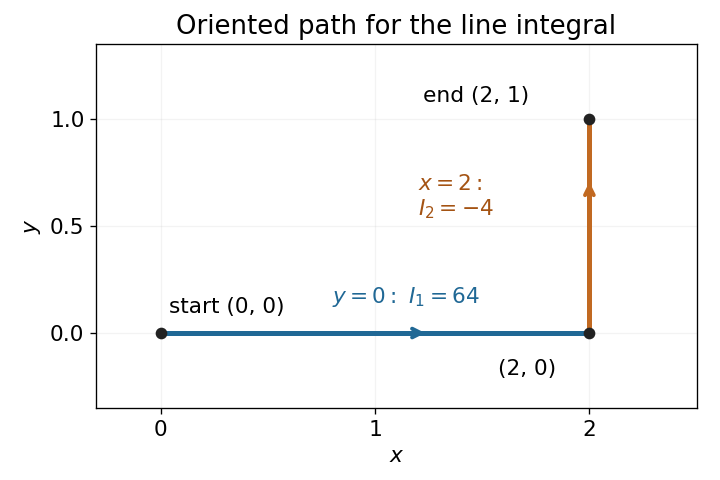
Choose the broken straight path . Along its horizontal segment and , givingAlong its vertical segment and , givingTherefore the line integral is

An exact differential is an expression that equals for a single-valued differentiable function on the domain. Its line integral is an endpoint difference by the fundamental theorem for line integrals.
Integrating with respect to gives . Matching to requires . HenceThe arbitrary additive constant cancels. This constructs the vector-field potential globally and provides a second proof of path independence.
Assume a simple, piecewise smooth closed curve oriented counterclockwise around its enclosed region . Apply Green's theorem with and :The orientation assumption is essential. A clockwise unit circle, , for , gives although its enclosed area is . For a self-intersecting curve the same line integral measures twice the signed area, with multiplicity, rather than necessarily twice an ordinary enclosed area.
Articles by others on the same topic
There are currently no matching articles.