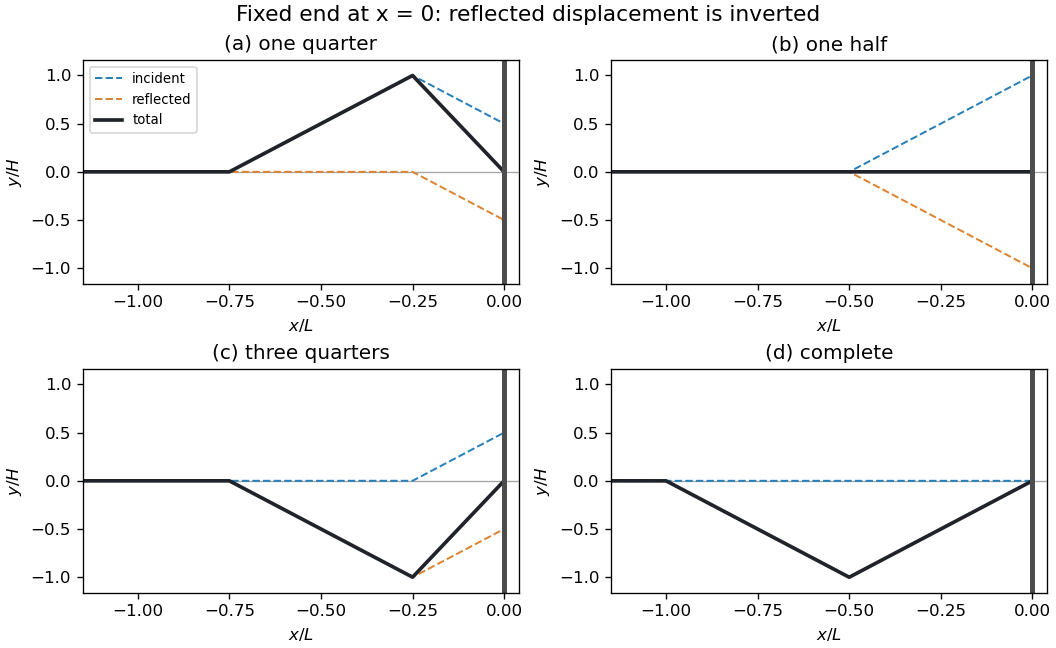
Put the fixed end at , with the mechanical string occupying . Let be the incident peak amplitude, set and , and take when the incident front first reaches the end. The symmetric triangular pulse in the source has initial profile , whereThe fixed-end reflection of a triangular pulse follows from the Dirichlet boundary condition and the superposition principle, giving the reflected displacementThe minus sign is the inversion on reflection. At , the resulting profile is zero outside and consists of the straight segments throughThe segment beside the wall is steeper because incident and inverted reflected pulses overlap there.
At , the two triangular pulses coincide with opposite signs:The instantaneous sketch is the straight equilibrium line. This is destructive interference, not the disappearance of the wave energy. For example, on the transverse velocity is , so the mechanical string is passing through equilibrium with nonzero kinetic energy.
At , the reflected pulse dominates the overlap. The total displacement is zero outside and consists of straight segments throughThis is the inverted version of the quarter-reflected profile. The entire negative pulse has not yet separated from the incident pulse.
At , the incident pulse has left the physical half-line, so only the inverted reflected pulse remains. Its straight segments pass throughIt subsequently travels toward decreasing at the original wave speed , with unchanged width and peak amplitude magnitude .

Articles by others on the same topic
There are currently no matching articles.