Take an ideal flexible mechanical string with constant tension and uniform linear mass density . Let measure distance along its straight equilibrium position and let be its small transverse displacement. Neglect damping, bending stiffness and external distributed forces, and assume .
A segment of reference length has mass . The endpoint tension forces have transverse resultantsince for small slopes. Newton's second law, divided by and taken to the limit, givesHere is time, the subscripts denote partial derivatives, and is the wave speed. The transverse acceleration is ; describes the small-slope curvature responsible for the net transverse force.
Put and assume has continuous second derivatives. The chain rule yieldsThus the wave equation is satisfied. A point of fixed wave phase has , so for this travelling wave moves in the .
For ,Equivalently . Thus every value of the displacement is translated by the same distance : the entire travelling wave profile keeps its shape. The wave speed is independent of the profile, as expected for this nondispersive wave equation.
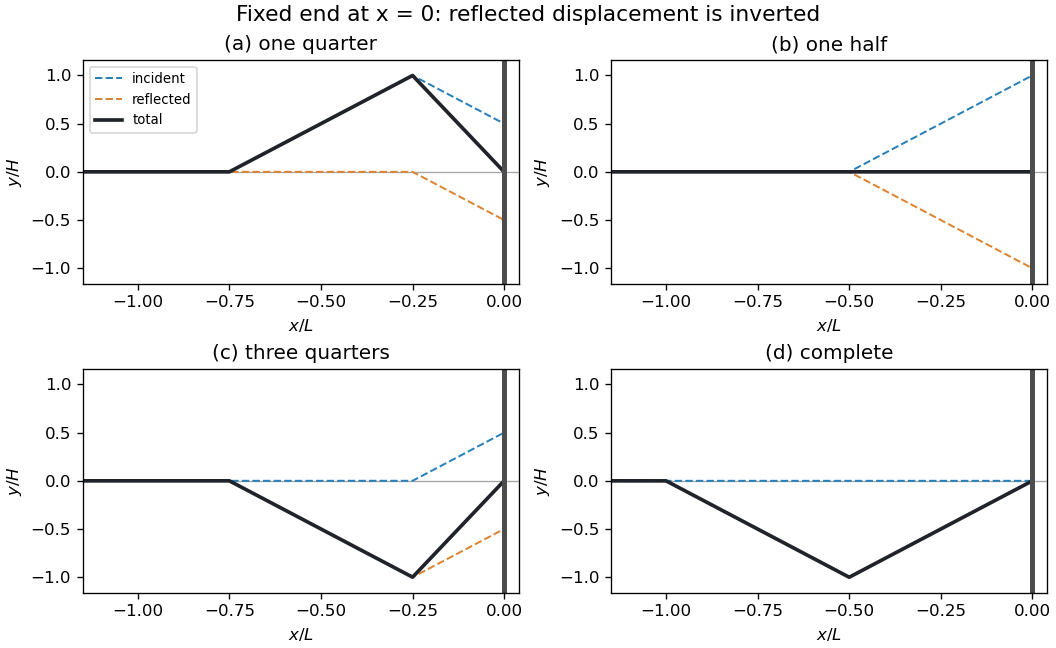
Put the fixed end at , with the mechanical string occupying . Let be the incident peak amplitude, set and , and take when the incident front first reaches the end. The symmetric triangular pulse in the source has initial profile , whereThe fixed-end reflection of a triangular pulse follows from the Dirichlet boundary condition and the superposition principle, giving the reflected displacementThe minus sign is the inversion on reflection. At , the resulting profile is zero outside and consists of the straight segments throughThe segment beside the wall is steeper because incident and inverted reflected pulses overlap there.
At , the two triangular pulses coincide with opposite signs:The instantaneous sketch is the straight equilibrium line. This is destructive interference, not the disappearance of the wave energy. For example, on the transverse velocity is , so the mechanical string is passing through equilibrium with nonzero kinetic energy.
At , the reflected pulse dominates the overlap. The total displacement is zero outside and consists of straight segments throughThis is the inverted version of the quarter-reflected profile. The entire negative pulse has not yet separated from the incident pulse.
At , the incident pulse has left the physical half-line, so only the inverted reflected pulse remains. Its straight segments pass throughIt subsequently travels toward decreasing at the original wave speed , with unchanged width and peak amplitude magnitude .

Articles by others on the same topic
There are currently no matching articles.