Source paper: www.whatdotheyknow.com/request/oxford_physics_past_papers_2/response/2340696/attach/9/Physics%20Papers%202020.pdf?cookie_passthrough=1 (ordinary sitting, 10 June 2021; the public bundle filename says 2020).
A stationary point occurs where the derivative vanishes. HereThe two families areConsequently there are infinitely many stationary points on the real line. The second derivative is : the first family consists of strict local minima and the second of strict local maxima.
The product rule and chain rule giveThe exponential function is strictly positive, so there are exactly two stationary points, at . The derivative is negative outside these two values and positive between them. Thus the negative value is a strict local minimum and the positive value a strict local maximum.
By the product rule and chain rule,Thus there are stationary points; the function is strictly increasing everywhere.
The probability density function is normalized because . Its expected value and second moment areBoth improper integrals converge, so the variance is
For a fixed , the allowed interval is . Integrating the joint probability density over it gives the marginal densityFor a fixed , the inequality is equivalent to . The other marginal density is thereforeAs a normalization check, and .
Under the usual intended interpretation that the descending quarter of a circle drops through one radius, its radius is . Its arc length is , givingThe printed smoothness condition is inconsistent. The terminal tangent vector of the helix is . Every tangent vector to a curve confined to the plane has zero component, so no such regular curve can join this helix with a common tangent line. Moreover, the helix is still rising at that endpoint. Thus no smooth ride satisfying all the literal conditions exists.
Even after allowing a corner, a quarter of a circle reaching the ground does not alone determine its radius: the orientation of its endpoint radii must also be specified. For example, in the plane, the circular arctraversed toward decreasing , descends monotonically for and reaches when . Choosing gives , whereas gives . The numerical answer above is conditional on the intended geometry; it does not repair the impossible smooth join.
At their intersection, and . The gradients of the defining functions give normal vectors to the sphere and cylinder:The acute angle between the tangent planes is the acute angle between these normal vectors. Their dot product givesIt is the same at every intersection point; the supplementary oriented angle is .
Interpret the cube root as the real cube root. The curved boundary is , so the bounded region is , . In particular is negative inside it. The double integral is the convergent improper integralFor negative real , an antiderivative is . The inner integral is therefore . HenceThe negative sign is essential. Absolute convergence follows by the same calculation with the sign removed, so the singular edge at causes no ambiguity.
Parametrize the curve by for . Then and . Their dot product gives the line integralUsing integration by parts for the second term,
Take an ideal flexible mechanical string with constant tension and uniform linear mass density . Let measure distance along its straight equilibrium position and let be its small transverse displacement. Neglect damping, bending stiffness and external distributed forces, and assume .
A segment of reference length has mass . The endpoint tension forces have transverse resultantsince for small slopes. Newton's second law, divided by and taken to the limit, givesHere is time, the subscripts denote partial derivatives, and is the wave speed. The transverse acceleration is ; describes the small-slope curvature responsible for the net transverse force.
Put and assume has continuous second derivatives. The chain rule yieldsThus the wave equation is satisfied. A point of fixed wave phase has , so for this travelling wave moves in the .
For ,Equivalently . Thus every value of the displacement is translated by the same distance : the entire travelling wave profile keeps its shape. The wave speed is independent of the profile, as expected for this nondispersive wave equation.
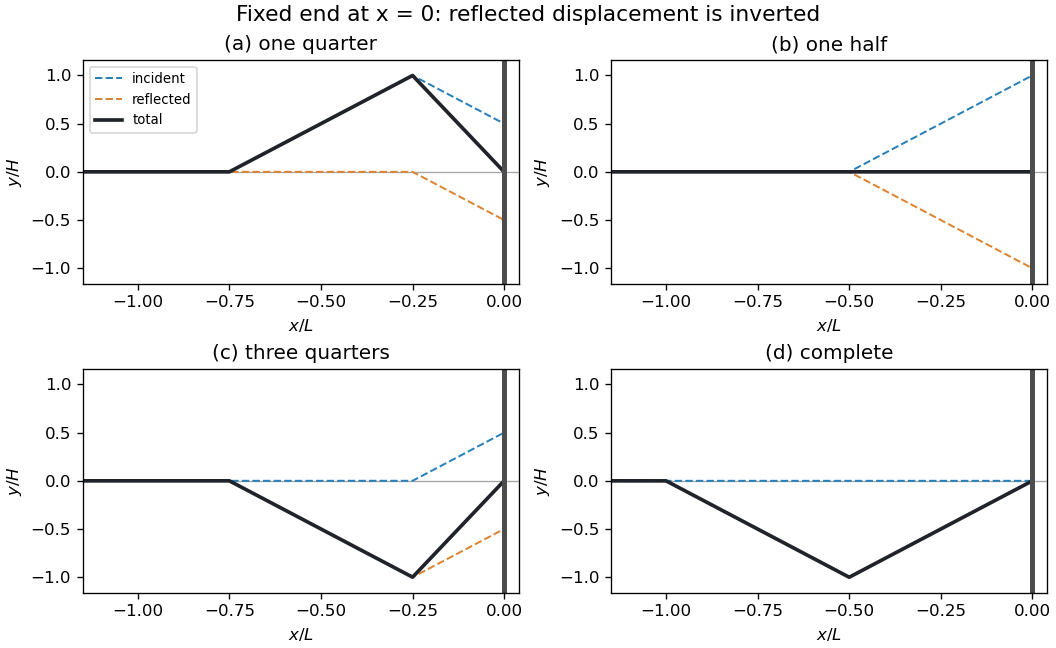
Put the fixed end at , with the mechanical string occupying . Let be the incident peak amplitude, set and , and take when the incident front first reaches the end. The symmetric triangular pulse in the source has initial profile , whereThe fixed-end reflection of a triangular pulse follows from the Dirichlet boundary condition and the superposition principle, giving the reflected displacementThe minus sign is the inversion on reflection. At , the resulting profile is zero outside and consists of the straight segments throughThe segment beside the wall is steeper because incident and inverted reflected pulses overlap there.
At , the two triangular pulses coincide with opposite signs:The instantaneous sketch is the straight equilibrium line. This is destructive interference, not the disappearance of the wave energy. For example, on the transverse velocity is , so the mechanical string is passing through equilibrium with nonzero kinetic energy.
At , the reflected pulse dominates the overlap. The total displacement is zero outside and consists of straight segments throughThis is the inverted version of the quarter-reflected profile. The entire negative pulse has not yet separated from the incident pulse.
At , the incident pulse has left the physical half-line, so only the inverted reflected pulse remains. Its straight segments pass throughIt subsequently travels toward decreasing at the original wave speed , with unchanged width and peak amplitude magnitude .

A normal mode of a stable undamped linear coupled oscillator has a single angular frequency and a fixed ratio of component displacements. All components share a sinusoidal time factor, with relative oscillation phases of zero or for real mode shapes. A general free motion is a superposition of the normal modes. For this system the symmetric stiffness matrix gives real eigenvalues and orthogonal eigenvectors; positive spring constants make the squared angular frequencies positive.
Write and . Assume ideal massless linear springs, negligible damping and positive . By Hooke's law and Newton's second law,The coupling spring extends by , giving equal and opposite coupling forces.
For a normal mode, take . Nonzero eigenvectors requireSolving this quadratic equation in givesA corresponding mode shape has ratioand the general real solution is . The arbitrary amplitudes and oscillation phases account for four independent initial data.
Weak coupling alone does not guarantee large beats. A useful representative sketch assumes nearly equal uncoupled angular frequencies. In the resonant case with , the mode shapes are and , andFor , , both normal modes have equal coefficients. With and ,These rapid oscillations have slowly varying complementary wave envelopes. The initial displacement shifts almost entirely to the other mass at , and returns after . Arbitrary initial data give a different superposition; if , the normal modes are localized mainly on individual masses, and strong exchange is suppressed.
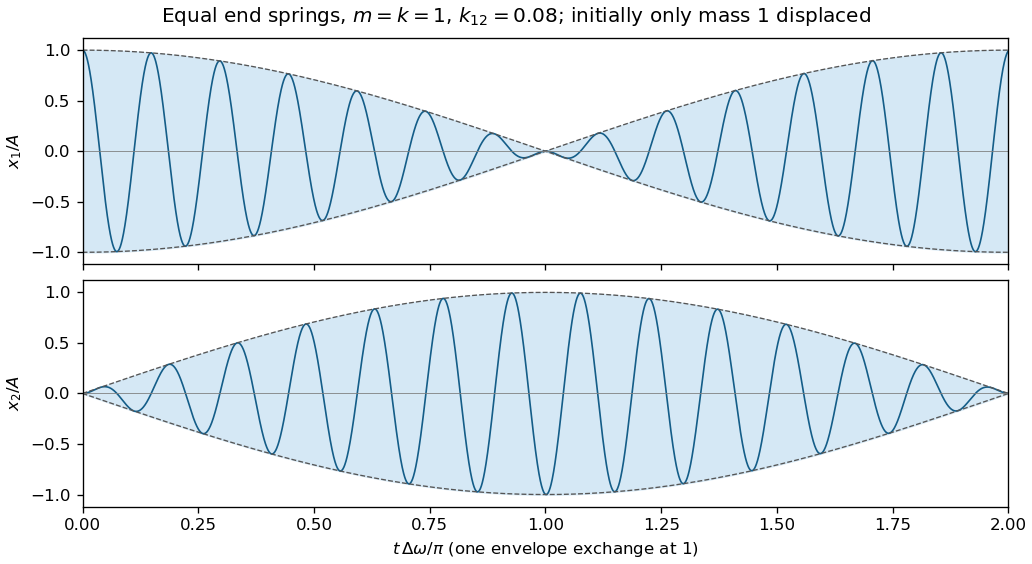
Representative weakly coupled resonant motion: rapid displacements inside slowly exchanging envelopes
. Details. 
Holding one mass fixed leaves the coupling spring attached and stretched by the other mass. Therefore the two constrained angular frequencies areThese differ from the angular frequencies obtained by physically removing the coupling spring. Ordinary frequencies in hertz are each corresponding .
Finally, for and , put . ThenSince , taking positive square roots provesAt , the outer inequalities become equalities.
Let be a compact piecewise smooth oriented surface, its chosen unit normal vector, and its entire oriented boundary. Let be a continuously differentiable vector field on a neighborhood of . Stokes theorem statesHere is the curl, is the surface area element, and is the directed line integral element. The boundary follows the right-hand rule relative to ; equivalently the surface lies to the left when walking along its boundary with one's head toward .
The topological requirement is orientability, together with the regularity and boundary assumptions above. Simple connectivity is unnecessary. An annulus or cylindrical side is allowed, provided every boundary component is included with its induced direction. For a concrete counterexample to a disk-only restriction, take the planar annulus and . The curl is , the surface integral is , and the outer counterclockwise and inner clockwise line integrals sum to .
For in the plane with upward normal vector and , its curl has vertical component . Thus Stokes theorem becomes Green's theorem:The outer boundary is counterclockwise and any inner boundaries are clockwise.
The position vector field is a gradient field:Along any piecewise smooth curve, . Therefore a closed line integral has identical endpoint values andFor a loop bounding an admissible oriented surface, Stokes theorem gives the same result because . The gradient field proof also applies directly to arbitrary piecewise smooth closed loops without choosing a spanning surface.
Choose the outward normal vector on the side of the elliptic cylinder. Parametrize it bySince points outward, the parameter rectangle has its bottom edge traversed with increasing , its right cut edge with increasing , its top edge with decreasing , and its left cut edge with decreasing . After identification, the two cut edges are the same physical curve with opposite directions. Their line integrals cancel for a single-valued vector field. Viewed from above, the bottom rim is counterclockwise and the top rim clockwise.
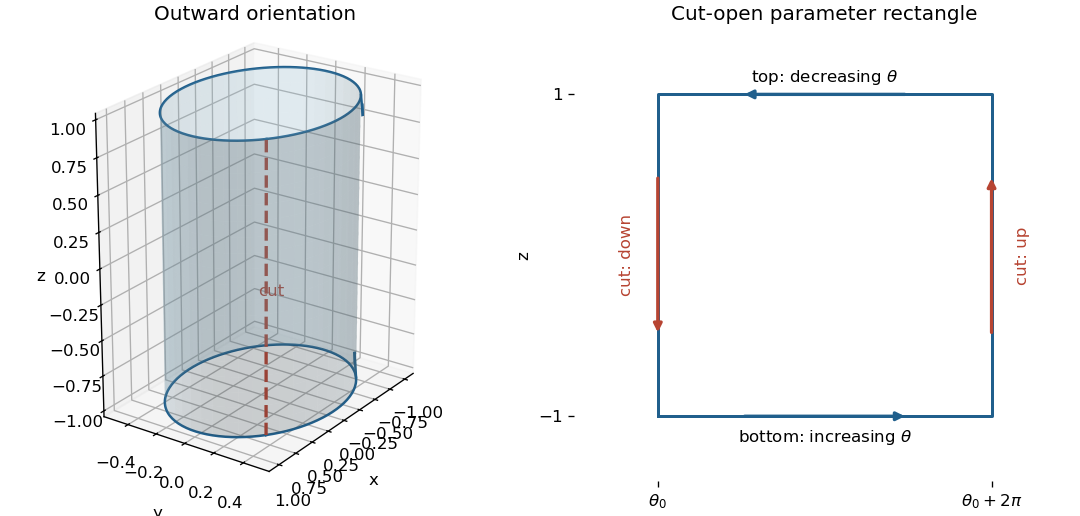
An elliptic cylindrical side cut open into a parameter rectangle, with compatible outward boundary directions
. Details. 
To apply Stokes theorem to a flux rather than a curl integral, first find a vector potential:This vector potential is smooth everywhere. On either horizontal rim, is horizontal whereas is vertical, giving . For a cut at , , so the upward cut contribution is and the downward one is . ConsequentlyA direct check uses the oriented surface element above: , whose integral over a full turn vanishes. Reversing the chosen orientation still gives zero.
Let be continuously differentiable near . Take a small axis-aligned rectangular volume around , with side lengths shrinking with bounded aspect ratios. The outward flux through its two faces is, to leading order,where . The analogous face pairs give and . Dividing total flux by and taking the limit givesThe divergence is thus the local outward flux per unit volume; the symbols on the right are Cartesian partial derivatives.
For a bounded volume with piecewise smooth closed boundary , subdivide into small cells. Each internal face occurs twice with opposite normal vectors, so its flux cancels. The remaining sum is the exterior surface integral; the cell sums of converge to the volume integral. Assuming continuous first partial derivatives on a neighborhood of the closure of , this proves the divergence theorem:The unit normal vector points out of . Multiple boundary components are allowed; at a cavity wall it points into the cavity.
Assume and choose the outward orientation. On the sphere, , so . In spherical coordinates, and . The direct surface integral isIndependently, . Its volume integral over the ball isThe two calculations agree exactly with the divergence theorem. The expression requested is a scalar flux of a vector field, namely the dot product with the directed surface area element.
For this vector field,The divergence theorem and spherical coordinates therefore give the outward fluxThe dependence also follows by combining the cubic field magnitude with the quadratic scaling of surface area.
Wave dispersion means that different frequencies propagate with different phase velocities, so a wave packet generally changes shape. Equivalently the dispersion relation is not proportional to over the relevant band. Three natural examples are the colour separation in a rainbow, where the refractive index of water depends on wavelength; deep-water surface gravity waves, for which and long waves have larger phase velocity; and capillary waves, whose short-wave limit is and whose shorter waves have larger phase velocity. Here is gravitational acceleration, is surface tension, and is fluid mass density, with positive and negligible viscosity.
A distinct application is an optical prism spectrometer: the wavelength-dependent refractive index produces different refraction angles, separating spectral components for measurement. This exploits wave dispersion deliberately.
Take constant complex amplitude and real wavenumber and angular frequency . Substitution of the complex exponential givesThus every nonzero plane wave of the given form solves the equation precisely whenThe wavenumber specifies spatial wave phase change per unit length, with wavelength . The angular frequency specifies temporal wave phase change per unit time, with period and ordinary frequency . The constant in this equation has dimensions time divided by length squared; without an additional dimensional coefficient, it is not an ordinary physical mass.
For propagating oscillatory solutions assume real . If , the equation becomes and only among these spatial plane waves is possible; the usual dispersion relation branch and velocity discussion would degenerate.
A fixed wave phase satisfies , so the signed phase velocity is . The group velocity gives the leading translation of the wave envelope of a narrow-band wave packet on a differentiable dispersion relation branch.
Here . For the conventional positive branch , and ,On the opposite propagation branch it is , so is the phase speed for either sign of . More generally, for real use with , allowing the sign of to follow that of . The constant solution has no distinguished phase velocity.
For equal complex amplitudes, the superposition principle and the complex exponential formula for the cosine give the exact identityThe cosine is a real periodic modulation of the rapidly varying carrier. It varies slowly when and . Its signed wave envelope travels with velocity ; its magnitude gives the visible amplitude envelope.
Equal magnitudes need not mean equal initial wave phases. If the two complex amplitudes are and , write and . The same result becomes , still with a real slowly varying modulation.
Apply the dispersion relation separately to the two components and subtract:In the narrow-band limit this is the group velocity, since givesEquivalently on the positive branch , and its reciprocal is . The factor of two applies to signed velocities on either nonzero propagation branch.
There is a small but useful finite-band qualification. Adding the two component relations gives . Thus the carrier formed by their exact midpoints has phase velocity , and its finite-band envelope-to-carrier velocity ratio isThe exact derivative relation refers to a single central point on the dispersion relation; the two-tone midpoint ratio approaches two as .
The result depends on the component amplitudes and wave phases; adding many frequencies does not by itself guarantee one localized wave packet. For a definite sketch, take many equally spaced wavenumbers in the same fixed band, with equal, aligned complex amplitudes . Linearize the dispersion relation as , where . Then with the wave envelope isfor odd . This is a normalized Dirichlet kernel: constructive interference occurs near , while most other positions undergo partial cancellation. At finite there are repeated groups separated by .
As grows with the half-bandwidth fixed, decreases and the repetition spacing grows. The continuous flat-band limit isThus a sinc function envelope has a central group between its first zeros at , smaller side lobes and rapidly oscillating crests. At fixed bandwidth the limiting central width is ; it does not shrink indefinitely just because more components are added. Smoother spectral weights can reduce the side lobes, and random wave phases would produce a different shape.
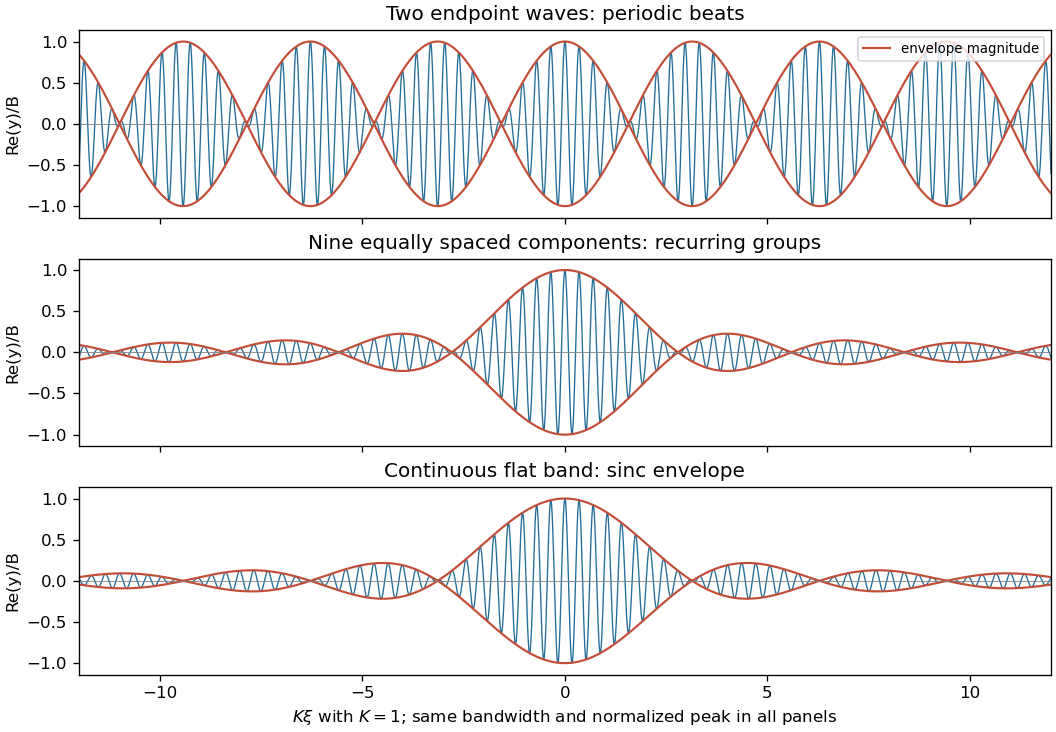
Equal-phase waves in a fixed band: a two-tone beat train, finite groups, and the continuous sinc envelope
. Details. 
For the exact quadratic dispersion relation,The additional quadratic wave phase makes the wave packet spread and change shape. The translating sinc function approximation is valid while ; the preceding figure is the exact comparison, where that approximation introduces no error.
Articles by others on the same topic
There are currently no matching articles.