Choose the outward normal vector on the side of the elliptic cylinder. Parametrize it bySince points outward, the parameter rectangle has its bottom edge traversed with increasing , its right cut edge with increasing , its top edge with decreasing , and its left cut edge with decreasing . After identification, the two cut edges are the same physical curve with opposite directions. Their line integrals cancel for a single-valued vector field. Viewed from above, the bottom rim is counterclockwise and the top rim clockwise.
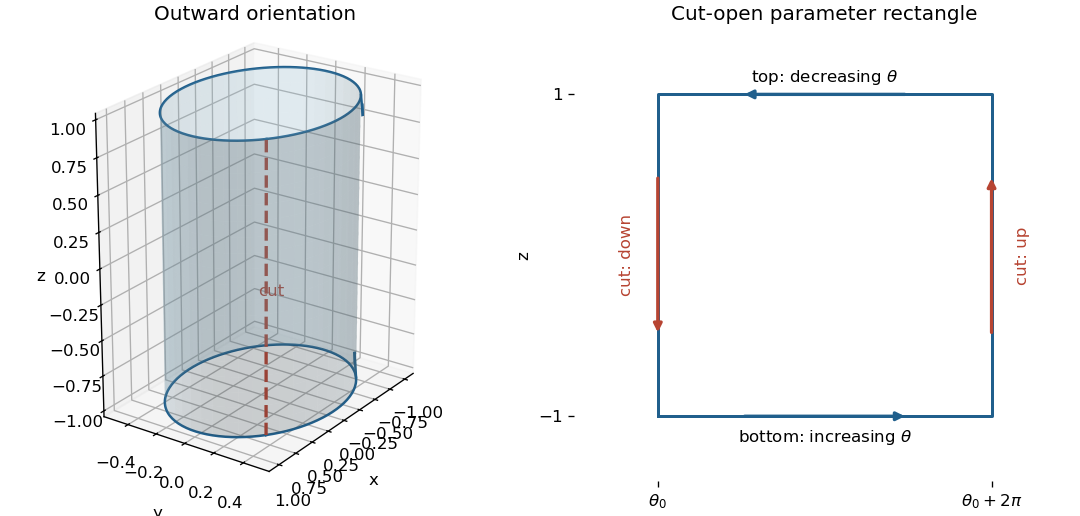
An elliptic cylindrical side cut open into a parameter rectangle, with compatible outward boundary directions
. Details. 
To apply Stokes theorem to a flux rather than a curl integral, first find a vector potential:This vector potential is smooth everywhere. On either horizontal rim, is horizontal whereas is vertical, giving . For a cut at , , so the upward cut contribution is and the downward one is . ConsequentlyA direct check uses the oriented surface element above: , whose integral over a full turn vanishes. Reversing the chosen orientation still gives zero.
Articles by others on the same topic
There are currently no matching articles.