Let be a compact piecewise smooth oriented surface, its chosen unit normal vector, and its entire oriented boundary. Let be a continuously differentiable vector field on a neighborhood of . Stokes theorem statesHere is the curl, is the surface area element, and is the directed line integral element. The boundary follows the right-hand rule relative to ; equivalently the surface lies to the left when walking along its boundary with one's head toward .
The topological requirement is orientability, together with the regularity and boundary assumptions above. Simple connectivity is unnecessary. An annulus or cylindrical side is allowed, provided every boundary component is included with its induced direction. For a concrete counterexample to a disk-only restriction, take the planar annulus and . The curl is , the surface integral is , and the outer counterclockwise and inner clockwise line integrals sum to .
For in the plane with upward normal vector and , its curl has vertical component . Thus Stokes theorem becomes Green's theorem:The outer boundary is counterclockwise and any inner boundaries are clockwise.
The position vector field is a gradient field:Along any piecewise smooth curve, . Therefore a closed line integral has identical endpoint values andFor a loop bounding an admissible oriented surface, Stokes theorem gives the same result because . The gradient field proof also applies directly to arbitrary piecewise smooth closed loops without choosing a spanning surface.
Choose the outward normal vector on the side of the elliptic cylinder. Parametrize it bySince points outward, the parameter rectangle has its bottom edge traversed with increasing , its right cut edge with increasing , its top edge with decreasing , and its left cut edge with decreasing . After identification, the two cut edges are the same physical curve with opposite directions. Their line integrals cancel for a single-valued vector field. Viewed from above, the bottom rim is counterclockwise and the top rim clockwise.
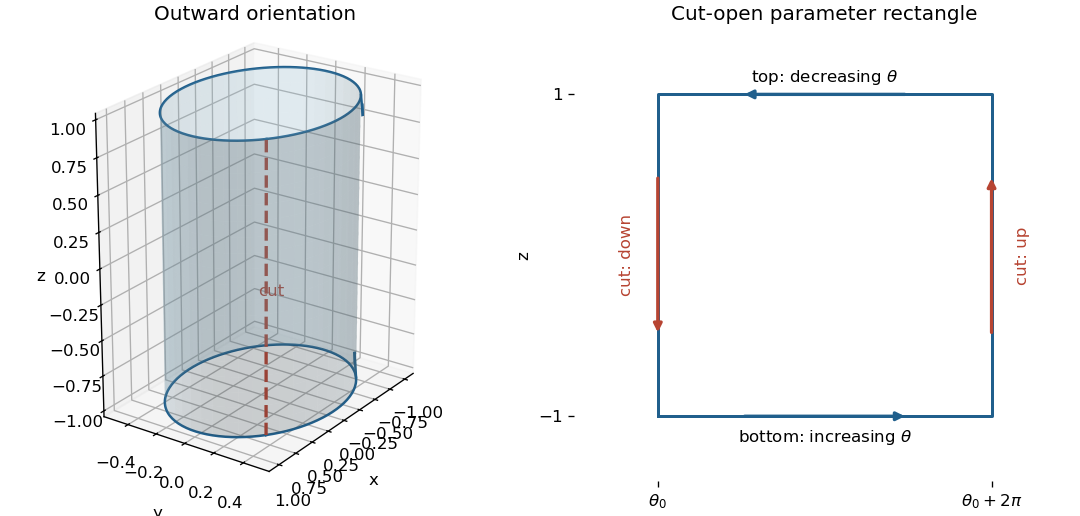
An elliptic cylindrical side cut open into a parameter rectangle, with compatible outward boundary directions
. Details. 
To apply Stokes theorem to a flux rather than a curl integral, first find a vector potential:This vector potential is smooth everywhere. On either horizontal rim, is horizontal whereas is vertical, giving . For a cut at , , so the upward cut contribution is and the downward one is . ConsequentlyA direct check uses the oriented surface element above: , whose integral over a full turn vanishes. Reversing the chosen orientation still gives zero.
Articles by others on the same topic
There are currently no matching articles.