At every equilibrium the store balance gives , and adding times that balance to the cytoplasmic one gives . The unique-root result therefore gives a single positive equilibrium . Its Jacobian iswith derivatives evaluated at that equilibrium. At small , and the trace is negative; sufficiently large also has , since is of order and of order . Thus both extreme regimes have a linearly stable unique equilibrium.
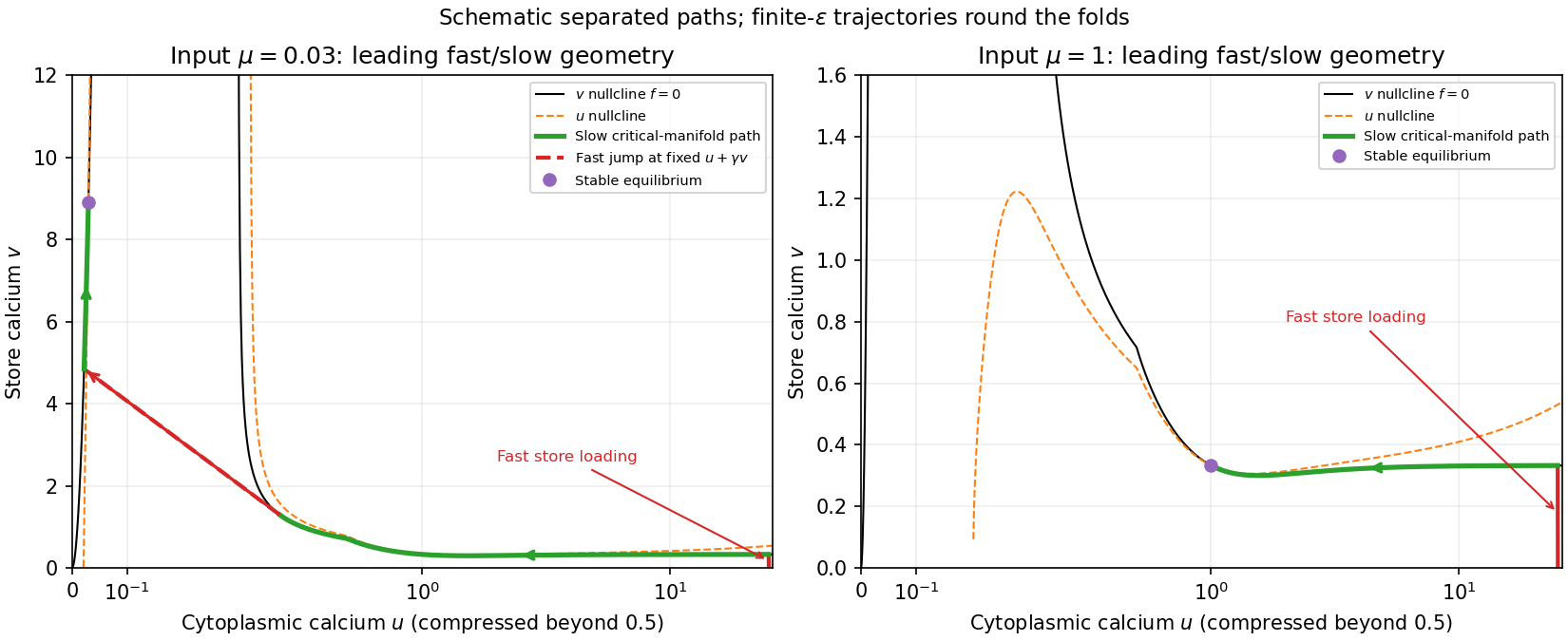
The fast variable is not alone. Using total-calcium fast fibres, introduce total scaled calcium . Then , while on fast time the leading equations give , and constant. Fast paths are therefore straight lines of slope in the plane. Attracting portions of the critical manifold satisfy , rather than merely . Along , slow motion obeysStarting with large and , drives a rapid move upward and left, loading the store until the trajectory approaches the right attracting branch. For large in the right stable regime, slow motion on that branch carries it toward ; the direction reverses appropriately if the starting value lies below that equilibrium. For sufficiently small , slow motion travels left along the right branch until its fold, then a fast approximately constant- jump carries the trajectory to the left attracting branch. Subsequent slow motion reaches the small- equilibrium. At a fold the slow approximation is singular, so the full equations resolve the transition. At very small an additional loss of time-scale separation is possible because the rates themselves vanish; the fast/slow drawing describes the separated portions, not a uniform estimate arbitrarily near the origin.

Articles by others on the same topic
There are currently no matching articles.