The cytoplasmic concentration gains a constant influx from outside the cell and loses calcium through a first-order extrusion term . The pump flux moves calcium from cytoplasm into the sarcoplasmic reticulum, saturating with cytoplasmic concentration through a Hill function with scale , maximal rate and exponent . The release flux returns stored calcium to the cytoplasm. It requires both calcium in the store and calcium-dependent activation of release; its two saturating factors have scales and exponents . This represents calcium-induced calcium release. The leak is passive return from the store.
Every internal transfer appears with opposite signs in the two balances, so in the model's compatible volume normalization. Only influx and extrusion change the total. The nonlinear pump and activated release can redistribute this total rapidly and generate oscillations even with constant external input.
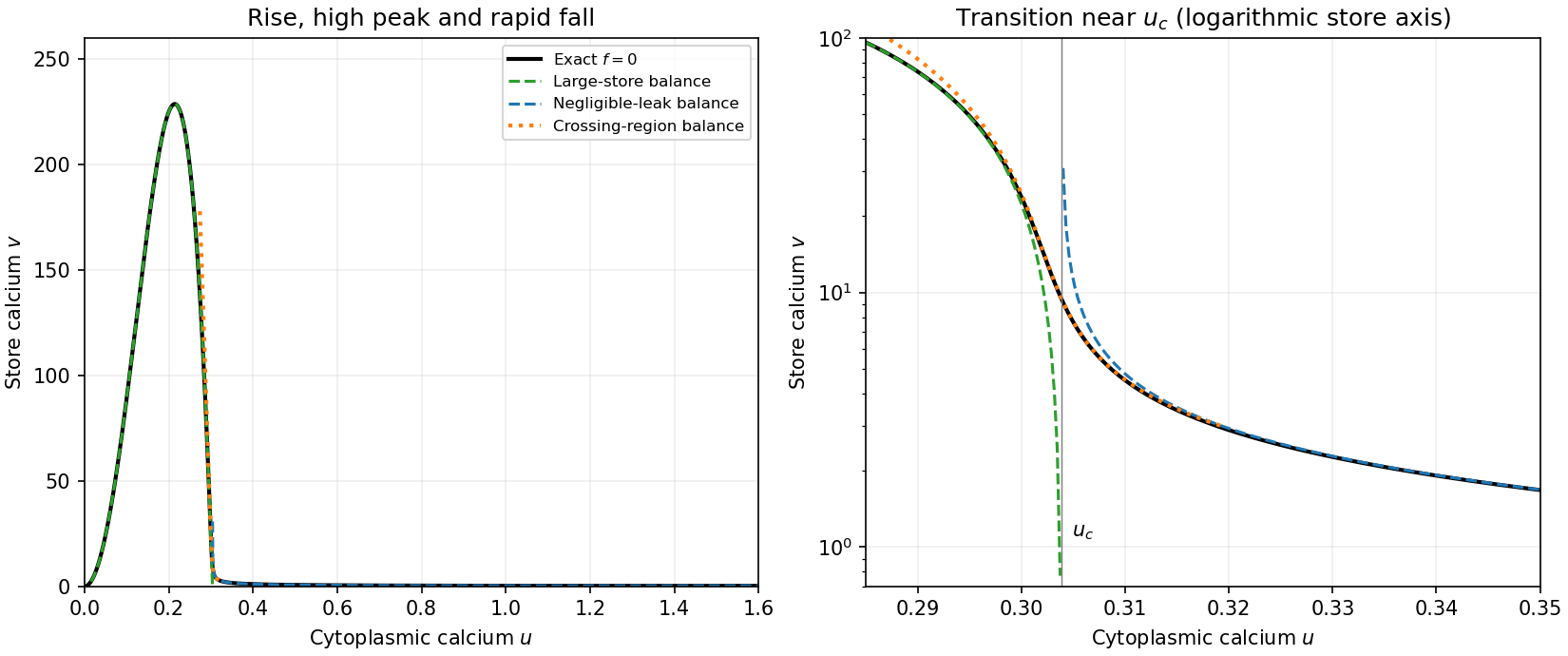
For the three-region calcium nullcline, defineFor , , as , and . Thus there is exactly one positive root for every positive . The curve starts at the origin and initially satisfies .
On the large- branch away from the crossing, replace by one. This gives where this is large and positive. Near retain the next term and linearize :Finally where the leak is negligible compared with the other terms, , so on the side . These are overlapping asymptotic descriptions with different validity ranges, not three exact disconnected curves. The curve rises to a large peak, falls sharply near , then approaches a small finite level as . At leading small- order that last level is .
At every equilibrium the store balance gives , and adding times that balance to the cytoplasmic one gives . The unique-root result therefore gives a single positive equilibrium . Its Jacobian iswith derivatives evaluated at that equilibrium. At small , and the trace is negative; sufficiently large also has , since is of order and of order . Thus both extreme regimes have a linearly stable unique equilibrium.
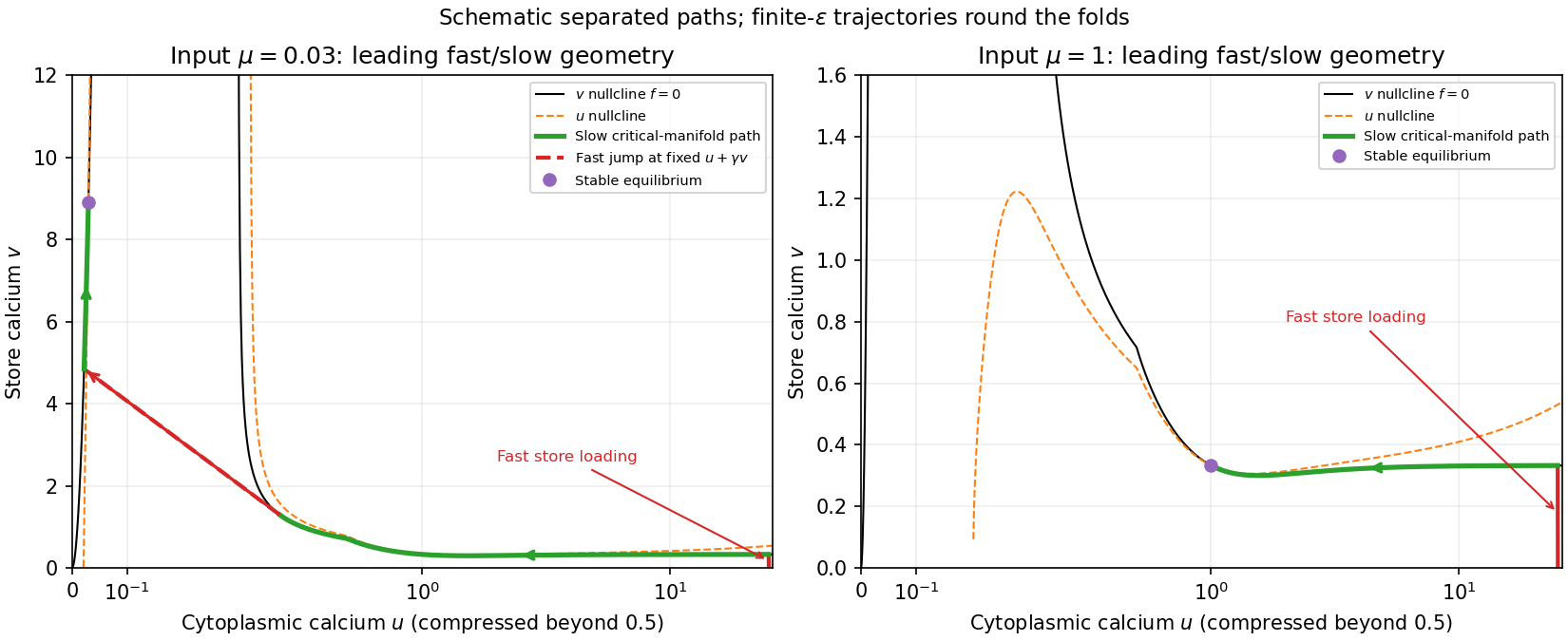
The fast variable is not alone. Using total-calcium fast fibres, introduce total scaled calcium . Then , while on fast time the leading equations give , and constant. Fast paths are therefore straight lines of slope in the plane. Attracting portions of the critical manifold satisfy , rather than merely . Along , slow motion obeysStarting with large and , drives a rapid move upward and left, loading the store until the trajectory approaches the right attracting branch. For large in the right stable regime, slow motion on that branch carries it toward ; the direction reverses appropriately if the starting value lies below that equilibrium. For sufficiently small , slow motion travels left along the right branch until its fold, then a fast approximately constant- jump carries the trajectory to the left attracting branch. Subsequent slow motion reaches the small- equilibrium. At a fold the slow approximation is singular, so the full equations resolve the transition. At very small an additional loss of time-scale separation is possible because the rates themselves vanish; the fast/slow drawing describes the separated portions, not a uniform estimate arbitrarily near the origin.
For Hopf thresholds in a two-pool calcium model, with the unique equilibrium parametrized by , locate changes of stability by solving the two equationsIf there are two simple roots with positive trace between them, the equilibrium is a repeller throughout that interval, since its determinant stays positive. At a nondegenerate crossing a Hopf bifurcation is possible, with linear frequency . A complete classification of criticality requires a nonlinear coefficient, not merely the trace calculation. At leading singular order the thresholds approach the folds determined by and , equivalently .
Periodic solutions are also supported globally in the positive quadrant. The axes point inward for positive input, bounds , and the equation then bounds by a linear restoring term plus a bounded source. A large rectangle can thus be chosen forward invariant. For an initial point distinct from the repelling unique equilibrium, its omega-limit set cannot contain that equilibrium or a boundary equilibrium. The Poincaré-Bendixson theorem supplies a periodic orbit. In the strong separation regime it follows the two attracting branches and jumps between them, a relaxation oscillation.
The interval requires the maximum of along the critical manifold to exceed ; the listed scale hierarchy alone is not a substitute for that test for arbitrary remaining constants. As an explicit example, , , and give approximately and . At the trace is positive, whereas at and it is negative. The figures use this example and label their singular-limit portions accordingly.
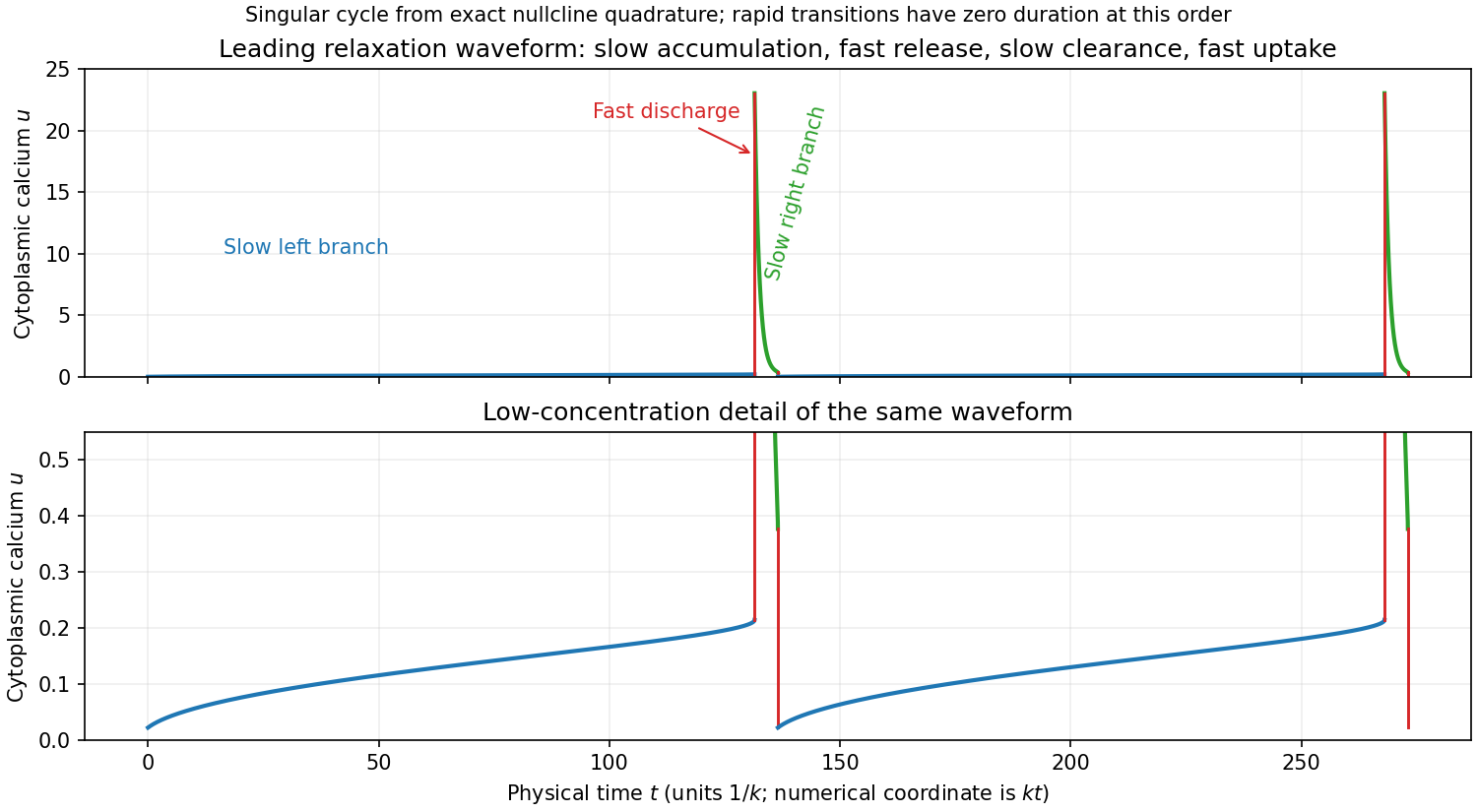
In a relaxation cycle, cytoplasmic calcium rises slowly on the left attracting branch while total calcium is accumulated, then rises rapidly during store discharge along a constant- fast path to the right branch. It subsequently decreases on the right slow branch as extrusion dominates input, and finally drops rapidly during store uptake back to the left branch. The result is a repeated pulse with slow sections joined by sharp transitions, rather than a sinusoid except near a small-amplitude Hopf bifurcation.
For explicit time labelling, the compatible scaling , gives , , , , and . Hence an interval corresponds to physical duration . Slow-branch times can be computed by integratingin the direction of motion; fast-jump durations are omitted at leading order. The plot uses that quadrature, with vertical lines representing the limiting rapid transitions. Finite rounds those lines and changes the precise amplitude and period, especially near folds.


Articles by others on the same topic
There are currently no matching articles.