Take a dense lower layer and write . In the Boussinesq approximation the fractional density difference is small; use the reference density in inertia and retain the difference in buoyancy. The one-layer model additionally treats the ambient as much deeper, with negligible distributed horizontal inertia away from the head. The shallow water approximation requires depth small relative to the horizontal variation length, small vertical accelerations, nearly hydrostatic pressure, and an approximately depth-uniform horizontal velocity. Neglect mixing, viscosity, bed friction and rotation. A slowly varying rectangular channel allows cross-sectional averages without large lateral separation.
A slice of width contains volume . Its outgoing volume flux is , so volume conservation gives . The integrated hydrostatic excess pressure is . Pressure on the sloping side walls contributes to the longitudinal force. The conservative momentum equation is thereforeUse the volume equation to simplify it. The resulting shallow water equations areOmitting the wall force would incorrectly introduce a width term into the material acceleration equation.
For the principal matrix is . Its eigenvalues are , where . For they are real and distinct, so the system is strictly hyperbolic. It degenerates at a dry front. From the volume equation, . Combine this with the momentum equation to obtain the variable-width shallow-water characteristics:In a constant-width channel are Riemann invariants along the corresponding characteristic curves; with varying width they satisfy compatibility equations with a source term.
The volume alone does not specify the early release geometry. For a concrete sketch, use a rectangular lock initially occupying with depth , at rest, and remove its gate at . Let and impose a gravity-current front condition , with fixed . The Benjamin deep-ambient front condition gives for the usual deep-ambient idealization.
A rarefaction wave propagates back from the release. Before information returns from the closed wall, its invariant is . With , the fan has , . The front-adjacent shelf hasThe fan extends from to ; a uniform shelf connects its tail to the finite-depth head at . A small nonhydrostatic head displaces ambient fluid; the hydrostatic interior model does not resolve its overturning structure.
The fan head first reaches the rear wall at . The wall condition is , and the returned positive characteristic curve begins to alter the interior. In the still-undisturbed fan it solves , henceIt reaches the fan's uniform shelf at , then propagates with speed to the head at . These times refer to this particular initial lock and front closure. After that first arrival, the finite supply influences the front: the constant-speed slumping stage gives way to deceleration and eventually the finite-volume inertial gravity current with , depth proportional to and speed proportional to . The initial fan and reflected signal are shown below; later characteristic trajectories change as the current adjusts.
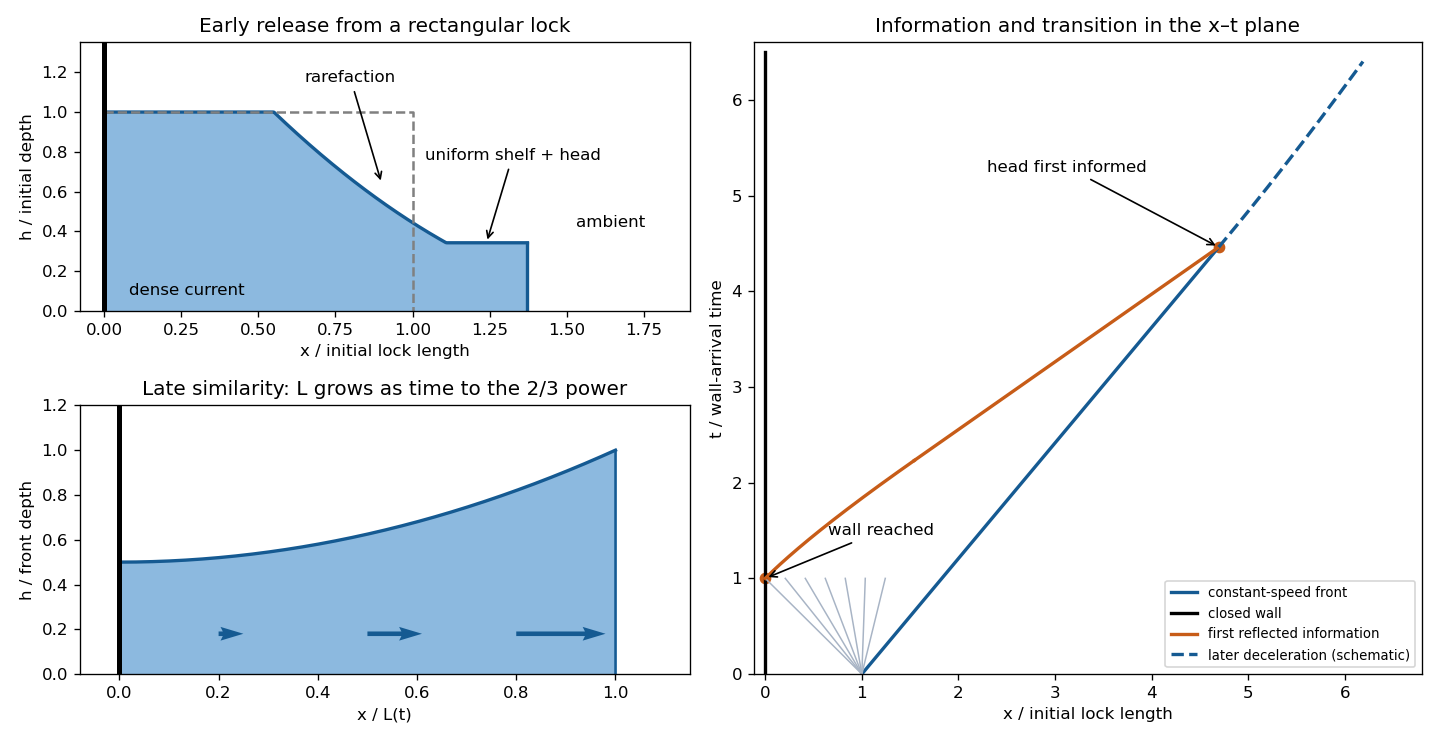

For the unit-width channel put , and . Fixed volume gives , soThe closed rear wall has . Substituting into volume conservation gives , or . The wall sets this constant to zero. Wherever , . Thus the velocity is and its material acceleration is .
Use a constant-Froude gravity-current front condition , with the front depth normalized by . Differentiating its square and using the volume relation gives . The Euler equation now reduces toIntegrate from to obtainA filled rear-wall solution needs ; is the limiting zero rear-depth profile. Integrating the front equation gives the complete similarity solutionHere is the horizontal velocity; the virtual origin accounts for matching to the finite initial release. With the Benjamin deep-ambient front condition, and , this simplifies toThe volume, wall condition and finite front depth can all be checked directly. Choosing another physically appropriate nose Froude number changes the coefficient and profile; the interior equations alone cannot choose it.
Articles by others on the same topic
There are currently no matching articles.