The unperturbed sinusoidal cellular flow hasIts stream function is a first integral, so each trajectory lies on a level set of . This planar autonomous Hamiltonian flow has one degree of freedom and its conserved quantity reduces motion on regular levels to a quadrature: this is its integrability. The central cell has closed streamlines; the zero level is the grid of separatrices.
Solving both components of gives saddle equilibria at and center equilibria at . In the specified open square, the saddles are and the only interior center is . Centers at the outer square's corners are on its excluded boundary.
At a saddle the Jacobian matrix is with . If is even, the horizontal branches are unstable and vertical branches stable; if it is odd, those roles reverse. The branches extend along and and connect neighboring saddles as heteroclinic orbits. For example the bottom boundary flows from to , the right boundary from to , the top boundary from to , and the left boundary returns to . A connecting branch is unstable relative to its departing saddle and stable relative to its arriving saddle.
At a center the Jacobian matrix is , where now . Its eigenvalues are . The local definite extremum of surrounds it by closed streamlines, giving a neutrally stable center, not an attracting equilibrium. Central circulation is counterclockwise and adjoining cells have alternating circulation.
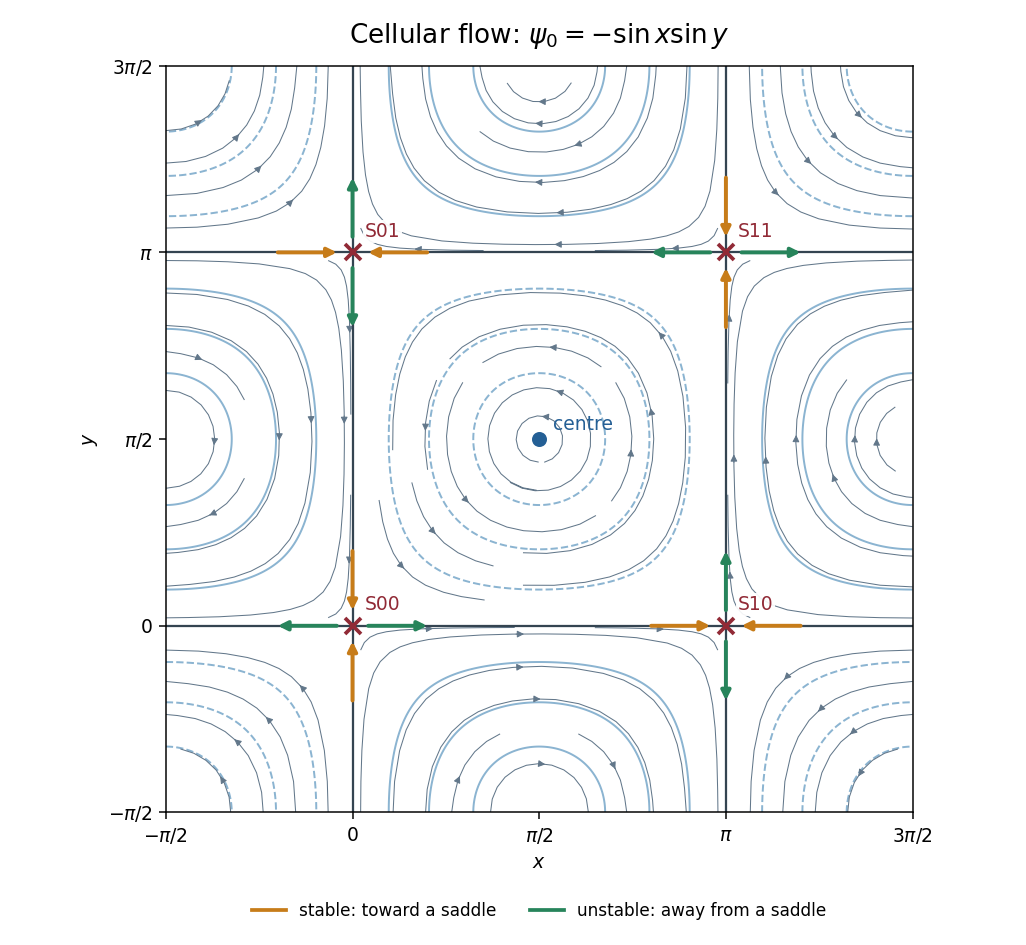
Unperturbed cellular streamlines, four interior saddles, and stable and unstable branches
. Details. 
Use a Poincaré map sampled once per forcing period. A hyperbolic periodic trajectory has stable manifolds containing parcels that approach it under forward iteration and unstable manifolds containing parcels that approach it under backward iteration. In the integrable limit the relevant branches coincide along a heteroclinic orbit and form a barrier between neighboring cells.
A transverse crossing in the perturbed map means that this barrier has split: a parcel on the intersection belongs to both asymptotic manifolds, and adjoining branches enclose fluid lobes transported across the former boundary. Iteration stretches and folds those lobes. In the connected heteroclinic network this creates complicated intercell transport and chaotic advection. The crossing is between invariant curves at the same forcing phase; it does not mean that different trajectories cross at one time in violation of uniqueness.
The incompressible flow gives an area-preserving map, so lobe exchange preserves parcel area. Without diffusion, an advected passive scalar also keeps its value on each trajectory. Therefore manifold intersections can generate fine filaments and efficient advective exchange but do not by themselves produce molecular homogenization, nor prove that every region of the flow becomes chaotic.
Put and . Expansion of the trajectory equation to first order gives, for either correction,Since the unperturbed Hamiltonian flow obeys , differentiation with respect to position yields . Along the heteroclinic orbit this says . Therefore the homogeneous terms cancel:The unperturbed orbit approaches its hyperbolic fixed points exponentially, so at either appropriate endpoint. The selected stable and unstable corrections remain bounded there, approaching the first-order corrections to the periodic trajectories. Their endpoint dot products consequently vanish. Integrating the stable correction forward and the unstable correction backward givesSubtracting proves the heteroclinic Melnikov function for a periodic planar flow:Choose a regular point on the connection where . The first-order signed normal distance between the perturbed invariant curves is . If has a simple zero in the along-orbit parameter, the implicit function theorem continues it to a zero of the actual distance for sufficiently small , with nonzero derivative. The curves consequently cross transversely rather than touching tangentially.
A phase shift and a shift of the reference point along the autonomous connection are equivalent in this calculation: using changes the integrand from to . Thus a simple phase zero can also describe a crossing along the connection at a fixed forcing phase. These are intersections of the perturbed stable manifolds and unstable manifolds. The word “unperturbed” in the printed conclusion cannot be literal: those branches coincide before perturbation and have no transverse splitting.
On , the unperturbed trajectory satisfies . Put . Integration with givesIt runs from to , so it is the appropriate heteroclinic orbit. From the perturbed stream function,On the chosen connection, ; hence the scalar product in the heteroclinic Melnikov function for a periodic planar flow is . ThereforeSet . The odd term integrates to zero, leaving the supplied even Fourier integral multiplied by . ThusFor every fixed the amplitude is nonzero and the phase zeros are simple: there is . At fixed phase, varying also gives simple zeros because is nonzero for . The Melnikov splitting of a periodically perturbed cellular flow therefore produces transverse manifold intersections at sufficiently small perturbation and fluid-lobe exchange between adjacent cells. The unperturbed separatrix is no longer a material transport barrier.
At high frequency the leading splitting amplitude is asymptotic to , so fast forcing has an exponentially weak first-order effect on this connection. This is a fixed-frequency, small- result; an exponentially small leading term need not dominate higher orders in a simultaneous high-frequency limit. At exactly the perturbation itself vanishes and , so the nonzero-frequency conclusion does not apply. Manifold splitting demonstrates intercell chaotic advection locally, not a proof of uniform mixing or ordinary diffusion throughout the entire domain.
Articles by others on the same topic
There are currently no matching articles.