The equilibrium points satisfy , . For there are none. For set . The Jacobian matrix isThe positive equilibrium point is always a saddle equilibrium. At the determinant is , so it is stable for and unstable for . The discriminant distinguishes a node from a focus; its zero does not destroy hyperbolicity and is not another local bifurcation curve.
The local bifurcation curves areAt the linearization has a double zero eigenvalue and is nilpotent, giving a Bogdanov–Takens bifurcation. For on , solving the local center manifold gives , displaying the saddle-node bifurcation. For the nonsaddle branch born at positive is attracting; for it is repelling. On the Hopf curve the angular frequency is . The permitted subcritical Hopf bifurcation creates a repelling periodic orbit on the stable-focus side .
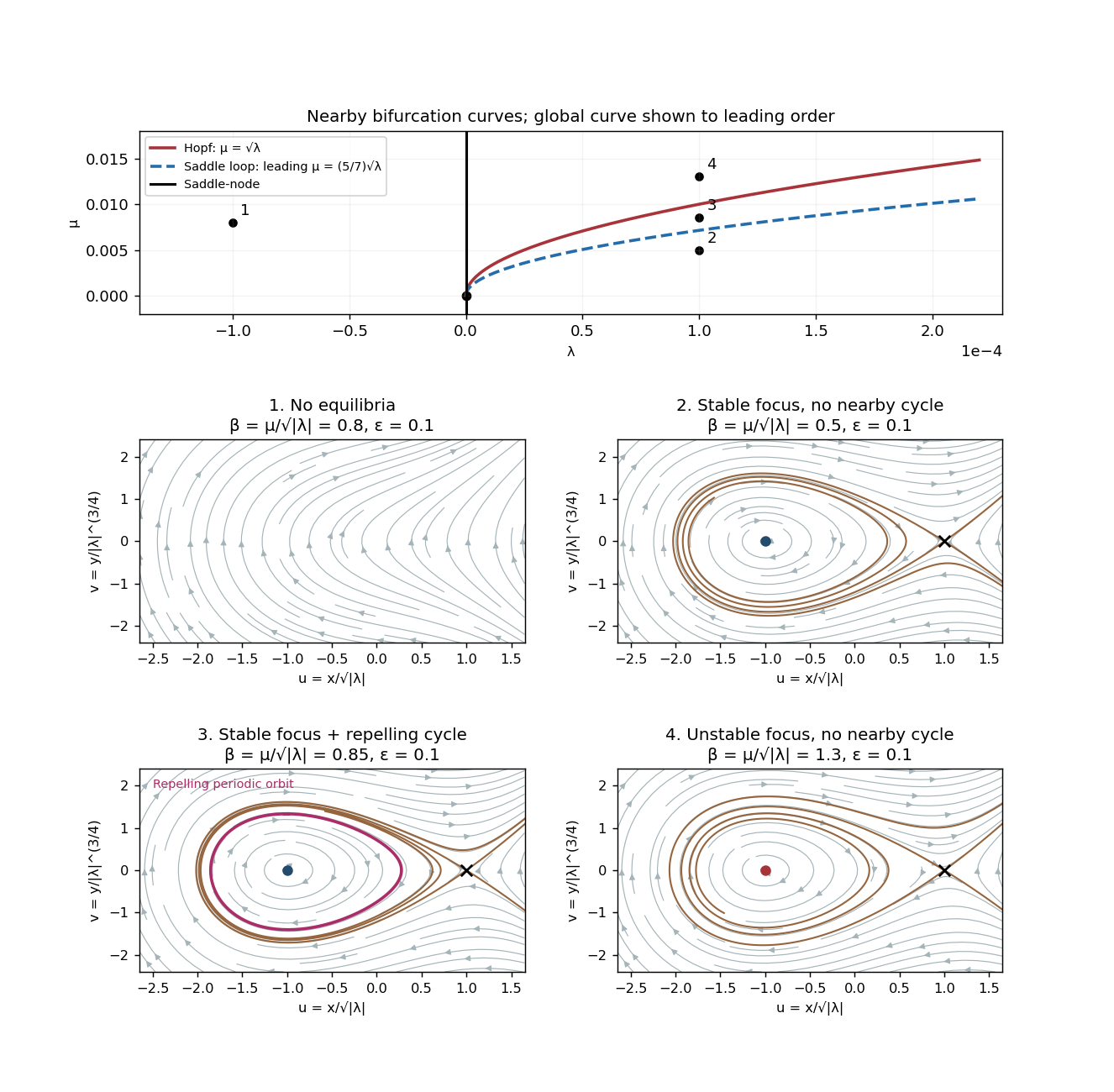
A local analysis alone does not say how far that periodic orbit extends. The global calculation below supplies the additional division of the stable-focus region. The complete nearby phase portraits and the leading global curve are shown together here. The flow has no closed periodic orbit, since a closed orbit would have index one and hence enclose an equilibrium point.

Substitution of the weighted scaling and givesThe derivative of the candidate Hamiltonian isThus is a conserved quantity at . For put . The conservative equilibrium point is a center with , and is a saddle equilibrium with saddle-loop energyThe closed component of a level between these energies surrounds the center. At ,is the homoclinic orbit, with left turning point . The upper branch is traversed to the right and the lower branch to the left. Levels above the barrier have escaping trajectories; the saddle level also has unbounded branches to the right. For the two critical points coalesce; for the potential is monotone and there is no center or saddle loop.
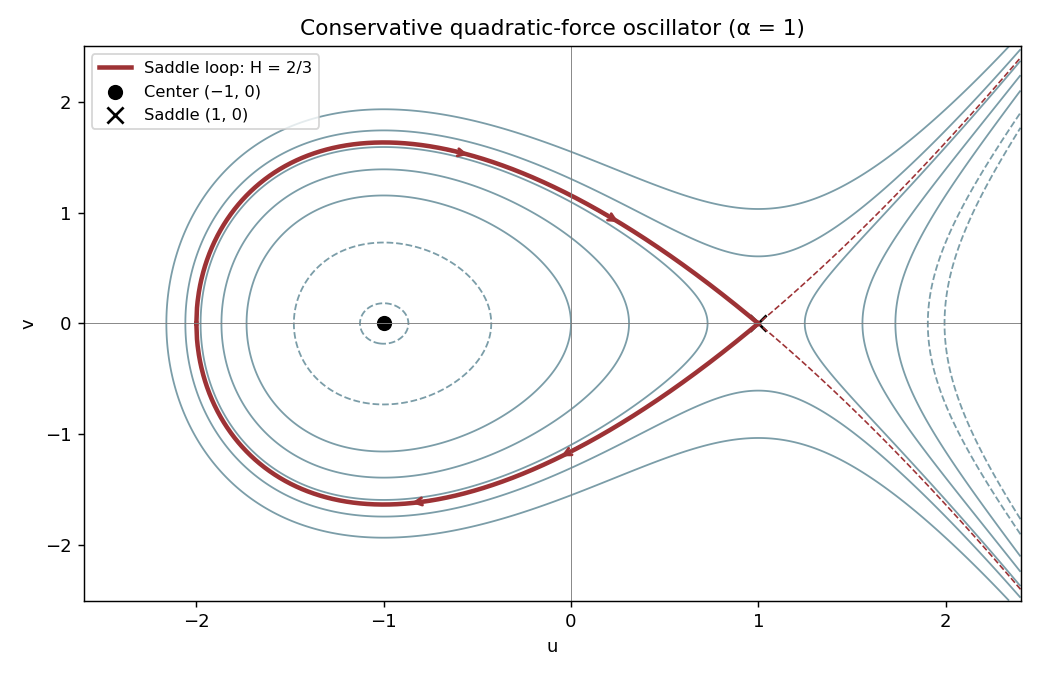
Hamiltonian level curves and the conservative saddle loop for alpha equal to one
. Details. 
Along a perturbed saddle loop the incoming and outgoing endpoints have the same Hamiltonian value. Integrating and evaluating the leading integral on the conservative homoclinic orbit givesOn the upper half of the loop and . The lower half makes an equal contribution, soThese homoclinic integrals for a quadratic-force oscillator give the simple first-order splitting zero , since . The Melnikov energy-balance method therefore yields the leading global bifurcation curveThis is an asymptotic curve near the double-zero point, not an exact finite-parameter identity. More precisely, time reversal preserves the loop condition. The smooth curve selected by its simple splitting zero is even in , giving and hence for fixed scaled .
Between the saddle-loop curve and , a stable focus is surrounded by the repelling periodic orbit created at the subcritical Hopf bifurcation. As decreases, this orbit grows until it reaches the saddle. Below the saddle-loop curve there is a stable focus and a saddle, but no nearby cycle. Above the Hopf curve there is an unstable focus and a saddle, with no nearby cycle. At the global curve the saddle separatrices form the repelling loop. Under the stipulated absence of further bifurcations, these are the distinct nearby regions in the earlier sketch; no extra remote phase structure is being inferred from the leading-order calculation.
At the saddle equilibrium , put . The two eigenvalues and saddle index areOn the nearby saddle-loop curve, . Therefore , with the more explicit expansionThe positive saddle quantity makes the loop repelling. In a transverse section its leading return map has the form ; its derivative grows without bound as . This is the mechanism by which a positive saddle quantity makes a nearby saddle loop repelling. It agrees with the repelling periodic orbit coming from the subcritical Hopf bifurcation, rather than predicting an attracting cycle at the collision.
Articles by others on the same topic
There are currently no matching articles.