Take increasing upwards and write . The particles have downward settling velocity; their upward volume flux is . Conservation of particle volume in any interval givesThus the kinematic sedimentation equation and its characteristic speed areFor this is a scalar hyperbolic partial differential equation: its one characteristic speed is real. The method of characteristics gives and . A concentration disturbance need not descend at the particle settling velocity; is the derivative of the transported flux, not . In particular can be positive even though every particle settles downwards. At , and the equation is ordinary translation. At the packing endpoint the differentiability of the chosen constitutive law depends on ; none of the initial values used below is at that endpoint.
For , , so the characteristic speed is and the conservation law flux is strictly convex. Let and let be the initial vertical position of a characteristic curve.
For the increasing ramp, the characteristic curves within its sloping part satisfy . They spread apart and never cross. The outer plateau characteristic speeds are and , so the complete entropy solution isThe transition widens linearly and its gradient decreases. At large time it approaches a rarefaction wave, with inside its expanding transition.
For the decreasing ramp, and the characteristic curves converge. Before they meet,All the ramp characteristic curves meet at atThereafter a stationary sedimentation shock separates below from above. Indeed the Rankine-Hugoniot condition givesand the incoming characteristic speeds satisfy , which makes it an admissible entropy shock. The discontinuity transports no net excess particle flux because both plateau fluxes equal . These are local solutions before a finite container's boundaries affect the transition.
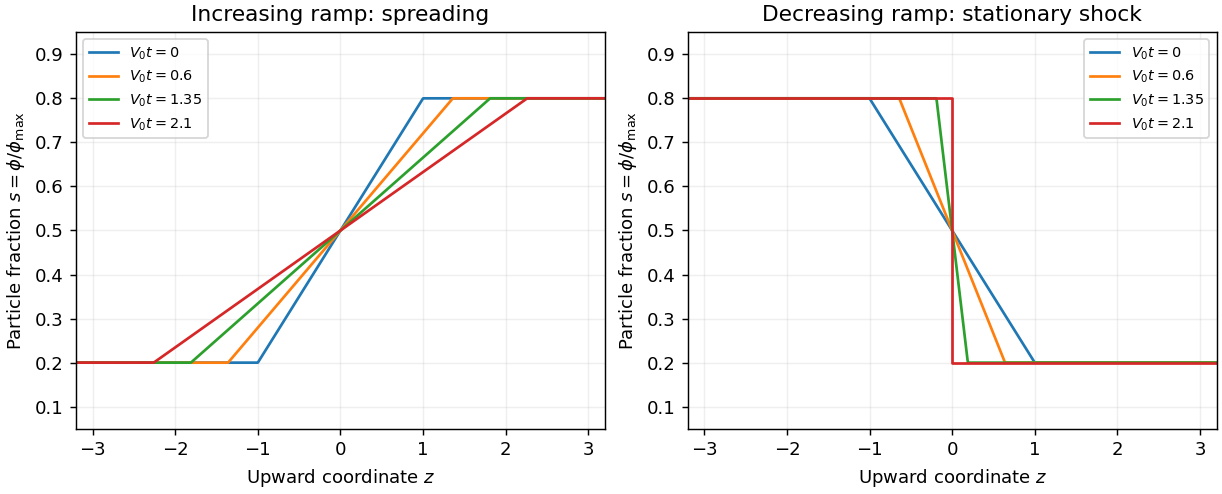
Spreading and shock formation for quadratic hindered-settling flux
. Details. 
The dependence on is controlled by the hindered-settling flux inflection:For any smooth initial profile, the characteristic flow map has derivativeThis formula gives the first characteristic crossing: minimize the positive values of . At neither ramp changes shape; both move down at . For , the flux is convex throughout : the increasing ramp spreads and the decreasing ramp steepens, although its entire ramp generally no longer focuses simultaneously. For , the flux is concave throughout that interval and these roles reverse. At the endpoint values the curvature vanishes at one plateau; it does not reverse sign inside the interval.
For , the inflection lies between the plateau concentrations. Below the increasing ramp spreads, while above it that ramp compresses; the decreasing ramp has the opposite local behavior. After characteristic crossing, the entropy solution can contain both a shock wave and a rarefaction wave. Quantitatively, an increasing step is selected by the lower convex envelope of on the interval between its states: curved portions supply rarefaction waves, and straight portions supply shock waves. A decreasing step uses the upper concave envelope. A join between a fan and a shock wave at a state satisfies the tangent-chord relation , where is the other shock state. Thus curvature, not simply the magnitude of , decides the wave pattern; the envelope may reduce to one shock if the tangent lies outside the state interval.
Let and . The aperture spans the enclosure's depth , so the incoming volume flux, equal to the outgoing volume flux, isOnly one of these equal exchange fluxes multiplies the temperature difference in the heat budget: incoming fluid brings , outgoing fluid removes . With constant mass density and specific heat capacity, those factors cancel and the well-mixed ventilation temperature balance isIntegrating from givesThe cooling is algebraic rather than exponential because the buoyancy-driven single-opening exchange flow weakens as its driving reduced gravity decreases. The formula assumes negligible wall heat capacity, no heat input, the specified aperture geometry, and a uniform interior temperature maintained by mixing.
With a low-level opening, the dense incoming cold fluid tends to spread along the floor instead of falling through the warm interior. A cold lower layer and warm upper layer develop, giving stable density stratification. The incoming fluid can short-circuit back out through the low opening after that layer occupies it, leaving warm fluid above poorly ventilated. Thus the uniform-temperature assumption is generally inappropriate: cooling becomes vertically nonuniform and substantially slower for the upper warm fluid. If mixing were artificially maintained, the same lumped budget would still apply; it is the loss of that assumption, rather than a reversal of buoyancy, that changes the physical outcome.
Articles by others on the same topic
There are currently no matching articles.