Label the full siblings at the bottom and their cousin parents . Let have parents and parents , where are siblings with parents . Include the other great-grandparents as , parents of , and , parents of . This gives fourteen people, with six independent founders in a pedigree .
The pedigree graphical model has the following Directed acyclic graph, with both members of each parent pair pointing to every listed child:Let be the founder genotype law under Hardy-Weinberg equilibrium, and let be the Mendelian segregation kernel. The joint probability of all genotypes isFor a biallelic locus with allele-1 frequency , , and . The kernel assigns probability to each labelled pair of parental transmissions and adds these probabilities when they produce the same unordered genotype. Summing this Bayesian network factorization over unobserved genotypes gives their marginal distribution or a pedigree likelihood.
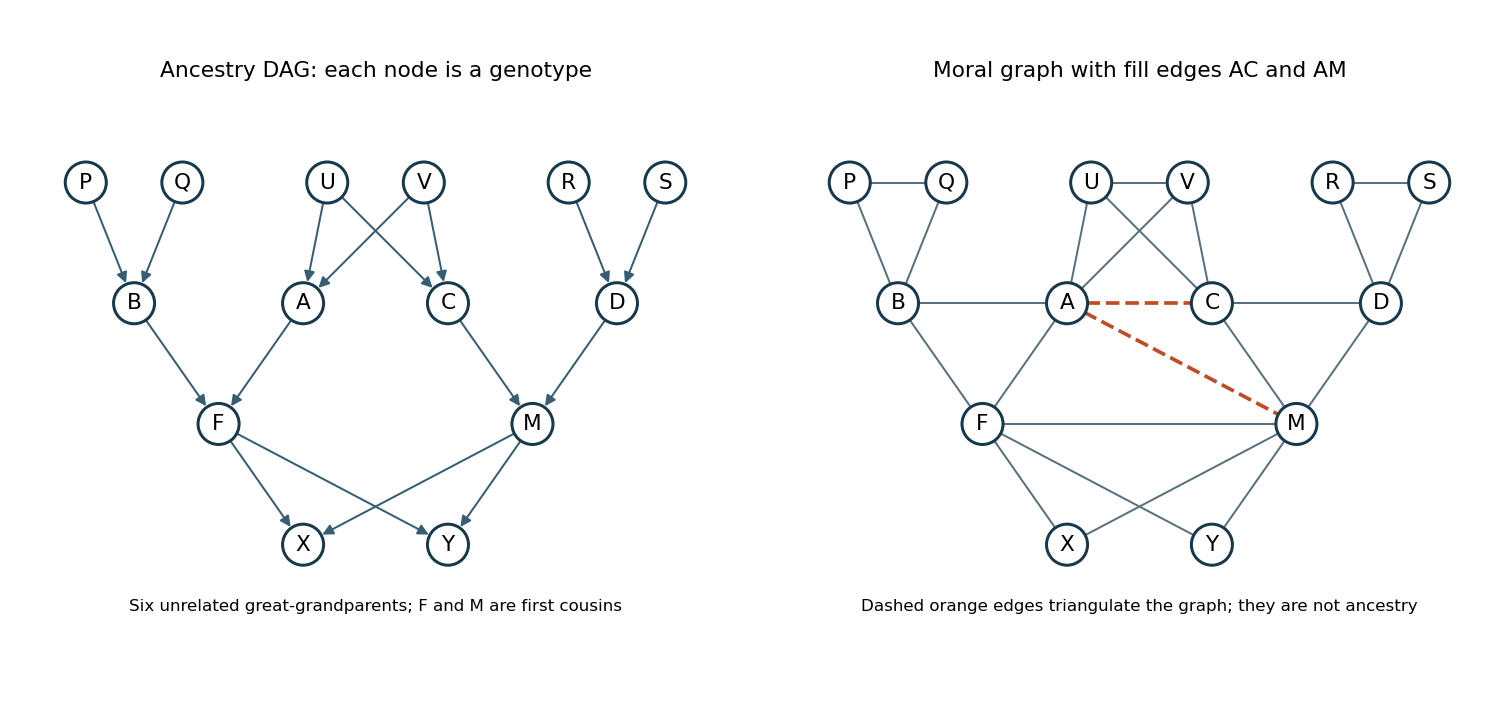

For the undirected representation of the pedigree graphical model, take the moral graph: remove arrowheads from all parent-child edges and join coparents. The added coparent edges areEvery Mendelian segregation factor involves a child and its two parents, so its variables form a clique in this graph. The product in the previous part is thus an undirected factorization. A separation of variables by a conditioning set in this graph implies the corresponding conditional independence.
This is a valid conditional independence graph representation of the joint genotype law. It need not be its minimal representation without a faithfulness of a directed acyclic graph assumption: some inheritance probabilities are zero, and special parameter choices can yield additional independences. It also differs from a graph of unconditioned correlations, since full siblings remain correlated through their parents when the parental genotypes are not conditioned on.
Articles by others on the same topic
There are currently no matching articles.