In ordinary diploid meiosis, the two copies at a genetic locus separate: each gamete receives one copy. With fair transmission, a heterozygote produces gametes carrying or with probability each. This is a transmission mechanism conditional on a parental genotype, rather than a statement about how common either allele is in a population.
For the one-locus cross , assume independent parental transmissions, no new mutation, and no differences in fertilization or survival between the resulting genotypes. Multiplying the two gamete probabilities gives four equally likely ordered outcomes: , each with probability . Combining the two orders of the heterozygote givesOnly under the additional ideal model of complete dominance of , complete penetrance, and no environmental changes to the scored characteristic do and share the dominant phenotype. Its probability is then . The inheritance calculation alone does not determine a phenotype or predict a generic disease risk.
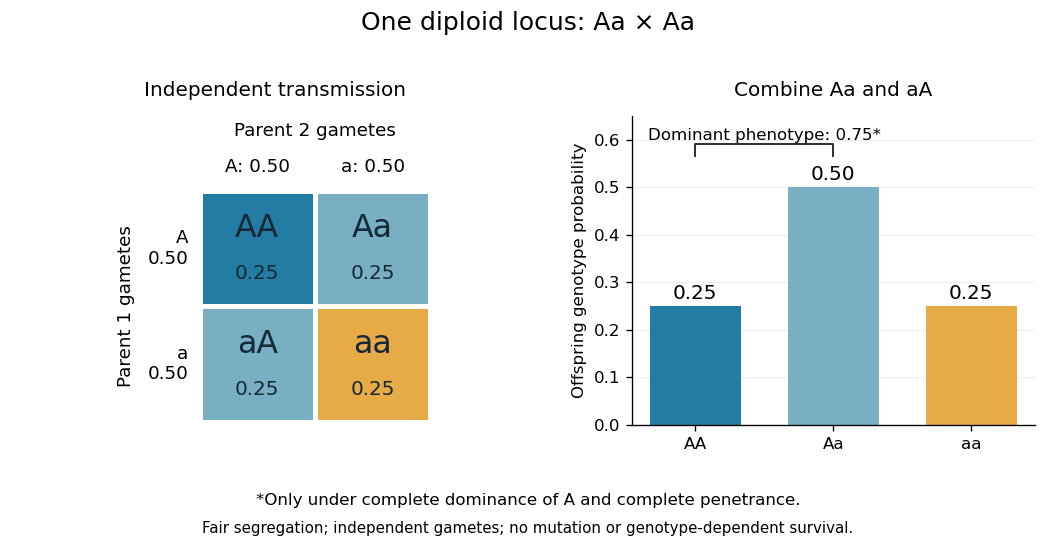
Fair Mendelian transmission in an Aa × Aa cross, with phenotype grouping under complete dominance and penetrance
. Details. 
These are probabilities, not a requirement that every four offspring contain one , two and one . For 100 independent offspring under the ideal model, the expected values of the three counts are ; the count has a binomial distribution with standard deviation . Each new transmission keeps the same conditional probabilities given the parental genotypes.
In his paper published in 1866, Mendel reported 5,474 round and 1,850 wrinkled pea seeds: round, close to the ideal . Following descendants also distinguished two inherited classes within the round phenotype, illustrating why genotype cannot always be read from appearance.[ref] At several genetic loci, transmission patterns additionally depend on genetic linkage and genetic recombination.
Articles by others on the same topic
There are currently no matching articles.