Let two observers be related by , with Q a proper rotation matrix. A spatial second-rank tensor has material frame indifference if its values at corresponding events satisfy . This defines an objective second-rank tensor, and allows the observer's rotation to depend on time.
For Cauchy stress tensor, consider a material surface element with unit normal n and contact traction . A rigid observer change preserves its area and rotates both its normal and actual contact force: , . Thus for every n, proving . Fictitious body forces of an accelerated observer do not alter this transformation of physical contact traction.
To keep the vorticity convention explicit, write , and , the negative of the usual component-first spin tensor. Equivalently, with the derivative-index-first used in the paper, . Put , which is antisymmetric. The transformed velocity is , and direct differentiation givesThe additional observer spin cancels from the symmetric part, proving that the rate-of-strain tensor is objective.
Along the same material particle, differentiating givesThe two extra terms cancel those from . Moreover . Hence the complete objective time derivative satisfiesThis proves covariance for every constant scalar ; changing the spin convention without changing the commutator sign would not. It is a Gordon--Schowalter derivative with the paper's slip-parameter convention.
For the Johnson-Segalman fluid, first use the standard uniaxial extensional flow , with . Here and E is diagonal. The steady conformation equation giveswith vanishing off-diagonal components on the stable steady branch. The tensile normal-stress difference is . Dividing by the extension rate gives the Johnson-Segalman extensional response:The conformation tensor evolution in each principal direction is . Therefore a positive, attracting steady conformation requires both displayed denominators positive. For the first pole is at ; for it is at in the transverse components. At a pole the corresponding component grows linearly in time, and beyond it generically grows exponentially. The model has a finite-rate extensional catastrophe; the algebraic viscosity cannot be continued as a physical steady response past the first pole. At zero rate, , giving Trouton ratio three. For the polymer contribution to stress disappears and the response is simply Newtonian.
The question does not specify extension geometry. If a planar convention is intended instead, the same diagonal calculation gives , valid on the stable branch . The preceding boxed formula uses the standard uniaxial definition of extensional viscosity.
For simple shear flow , write , , , and . The xx, yy and xy components of the steady constitutive equation giveSubstituting the first two relations into the third yields , with . Define the viscometric functions by , and , using x for flow, y for the shear gradient and z for vorticity. The Johnson-Segalman steady viscometric functions are thereforeThe solvent creates no normal-stress differences in this flow. For nonzero , the fluid is shear thinning with positive first and negative second normal-stress differences.
To classify the stress curves, set and . The scaled shear stress is , andThe second term has minimum at . Thus the shear stress is monotone for and has a decreasing segment for . At equality it has a horizontal tangent but no decreasing interval. Below the threshold, its maximum and minimum occur atwith the smaller root giving the maximum. Negative-rate curves are obtained by odd reflection.
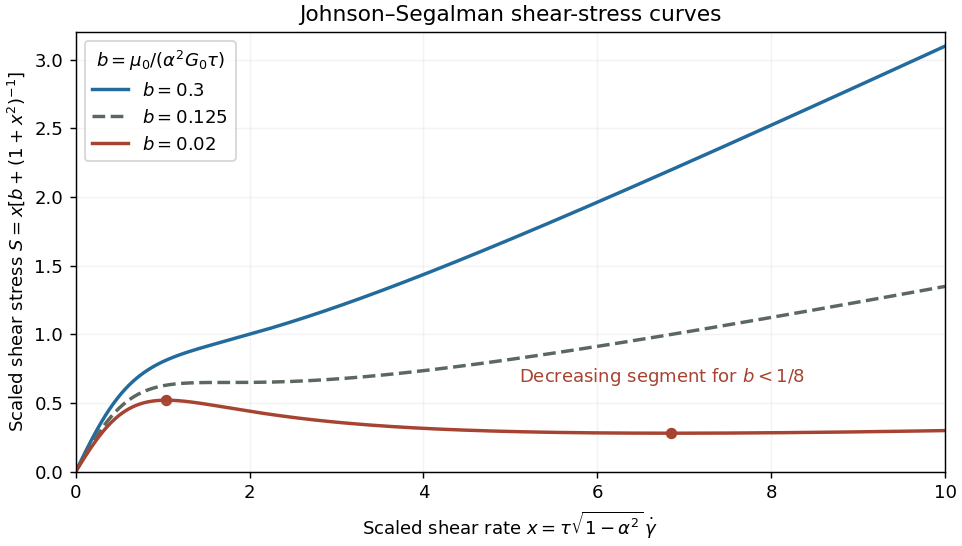
Monotone, marginal and nonmonotone Johnson-Segalman shear-stress curves
. Details. For small b, polymer stress dominates the low-rate response, while the solvent restores a positive high-rate slope. The Johnson-Segalman negative-slope shear threshold signals a constitutive instability of homogeneous shear: different local shear rates can carry the same shear stress, permitting shear banding. A stress plateau or a selected interface position cannot be inferred from the local curve alone; spatial regularization and boundary/history information matter. This limitation is illustrated in a primary diffusive Johnson-Segalman study. If , the scaling by b is inapplicable and the stress is just .
A generalized Newtonian fluid can approximate the shear response of a fluid with viscoelasticity when the flow varies slowly relative to its stress-memory time scales and elastic stresses are negligible, or in locally steady unidirectional flow where a fitted steady shear viscosity captures the relevant stress and elastic normal stresses do not significantly influence the motion. It is not a general replacement in rapidly changing flows or in flows controlled by elastic stresses. Two specific failures are stress relaxation after deformation stops, since this law has no memory, and nonzero normal-stress differences in steady simple shear flow, since the only nonzero nonpressure components are off diagonal. A rate-dependent viscosity alone cannot repair either limitation.
Take the usual physical power-law fluid range , , and . The steady unidirectional Couette-Poiseuille flow satisfies . The stated upper-wall stress thus givesPut . Inverting this monotone stress law gives . Integration from the lower no-slip boundary condition gives the power-law Couette-Poiseuille flow profileThe upper no-slip boundary condition requiresThe bracket is a strictly increasing function of with value zero at , so the equation determines a unique positive . The absolute values are essential: for sufficiently strong pressure driving, the shear can reverse inside the channel. For a Newtonian fluid, , , and the bracket reduces to , yieldingFor zero pressure gradient the limit is pure Couette flow; the parameterization of wall stress by then becomes singular rather than indicating zero Couette stress.
For weak pressure forcing, let and . Write the center-plane shear stress as . Linearization of the power-law relation about the positive base shear givesIntegrating across the channel must still give . The Gy term has zero mean, so at first order. Hence the weak-pressure Couette-Poiseuille expansion isIt is a small positive parabolic displacement of the straight Couette profile, preserving both wall velocities. For fixed positive n the stated controls the expansion; when n is very small one needs the stronger incremental condition .
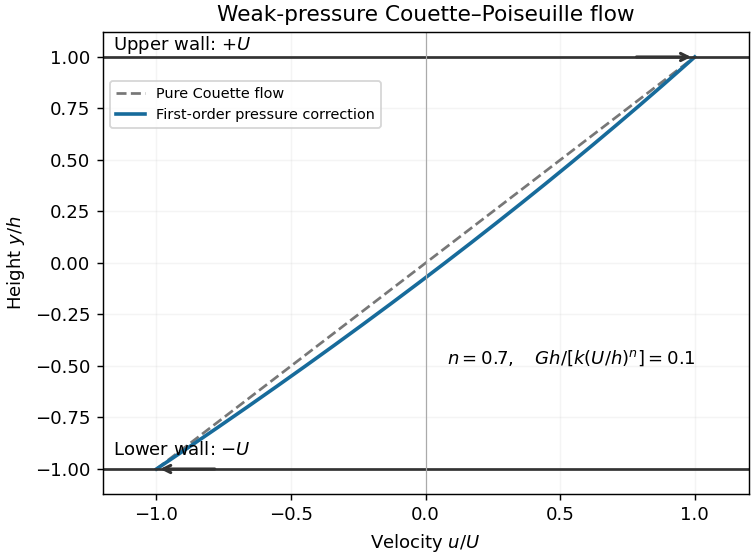


The volume flux per unit spanwise width is . The odd Couette part contributes zero and the parabola contributes times its coefficient, soThis correctly reduces to the exact Newtonian flux at .
The extension to a general smooth generalized Newtonian fluid uses its differential shear viscosity, rather than its secant viscosity. Let for positive shear rate, and assumeLinearizing the stress law repeats the preceding calculation with replaced by . ThusThe expansion requires small rate changes, , and a smooth constitutive law on the perturbed rates. At zero differential viscosity the regular first-order expansion fails. A negative differential viscosity is still locally invertible mathematically, so the formula is formally applicable, but belongs to a decreasing, mechanically unstable constitutive branch. The usual stable-flow interpretation requires positive differential viscosity. Thus “any” generalized-Newtonian law needs these local qualifications.
For a linear viscoelastic fluid, causal superposition givesThe relaxation modulus is the stress response to a unit small step of shear strain. The equation assumes an isotropic reference state and deformations and rotations small enough over the significant memory times that nonlinear transport and strain products can be neglected. Small-amplitude motion can have high frequency; linearity does not require low frequency by itself. The infinite-past integral encodes the preceding history, rather than assuming that stress vanishes whenever the present rate vanishes.
For a small constant shear rate maintained from the remote past, the rate can be taken outside the integral. Therefore the zero-shear viscosity isprovided the kernel is integrable, with any instantaneous contribution counted fully. A nondecaying solid-like modulus would not yield a finite fluid viscosity.
To linearize the stated Oldroyd-B model, put and absorb the isotropic into pressure. The products of the small deformation tensor C and velocity gradient are second order. Using the paper's derivative-index-first gradient convention therefore givesAn integrating factor, with the prescribed preceding history, gives . Thus the linear nonpressure stress isThe regular relaxation tail is , while the solvent is instantaneous. Equivalently, the instantaneous solvent term in a relaxation modulus can be represented byHere the causal endpoint delta is defined by . If instead a symmetric Dirac delta is assigned half its mass at the endpoint, the same solvent term is written . Stating the convention prevents a factor-of-two error in the viscosity; the explicit stress formula above has no such ambiguity.
In a cone-and-plate rheometer, the small-angle gap is and the local wall speed is , so the shear rate is independent of radius to leading order: . Write for shear stress and for its polymer part. The linear constitutive response isThe uniform shear stress gives torqueFor the initial steady torque T, put and , . The steady polymer stress is , with . Hence the initial angular velocity is
For , the total stress is , but the polymer stress is continuous at the torque reversal. Since , a finite jump in shear rate is possible even though P cannot jump. Its immediate value isEliminating P from the constant-stress equations for givesThe decay time is the Retardation time of an Oldroyd fluid . Solving this first-order equation with the actual initial value yields the complete torque reversal of a linear Oldroyd fluid:In particular, but is more negative. The stored polymer stress initially retains its old positive sign, requiring a larger negative solvent shear stress to attain the new negative total torque. This produces the backward-speed overshoot and its subsequent relaxation. Apparatus inertia would smooth the instantaneous jump, but is neglected in the question. The torque must be sufficiently small for the entire transient, including its enhanced initial rate, to remain in the linear viscoelastic regime; small pre-reversal rate alone is not sufficient when is large.
Articles by others on the same topic
There are currently no matching articles.