Five consequences of the ancestral recombination graph are:
- Linkage disequilibrium and its distance dependence. Nearby sites often inherit the same local genealogy, so mutations on their shared ancestral branches produce correlated alleles. The chance of an ancestral breakpoint between sites increases with their genetic distance, reducing shared genealogy and, on average, linkage disequilibrium. This gives the genealogical explanation of the two-locus decay calculation.
- Haplotype blocks and recombination hotspots. With a varying recombination map, the ARG has relatively few breakpoints within low-recombination regions and many near recombination hotspots. Long intervals can consequently retain a small number of common ancestral haplotypes, while genealogical relationships change more frequently across the intervening regions. This explains why LD blocks are heterogeneous rather than equally spaced units.
- Mosaic inheritance and shared ancestral tracts. Backward splits assign different pieces of one contemporary chromosome to different ancestral chromosomes. Two sampled chromosomes can therefore share a recent ancestor over one interval but not its neighbors. For a specified total of independent ancestral meioses, a tract of genetic length has approximately expected crossovers under a Poisson crossover model, so its probability of remaining intact is . This relates long IBD segments to recent common ancestry, while distinguishing tract-boundary sampling from length-biased sampling at a random genomic point.
- Incompatible site patterns and four observed gametes. Under an infinite sites mutation model on a single rooted tree, the descendant sets of two mutations are nested or disjoint. They cannot cross, so all four haplotypes cannot occur. Recombination permits different local trees: one site's derived clade can be and the other's , producing all four without repeated mutation. The four-gamete test therefore detects a failure of the unrecombined, single-mutation-per-site model. Recurrent mutation would be an alternative explanation if the infinite-sites assumption were dropped.
- Variation in local diversity and allele frequencies. Coalescent mergers describe genetic drift; their random times produce different branch lengths and descendant-group sizes. Recombination makes these genealogies vary along the chromosome. Conditional on a local genealogy, its segregating site count is Poisson with mean , so a longer tree tends to contain more variants. A mutation on a branch subtending of the samples appears at sample frequency . Together, random branch lengths, descendant counts and mutations explain heterogeneous local diversity and the distribution of allele frequencies without requiring selection.
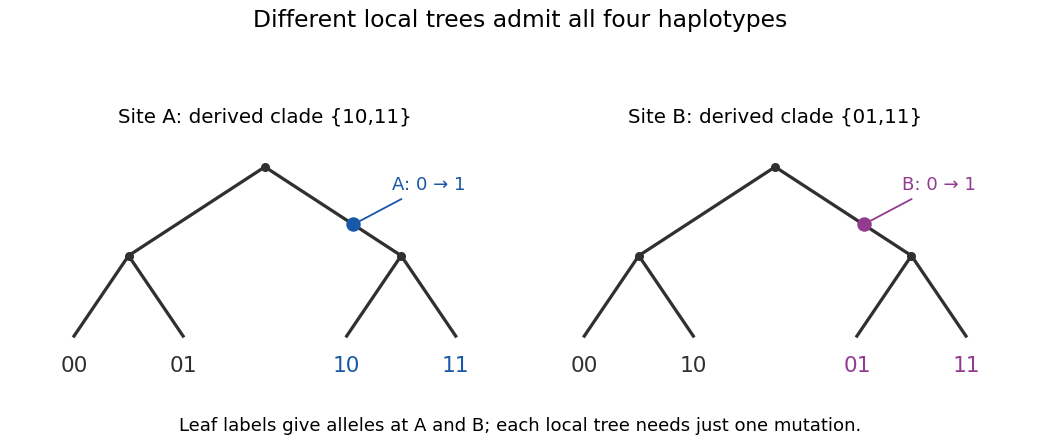
Different local genealogies can generate all four haplotypes with one mutation per site
. Details. 
Shared ancestry explains correlation; recombination makes ancestry a mosaic; mutation on the resulting branches converts genealogy into observed variation. These explanations use the neutral ARG, with a variable recombination map where stated. Selection, population subdivision or changing population size can also be studied genealogically, but require extending the event model rather than being consequences of the constant-size panmictic neutral process alone.
Articles by others on the same topic
There are currently no matching articles.