A mutation changes inherited genetic sequence. Under an infinite sites mutation model, every mutation occurs at a previously unmutated position, so mutations below the sample's common ancestor correspond to segregating sites.
More precisely, a mutation changes a genetic nucleotide sequence; in cellular organisms this is a DNA sequence. An altered sequence can be copied by DNA replication into descendant biological cells, changing their genotype whether or not an observable phenotype changes. Inheritance along a cell lineage does not require transmission to an offspring organism. In animals, germline mutations can enter offspring through gametes, whereas somatic mutations remain in body-cell lineages.[ref]
Mutation by National Human Genome Research Institute. Definition and Narration: DNA sequence change, germline transmission and descendants of somatic cells
A DNA lesion is damage to the physical DNA molecule, such as a damaged nucleobase or a broken strand. It need not become a lasting mutation: DNA repair can restore the original sequence. Conversely, a copied nucleotide substitution can leave an ordinary, correctly paired DNA duplex whose sequence differs from the ancestor. The distinction is between a damaged template and a changed inherited message, not simply between harmful and harmless effects.[ref]
Molecular Biology of the Cell, 4th edition by Bruce Alberts and others. Chapter 5, DNA Repair, Without DNA Repair, Spontaneous DNA Damage Would Rapidly Change DNA Sequences; Figures 5-46–5-49
Small mutations include nucleotide substitutions and indels. Larger changes can remove a gene, duplicate a chromosome region or rearrange its order. Genetic recombination can bring existing alleles together without creating a new nucleobase at the exchanged positions; the mechanism and the resulting sequence change are different questions. A molecular description of a mutation, its effect on a gene product and its effect on a phenotype are likewise three separate statements.
For an original consequence ledger, choose the coding strand segment with initiation at the first displayed codon. Use the standard genetic code, the same reading frame and suitable gene expression context throughout. Its messenger RNA has U in place of T, and the predicted amino acid chain is methionine–phenylalanine–glutamic acid residue, followed by a stop codon. This is a constructed coding segment, not an experimentally measured gene.
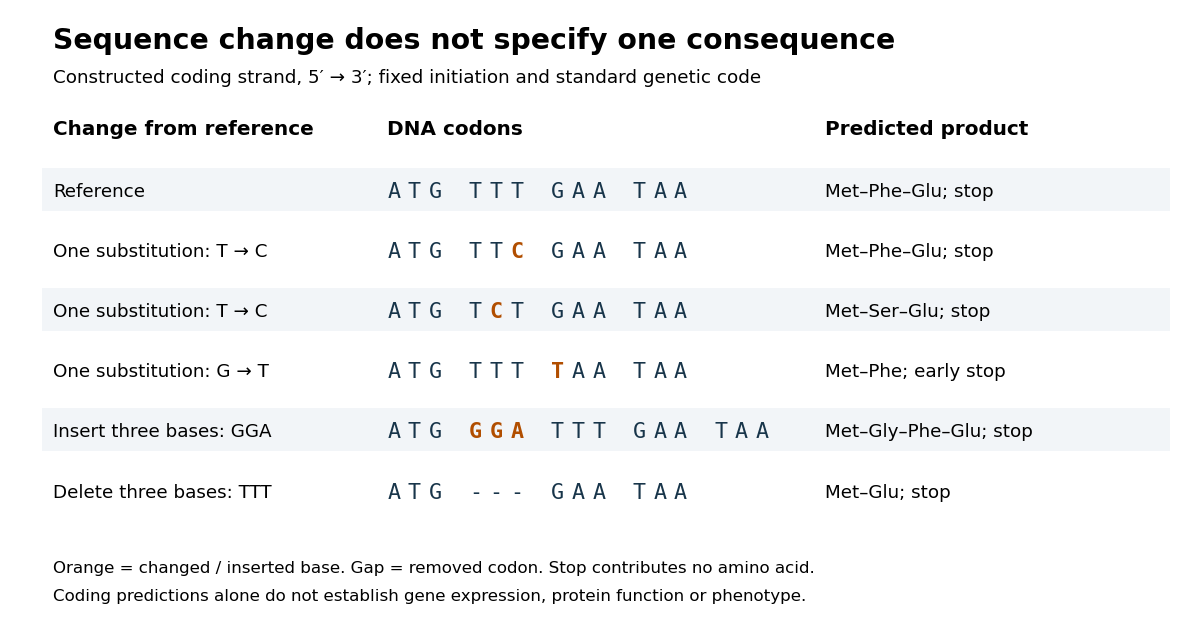
In the second row, position 6 changes from T to C, replacing TTT by TTC. Both corresponding RNA codons specify phenylalanine, so the predicted chain is unchanged. Changing position 5 from T to C instead gives TCT, whose RNA codon specifies serine. Changing position 7 from G to T gives TAA and therefore a stop codon before the original glutamic acid residue. Each is one nucleotide substitution, but their coding consequences differ. Even preservation of the amino acid chain does not guarantee unchanged gene expression or phenotype.
Insert GGA after ATG to add a glycine codon, or remove the complete TTT codon to remove phenylalanine. Both indels preserve the downstream reading frame because their lengths are three nucleotides. A one-nucleotide insertion at that location instead produces a frameshift mutation; the positional explanation and a worked regrouping appear under frameshift mutation. The ledger illustrates why interpreting a genetic variant requires its position and context, rather than just the label mutation.
Mutation supplies new inherited variation on which natural selection can act. The Luria-Delbrück experiment makes the distinction unusually visible: natural selection reveals resistant descendants, while the timing of a prior mutation determines how many descendants are available to reveal. This connects an invisible change in one biological cell to a visible pattern across cell cultures.
An allele that reduces a specified drug response. Resistance can arise through altered target binding, altered target function or other cellular mechanisms; biochemical and exposure controls distinguish them.
Loss of sequence from a genetic molecule. Its effects depend on location and length, including whether the reading frame is preserved.
Addition of sequence to a genetic molecule. In a coding region an insertion whose length is not divisible by three can change the downstream reading frame.
Replacement of a base-pair state by another. A newly formed mismatch is an intermediate and need not become a heritable substitution if repaired.
A genetic rearrangement joining parts of different genes. It can create an altered protein or expression context without inventing entirely new molecular components.
A mutation increasing an existing activity or producing a new functional effect. A changed substrate reaction is more specific than merely higher expression.
A mutation giving a qualitatively altered activity, such as a new substrate reaction. Mutant IDH1 production of 2-hydroxyglutarate provides an example.
A sequence change reducing a relevant gene activity. Complete deletion, partial loss and context-dependent defects can have different phenotypes.
Loss of one of the distinguishable allelic states at a locus in a lineage, through deletion or other genetic events. Copy-number change and allelic change should be measured separately.
A change in the number of copies of a genomic region. cancer analysis must account for purity, ploidy and the boundaries of the altered segment before assigning a specific gene as a driver.
An increase in genomic copy number of a gene or region. It can raise expression or activity, but an amplified gene may instead accompany another selected alteration. It is distinct from laboratory PCR amplification.
A mutation whose phenotype changes with temperature. Conditional loss of an essential function permits study of its consequences after an organism has grown under permissive conditions.
Changing between permissive and restrictive temperatures at defined stages tests when a conditional gene product is required. Reciprocal shifts and short pulses separate initiation from maintenance, subject to inactivation kinetics and protein perdurance.
A mutation that selectively disrupts one measured activity while preserving others relevant to the test. Preservation must be demonstrated, rather than inferred from unchanged abundance.
Insertional oncogenesis is oncogenic change caused by insertion of genetic material at a site affecting cellular gene expression or function. Recurrent sites in independent tumours and functional validation help distinguish a causal driver from an incidental insertion.
A mutation not responsible for the selective advantage that expands the observed clone. It can be carried along with a driver and can recur through high mutation opportunity.
A mutation conferring a selective advantage on a somatic lineage in a specified environment. Its effect depends on cellular background and can concern initiation, progression or treatment resistance.
An organism, biological cell or molecular variant carrying a specified mutation. A mechanistic rescue experiment must check whether a mutant changes abundance, folding or location as well as the proposed activity.
In an embryonic genetic analysis, a mutation whose developmental effect is assigned to the embryo's own genotype, in contrast to a maternal-effect mutation. This usage does not assert when the sequence change first arose.
A mutation whose offspring phenotype depends on the mother's genotype, for example through products deposited during oogenesis, rather than solely on the offspring's own genotype.
A point mutation affects a single base pair. Terminology varies: the broad usage includes a one-base pair insertion or deletion as well as a nucleotide substitution. Describing the actual sequence change avoids this ambiguity.[ref]
Point Mutation by National Human Genome Research Institute. Definition: a single base pair added, deleted or changed
A nucleotide substitution replaces a nucleotide at a specified position without changing sequence length. In a fixed reading frame, a single substitution can preserve an amino acid assignment, change it or introduce a stop codon; the mutation ledger exhibits all three possibilities.
The Jukes-Cantor model is a symmetric four-state continuous-time Markov chain for DNA evolution. Each change to a specified different base has rate , so the total rate of actual changes is . Its same-base probability is and its probability for one specified different base is . The probability of any mismatch is three times the latter, tending to at long times. Distinguish the exponent parameter from the actual per-site mutation rate when fitting this model.
An indel is an insertion or deletion of nucleotides relative to a specified reference nucleotide sequence. Its length and location matter: within a coding region, a length not divisible by three changes the downstream reading frame, producing a frameshift mutation. A gene deletion is a larger removal defined by the gene it eliminates.
A germline mutation occurs in the lineage that makes gametes and can therefore be inherited by an offspring organism. Transmission depends on whether the affected lineage actually contributes a gamete to that offspring. Compare somatic mutation.
A somatic mutation occurs in a body-cell lineage outside the germline mutation route. Its descendant biological cells can inherit it through DNA replication, even though it is not transmitted through gametes. Thus heritability within a cell lineage differs from inheritance between sexually reproducing organisms.
In 1943, Salvador Luria and Max Delbrück grew separate Escherichia coli B cell cultures from small equal inocula, without the challenging bacteriophage. They used nutrient broth or an asparagine–glucose cell culture medium. On nutrient agar plates, they first spread excess bacteriophage and then the bacterial sample centrally, leaving an outer margin. After incubation, resistant biological colonies provided the readout; counts were usually made at 24 and 48 hours. Their control plated repeated samples from one shared culture. Independently grown cultures varied much more than this sampling comparison. That contrast supported resistant lineages arising before challenge: early mutations could produce many resistant descendants before natural selection revealed them.[ref]
Mutations of Bacteria from Virus Sensitivity to Virus Resistance by Salvador Luria and Max Delbrück. pp. 501–504, Material and Methods; Experimental, plating reliability, Table 1 and independent cultures, Table 2
This was evidence about the timing of heritable resistance, not DNA sequencing of the responsible genes. It does not establish uniform mutation rates or exclude environmentally induced mutations; the paper itself discusses physiological dependence and delayed expression.[ref]
Mutations of Bacteria from Virus Sensitivity to Virus Resistance by Salvador Luria and Max Delbrück. pp. 505–507, discussion of excess variation, physiological state, delayed resistance and genetic relatedness
Now construct a deliberately small mathematical model of the timing effect. Start with one sensitive biological cell at generation . Every biological cell divides into two in each of five synchronous rounds, with no death or growth difference. There are biological cells immediately after round , ending with . In each scenario, exactly one newly formed daughter changes to resistance immediately after round ; its descendants inherit resistance without reversion or further mutations. Resistance is expressed immediately, and the final challenge allows every resistant biological cell, and no sensitive one, to form one separate biological colony.
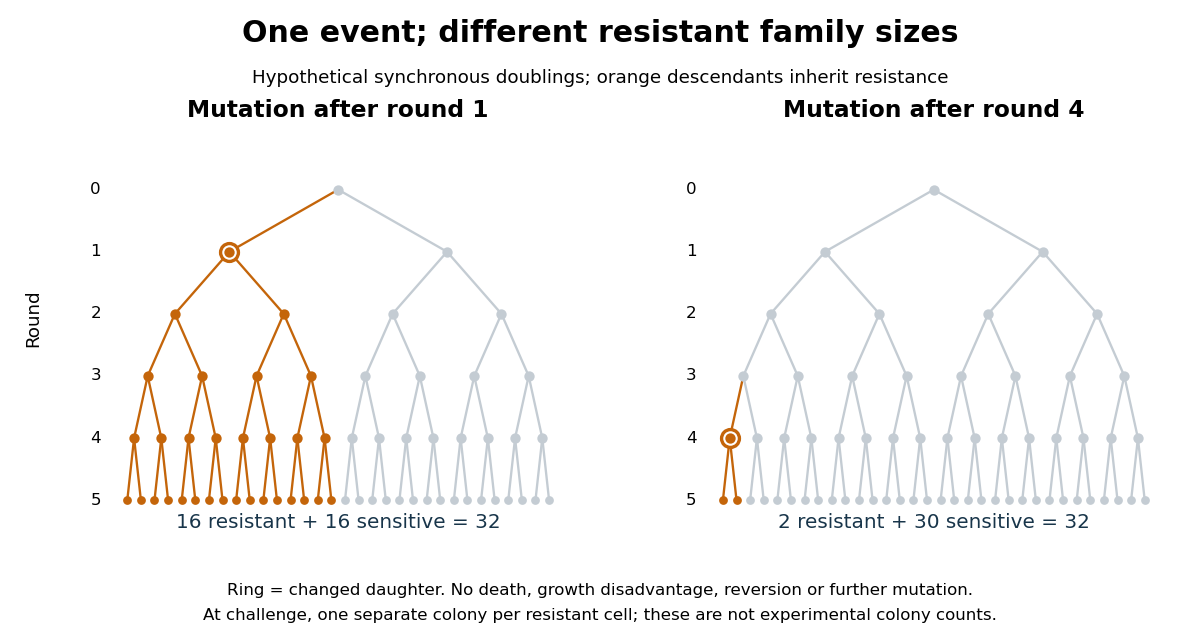
The descendant count obeysAt the moment of the event there is one resistant biological cell; each remaining round doubles its descendants. This proves the formula by repeated multiplication, with terminal case . An event after round 1 gives resistant and 16 sensitive biological cells; an event after round 4 gives resistant and 30 sensitive biological cells. Both scenarios contain one mutation event. A culture with no event gives zero resistant biological colonies under these assumptions. The difference is family size, rather than the number of events.
For comparison, suppose each of the 32 final sensitive biological cells independently acquires resistance only on challenge, with probability and no subsequent multiplication before counting. Then the resistant count has a binomial distribution, with expected value and variance . This alternative mathematical model has no pre-challenge resistant family to amplify. Its independent trials are an assumption of the comparison, not a consequence of using physically distinct biological cells. The clonal scenarios explain how a jackpot can occur; they do not assign probabilities to the event times or estimate a real mutation rate.
// Target: biology.bigb
A gene deletion removes a chosen gene sequence from a genome. An experimental gene deletion tests the consequences of that removal in a specified genetic background and environment; lack of an observed phenotype does not prove that the gene has no function under other conditions.
A mutation rate measures the frequency of mutation events per specified unit, such as per chromosome segment per generation. Its units and the population-size convention must be specified. If time is measured in generations and , each ancestral lineage has mutation intensity per unit of coalescent time.
An allele that increases the rate of mutations. In an asexual lineage it can hitchhike with a beneficial change, despite also increasing the production of harmful changes; genetic recombination can weaken that association.


