Use the Minkowski metric and the free real scalar field Lagrangian density . Its conjugate canonical momentum is . Spatial translation symmetry and Noether's theorem give the canonical stress-energy tensorVanishing boundary flux then makes the four-momentum of a free real scalar field constant. In particular the contravariant spatial momentum isThe minus sign is from ; it is essential for the following mode calculation.
In the quantized theory, insert the mode expansions into this integral, using a Hermitian symmetric ordering or normal ordering. Write . The spatial integral is , leavingEach last term integrates to zero: replace by and commute the two annihilation operators or the two creation operators. The mixed terms reorder by the canonical commutation relation. Their vacuum contribution is proportional to the integral of the odd vector and vanishes with an inversion-symmetric regulator; normal ordering removes it directly. Thus the normal-ordered free scalar four-momentum has spatial partThese manipulations can be made first with box modes and a symmetric momentum cutoff, then used on finite-particle wave packets.
The commutator derivation identity givesFor , the commutator expansion for exponential conjugation therefore gives the translation of a scalar creation operatorThe vacuum has zero momentum, so . Hence the one-particle momentum eigenstate obeys : translation preserves its momentum and multiplies it by the associated phase.
The annihilation operator receives the opposite phase. Substituting both phases into the field expansion givesThis is the specified conjugation convention for the spatial translation operator. On states, the active translation moves a wave packet by , giving a position wavefunction . Conjugating the field by instead would give the opposite argument shift. Infinitesimally the displayed result is .
Direct multiplication of the gamma matrices in the chiral representation givesFor example by the Pauli matrix multiplication law, and the block multiplications give the displayed signs. Every is off-diagonal in this representation, whereas the chirality matrix has opposite diagonal blocks. Therefore for all .
The left-handed chirality condition makes the plane-wave coefficient . With , the Dirac equation givesSince , its determinant is . A nonzero spinor therefore exists exactly whenFor nonzero momentum, put and write its direction as . Normalized eigenvectors of areThe general nonzero solution is for and for , with arbitrary nonzero complex normalization . At any constant two-component solves the equation, but the momentum direction and helicity are undefined. For the physical positive-energy branch this is the left-handed massless plane-wave spinor.
A rotation by angle about acts on the two-component spinor asThe plane-wave argument is unchanged because the rotation fixes , and . Thus the positive-energy solution has helicity , where a helicity- state has rotation phase . The negative-energy coefficient has the opposite spinor phase.
In a quantized complex left-handed Weyl field, the positive-frequency term annihilates particles and the negative-frequency term creates antiparticles. Reinterpreting negative energy also reverses its spatial momentum; for the positive physical momentum the two spinor coefficients have the same left-chiral kernel. Because one multiplies an annihilation operator and the other a creation operator, the corresponding particle and antiparticle state phases are conjugate. The helicity content of a quantized Weyl field is consequentlyThere is one particle spin state at each nonzero momentum, rather than the two helicities supplied by a full massless Dirac field. The right-handed Weyl field interchanges these signs. This is the massless relation between chirality and helicity; it does not identify them for a massive field.
Split the free interaction picture field as , where the first part contains annihilation operators and the second creation operators. Time ordering places the operator at the later time on the left, while normal ordering places all creation operators on the left. For , commuting the annihilation part of the first field through the creation part of the second givesThe commutator is the c-numberFor , the same calculation interchanges . Combining the two time orders proves the two-field Wick contraction identitywhereThe equality with the four-dimensional integral follows by closing the energy contour at the positive-energy pole for and the negative-energy pole for the reverse order. This fixes the scalar Feynman propagator pole prescription; in this convention itself includes the factor .
Because these interactions have no derivatives, . Expand the Dyson seriesApply the Wick theorem to each term together with the external insertions. Every paired field contributes a propagator, and the remaining normal-ordered vacuum expectation vanishes unless no fields remain. Representing the propagators by Fourier integrals and integrating each vertex position gives the four-momentum conservation delta function. The and contractions into labelled vertex slots cancel the factorials in the interaction density. The resulting scalar-field cubic and quartic Feynman vertices areEach vertex also has , each independent internal momentum is integrated with , and repeated equivalent contractions give the usual Feynman-diagram symmetry factor. For the unamputated correlation functions, retain the propagators joining external insertions to vertices. The displayed unnormalized numerator includes disconnected vacuum bubbles; dividing by cancels them. Amputated scattering amplitudes additionally use the LSZ reduction formula.
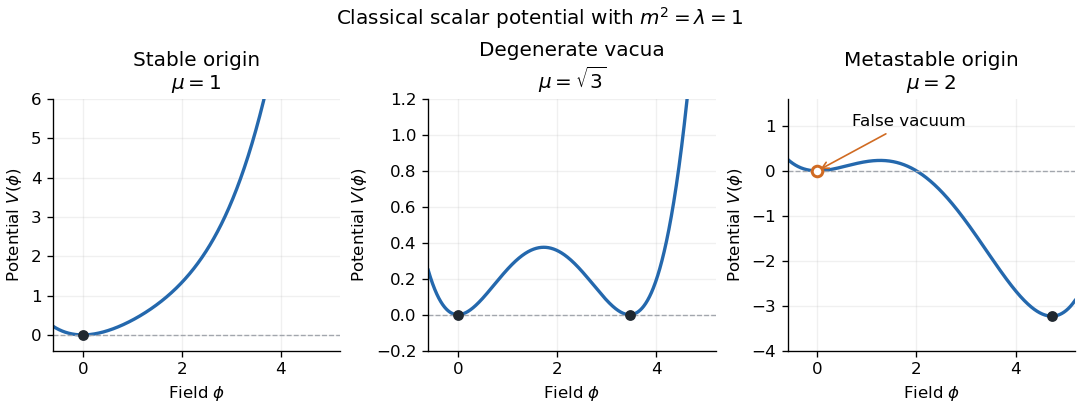
For stability, examine the classical scalar potentialThe tree-level boundedness criterion is , with arbitrary real cubic coupling. If , boundedness requires and ; if , or with , the potential is unbounded below. Thus a positive quartic coupling permits a stable ground-state vacuum, although it need not be the perturbative vacuum at .
For and , the stability of a cubic-quartic scalar potential determines when zero is a global minimum:The square bracket is nonnegative for every field value exactly whenFor a nontrivial equality case there is a second degenerate minimum at . If and , zero remains a local minimum but is a false vacuum, with a lower minimum elsewhere. If and , the origin is the quartic minimum despite its vanishing quadratic curvature. These are classical or tree-level stability statements; renormalized couplings and the quantum effective potential refine the quantum analysis.

Choose the phase convention in the question and use the gauge covariant derivative . For a charged Dirac field, the quantum electrodynamics Lagrangian isThe simultaneous local gauge transformation isDirect differentiation gives : the derivative of the phase cancels the shift of . The mass term and covariant kinetic term are therefore invariant. The electromagnetic field tensor is unchanged because mixed partial derivatives of commute. This proves classical gauge invariance of the coupled field action. A charged scalar similarly uses and a potential depending only on .
The electromagnetic coupling is . The matter equations give a conserved current , with . Constant gives the global symmetry and its conserved charge. When applying Noether's theorem, the sign of the parameterized Noether generator can be reversed without changing this conservation law; the transformation and coupling signs above remain fixed.
A constant phase leaves the photon unchanged and makes every QED interaction vertex invariant: its one and one acquire opposite phases. Thus the propagators and vertex factors in the QED Feynman rules are unchanged. A Green function with insertions of and of acquires the phase . For an invariant vacuum it can be nonzero only when its total inserted charge is zero.
Equivalently, the conserved charge operator commutes with the S-matrix. If initial and final states have charges , thenThe scattering charge selection rule from global gauge symmetry is thereforeIn diagrams the oriented fermion lines preserve charge at every vertex, and a photon is neutral. Pair creation is allowed because a particle and its antiparticle have opposite charges. Global phase invariance supplies this selection rule; local gauge invariance supplies the stronger momentum-dependent Ward-Takahashi identity.
The Maxwell quadratic action has a null longitudinal direction: its momentum-space kinetic operator annihilates , reflecting gauge invariance under addition of a gradient to the potential. It cannot be inverted on all four vector components before gauge fixing.
Add the covariant gauge density . Away from the pole, introduce the transverse and longitudinal momentum projectorsWith one index raised they obey , , and . The gauge-fixed kinetic operator is . Its inverse times gives the photon propagatorThe pole factors are interpreted with the Feynman boundary prescription; the algebraic projector inversion is performed off the pole. The choice is Feynman gauge.
Changing changes only a longitudinal term proportional to . Between conserved currents it vanishes because . In full QED amplitudes, the Ward-Takahashi identity supplies the corresponding cancellations when all diagrams at an order are combined. Thus physical on-shell scattering is gauge-parameter independent, whereas off-shell Green functions and the propagator itself can depend on the gauge choice. For the charged scalar, derivative vertices and contact terms must likewise be included for this cancellation.
The covariant Landau gauge is the zero-parameter limit of the covariant gauge family. It imposes the Lorenz gauge condition sharply. The Landau gauge photon propagator is the transverse part of the inverse from solution:Away from the pole, , matching the divergence-free condition. This is transversality to the four-momentum, rather than a projector onto only the two physical spatial photon polarizations. The Lorenz gauge equation alone still admits residual gauge transformations with ; boundary conditions and the pole prescription complete the propagator choice. The parameter limit specifies the Landau propagator without trying to invert the ungauged Maxwell operator on its longitudinal null space.
Articles by others on the same topic
There are currently no matching articles.