The single-particle Hamiltonian has a periodic potential . Define the unitary spatial translation operator . Its derivatives commute with translation, and the potential's periodicity gives .
Each energy eigenspace is therefore preserved by , so within it one may choose simultaneous energy and translation eigenstates. On a large periodic interval of cells, and its eigenvalues are phases , with ; the infinite-volume limit gives continuous quasimomentum modulo . For a simultaneous state in band , this provesThen obeys , which constructs the usual Bloch state rather than assuming its form. The label distinguishes energy bands at the same crystal momentum . In a degenerate energy eigenspace an arbitrary superposition need not itself have one translation phase; the result refers to the simultaneous Bloch states.
Let be the normalized stationary profile. Multiplying its stationary Gross–Pitaevskii equation by , integrating and integrating the kinetic term by parts yieldsThis is not simply : the quartic contribution is twice its contribution to that energy per particle. For an infinite periodic system one uses one cell and the corresponding cell particle number, or equivalently average densities.
At fixed lattice spacing, mean density , coupling and temperature, the commonly used condensate compressibility in an optical lattice isIf compressibility means the thermodynamic volume response instead, the Gibbs-Duhem equation at zero temperature gives . Stating the convention removes this factor-of-density ambiguity; the lattice-depth derivative has the same sign at fixed .
For the stable repulsive ground-band Bose-Einstein condensate, the intended trend is for increasing nonzero lattice depth, with mean density held fixed. Deeper wells localize the field, enhancing the repulsive interaction response. To quantify this, in the weak-interaction band approximation write , with the cell average of equal to one. Perturbation in givesIn deep wells the localized orbital is approximately a normalized Gaussian of width . Neglecting interwell overlap, , hence . This explicitly establishes the sign in that controlled regime; the repulsive ground-band calculation describes the broader trend.
The sign statement needs the repulsive, stable ground-band interpretation, not merely the literal assumption . It also need not be a strictly nonzero derivative at : at weak interaction , with normalization corrected at second order, gives and a zero initial slope. A leading density-dominated Thomas–Fermi approximation for a condensate with density positive everywhere gives and no depth dependence of this response at that approximation's order. These limits do not justify a strict universal sign for every unspecified interaction and parameter regime.
Use the stationary quantum vortex fieldwith no dependence on the coordinate along the vortex line. The polar Laplacian contributes . ConsequentlyA regular vortex with nonzero integer winding number has near the origin. The angular phase gives the superfluid velocity outside the core. For , the exterior amplitude responds to the periodically varying potential; it is not generally a constant bulk value. The radial potential here is not a Cartesian translation-invariant optical lattice, so the Cartesian Bloch theorem is not an exact theorem for its full radial equation.
Set , , using the healing length and . For zero external potential, division by producesPrimes now denote dimensionless-radius derivatives. Let . Then , while the centrifugal term is and . Their leading balance gives . Therefore the inverse-square tail of a Gross–Pitaevskii vortex yieldsFor a singly quantized vortex the answer is . This is the amplitude deficit; the density deficit has limiting coefficient instead.
A nonzero radial lattice prevents a unique universal curve without values of the depth, period, chemical potential, coupling and winding number. An explicit example of the requested profile is shown below for , repulsive coupling, and ; since , this corresponds to .
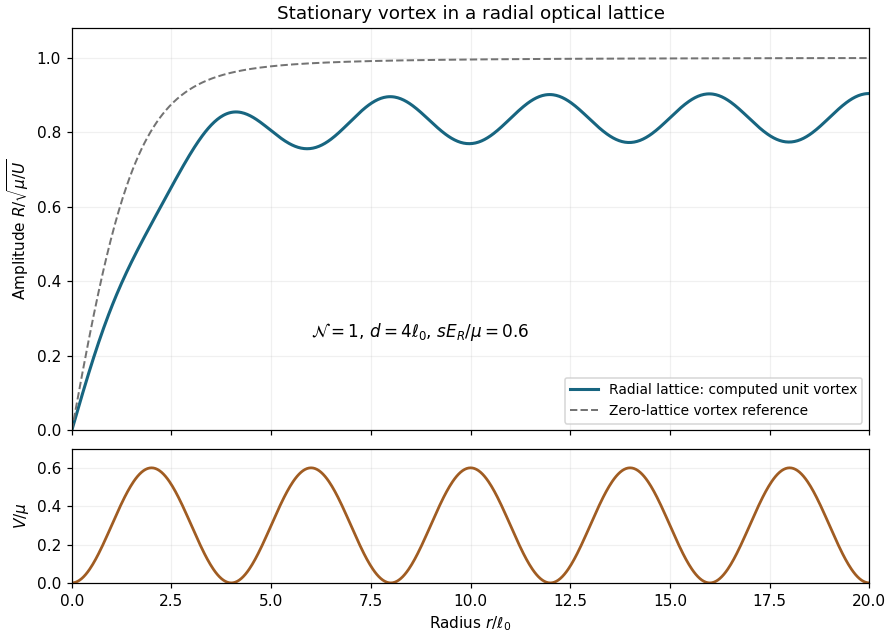
Computed unit-vortex amplitude in a radial optical lattice, with the lattice potential and homogeneous-vortex reference
. Details. 
The plotted dimensionless amplitude is . The generator solves the nonlinear radial equationby finite differences and damped Newton iteration; here is in healing length units. It imposes regularity and a zero radial derivative at , well outside the plotted interval . The exterior boundary is at a potential minimum, and its placement is checked by an extended-domain calculation.
The quantum vortex core still forces the amplitude to vanish at the origin. Farther out, amplitude minima occur near potential maxima, where repulsion and trapping reduce the local equilibrium density, and amplitude maxima occur near the low-potential annuli. Gradient energy smooths the modulation, so the profile does not exactly follow the local estimate . It approaches a periodically modulated exterior background rather than the homogeneous limit one; the dashed zero-lattice curve is included solely as a reference. At sufficiently deep lattice barriers the density troughs can become much more pronounced than in this example.
Articles by others on the same topic
There are currently no matching articles.