The Gibbs-Duhem equation constrains changes of the intensive quantities describing one uniform thermodynamic phase. For a mixture with independently specified component amounts, its molar form isHere is entropy, is volume, is temperature, is pressure, is the amount of substance of component , and is its molar chemical potential. This assumes a simple compressible system whose bulk internal energy is an extensive quantity; additional work coordinates require additional terms.[ref]
Thermodynamics and Chemistry by Howard DeVoe. Howard DeVoe, Thermodynamics and Chemistry, second edition, version 10, §9.2.8, printed p. 240, equations 9.2.42–9.2.44
The proof exposes the source of the constraint. For internal energy , replication of the whole thermodynamic phase by a factor gives . The Euler theorem for homogeneous functions and the fundamental differential of internal energy therefore giveTaking the differential of the first equation produces all the terms in the second, plus . Subtraction proves the Gibbs-Duhem equation. Thus the constraint comes from two descriptions of the same state function, rather than an assumed microscopic interaction model.
At fixed temperature and pressure, divide by and introduce the mole fractions :The chemical potentials cannot be varied independently. In a two-component mixture, put and . Within a smooth single-thermodynamic phase region with ,One chemical potential fixes the other's change, but determining its absolute value still requires a reference value. This does not say : equality at phase coexistence concerns the same chemical species in different thermodynamic phases. Nor does the constraint say whenever temperature and pressure are fixed; changing composition still contributes to the Gibbs free energy.
An ideal solution has molar chemical potentialswhere is the molar gas constant and the stars denote pure-component reference values at the same temperature and pressure.[ref]
Thermodynamics and Chemistry by Howard DeVoe. Thermodynamics and Chemistry, §9.4.2, printed pp. 249–250, equations 9.4.5 and 9.4.8; definition of an ideal mixture
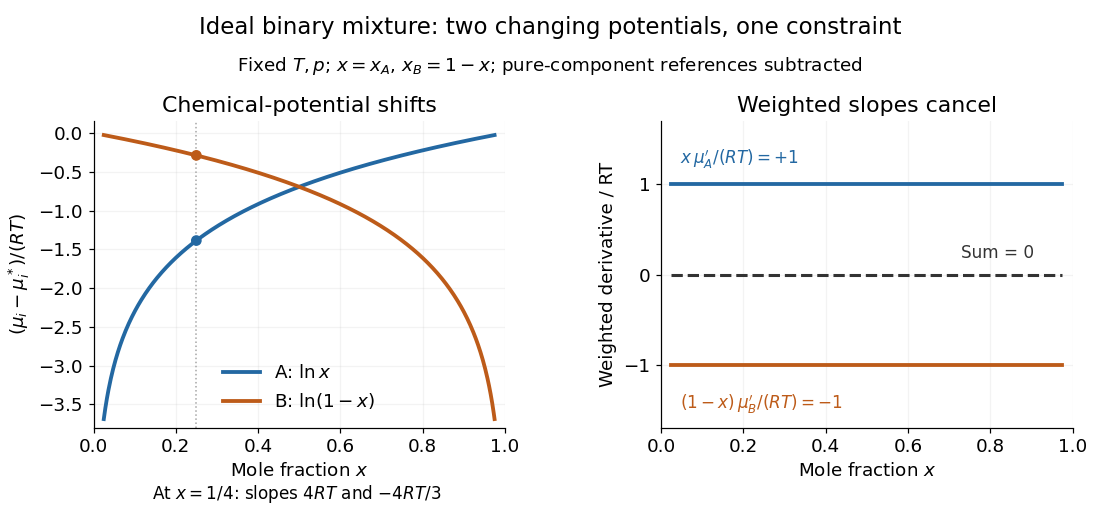
Hold temperature and pressure fixed. The derivatives with respect to are and , soEach chemical potential changes, yet their composition-weighted slopes cancel exactly. At , the two slopes are and ; multiplying by and gives and . Near either pure-component endpoint the dilute component's slope diverges, but its weighted contribution remains finite. The endpoint chemical potential itself requires a limiting interpretation because its logarithm diverges.
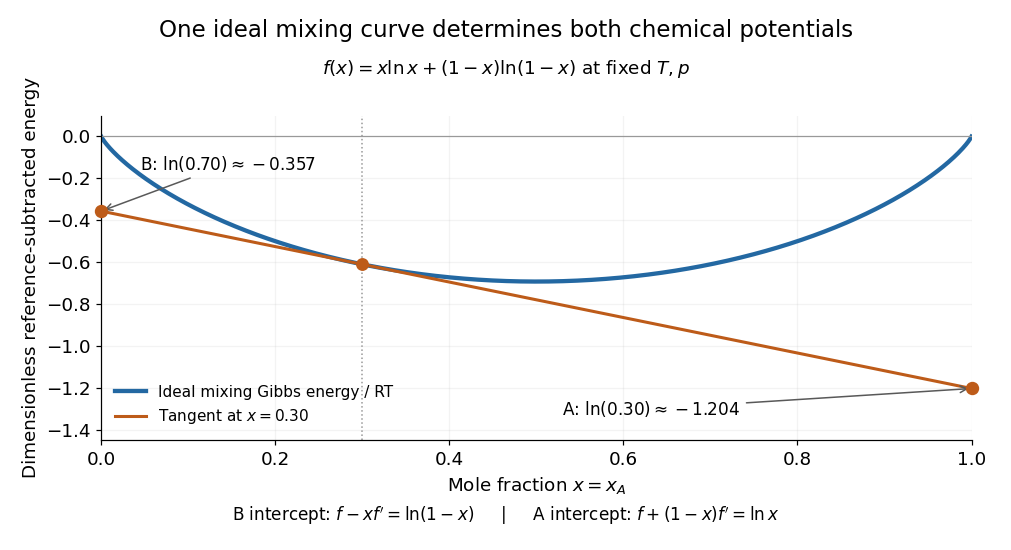
The same constraint has a geometric explanation. Subtract the pure-component reference contribution from the molar Gibbs free energy and divide by to obtainIts derivative is . At fixed total amount of substance, exchanging a little B for A changes the Gibbs free energy with slope . Consequently the tangent to at has interceptsat horizontal coordinates and , respectively. The two chemical potentials come from the same curve: choosing two unrelated functions would generally destroy this tangent construction.
For a nonideal chemical solution, write its thermodynamic activities on a mole fraction basis as and . Use composition-independent pure-component reference chemical potentials at the same temperature and pressure:The activity coefficients describe departure from the ideal solution under that reference convention.[ref]
At fixed temperature and pressure, insert these expressions into the Gibbs-Duhem equation. The ideal solution terms cancel because . What remains isThus two independent fits to measured activity coefficients can each look smooth while failing to describe one possible Gibbs free energy. This is a necessary consistency condition; satisfying it alone does not establish experimental accuracy or thermodynamic stability.
For an original algebraic example, suppose at one fixed temperature and pressure that , with dimensionless constant . The constraint requires . With the pure-B normalization , integration givesFor and , the derivatives of the two logarithms are and ; their weighted sum is . Choosing instead would give a weighted sum at that composition, contradicting the Gibbs-Duhem equation. These are invented model functions, with no claim to fit a particular mixture.
The fixed-temperature, fixed-pressure restriction matters. Along a path with changing temperature or pressure, the general equation contains , and the reference chemical potentials and also change. Across phase coexistence, apply the relation separately within each smooth thermodynamic phase; do not differentiate a discontinuous switch between phases as if it were a single composition curve.
A concrete motivating experiment is the acetone–chloroform mixture in Truman State University's Liquid-Vapor Equilibrium of a Binary System, Procedure and Figure 1. A two-neck flask feeds a distillation head with a water-cooled laboratory condenser, condensate sampling arm and temperature probe. Starting with one pure liquid, the procedure adds the other component successively and waits for stable temperature with returning condensate. Small paired samples from the flask and condensate are read on an Abbé refractometer; a tabulated refractive index–composition relation gives the two compositions. Controls include three-point thermometer calibration, corrected atmospheric pressure readings, and agreement of the initial pure-liquid and condensate refractive indices with the reference value. Small withdrawals and little retained condensate reduce disturbance of composition. Sample evaporation can bias the readout. The inferred paired mole fractions, temperature and pressure describe vapor-liquid equilibrium, subject to the conversion from mass fraction to mole fraction and to representative sampling. This teaching protocol reports no measured results of a particular student run.[ref]
How does such a measurement expose activity coefficients? Let and be the mole fractions in the liquid and gas thermodynamic phases, respectively, and let be the pure-component vapor pressure. Assume the gas thermodynamic phase is an ideal gas mixture and neglect the change of the pure-liquid reference chemical potential between its saturation pressure and the experimental pressure. Equality of each component's chemical potential between the two thermodynamic phases then givesThis turns the paired composition readings into estimates of the activity coefficients. The approximation needs refinement when the gas departs appreciably from ideal gas behavior or the neglected liquid pressure effect matters.
The apparatus measures a boiling-composition series in which temperature changes as the mixture changes. Its readings therefore cannot be inserted directly into the fixed-temperature, fixed-pressure activity coefficient constraint. They motivate the more general task: test whether the measured mixture properties can arise from a common Gibbs free energy while accounting for changing state variables. A failure can reveal incompatible property fits or experimental bias; a pass supplies a consistency check, not proof that every reading is correct.
Articles by others on the same topic



The Gibbs–Duhem equation is a relationship in thermodynamics that describes the changes in the chemical potential of a system in relation to its temperature, pressure, and composition. It arises from the fundamental thermodynamic definition of the differential change in the Gibbs free energy \( G \).