It is useful to rewrite the local lensing convergence asFor positive core radius, the requested limits areA singular isothermal sphere lens instead has , which diverges at the centre. The finite core of the softened isothermal lensing potential regularizes this central lensing convergence; at large angular radius the two models have the same leading profile.
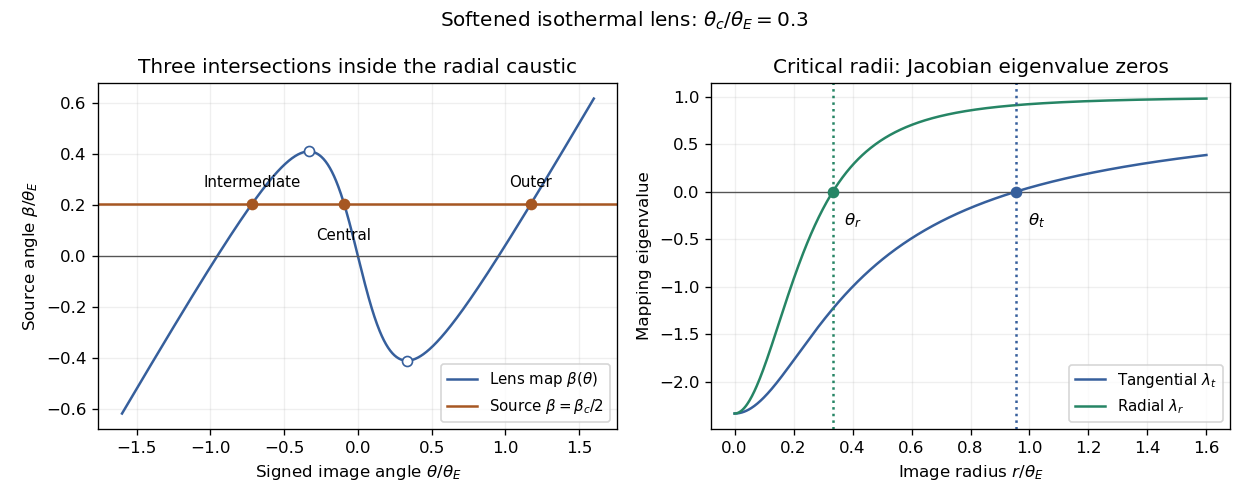
For an axisymmetric gravitational lens, the reduced deflection is . The specified mean lensing convergence therefore givesThe derivative is smallest at the centre, where . If , the mapping is monotone and an offset source has only one image. If , the derivative is negative near zero and positive at large radius, producing two stationary points and a range of source offsets with three images. Thus the condition for a nonempty multiple-image region isThis condition permits multiple images; a particular source must additionally lie inside the multiple-image caustic of a softened isothermal lensing potential. At equality the critical radii collapse to the origin and there is no finite three-image region.
Put and write the vector thin gravitational lens equation as . A tangential displacement at fixed radius has eigenvalue . A radial displacement has eigenvalue . From the definition of the mean lensing convergence,Since , this gives . Consequently,The two requested gravitational-lensing critical curve conditions are thereforeThey correspond respectively to a tangential critical curve of an axisymmetric lens and a radial critical curve of an axisymmetric lens.
The tangential condition gives , henceThis is a nonzero gravitational-lensing critical curve precisely when . It is also the radius of the Einstein ring for an aligned source in this cored model, so the strength parameter itself is not the cored model's ring radius.
For completeness the radial condition is equally explicit. Subtracting the mean lensing convergence from twice the local one givesThus the radial critical curve of an axisymmetric lens has radiusagain nonzero exactly when .
The conditions are singularities of the image-plane Jacobian matrix, where the formal lensing magnification of a point-like astronomical source diverges. A small source is strongly stretched in the corresponding eigenvector direction: tangentially near , radially near . Their mapped loci are source-plane gravitational-lensing caustics, which determine where image counts change.
The tangential circle maps to and gives the aligned Einstein ring. To find the radial caustic, put . At , and . Substitution in the signed lens mapping gives a negative source position for positive ; its magnitude isAn offset source with has three images. For , one outer image is on the positive side and two are on the negative side, as the sketch shows. The central and outer images have positive parity; the intermediate image has negative parity. On the radial caustic the inner pair merges, with a separate outer image remaining; outside it only the outer image survives. At exact alignment a central image coexists with the ring. Finite source extent smooths the formal divergences. The singular zero-core limit removes the central image, so its image-count rule differs from the finite-core case.

Articles by others on the same topic
There are currently no matching articles.