Write , , and denote the slow density and velocity field amplitudes by and . Acting on the rapid phase, gives , where . Spatial differentiation gives , while derivatives of the amplitudes and the mean shear flow are . The leading continuity equation and linearized Euler equations therefore becomeEliminating on the nonzero acoustic branch gives the acoustic eikonal equation in a shear flow:The mean-shear term is small here because ; retaining advection does not require retaining that gradient in the leading phase equation. The positive intrinsic-frequency acoustic dispersion relation is , with group velocity .
In a stationary wall boundary layer, horizontal homogeneity preserves and along a Hamiltonian ray-tracing equations trajectory. For a two-dimensional ray,Suppose increases from zero at the wall to a positive free-stream value. For a downstream-directed wave normal, , increasing decreases and . The wave normal bends towards the wall, and the ray becomes more nearly parallel to it. If reaches , then : the ray turns and returns towards the wall rather than reaching the free stream. With launch angle above the wall and free-stream Mach number , the escape condition isFor upstream-directed wave normals, , and increase through the layer; there is no such downstream turning barrier on this branch. A wavefront normal is parallel to , while the energy ray follows the group velocity: advection makes their directions different. In particular, a wall-normal wave normal with can still have a ray drifting downstream. The ordinary WKB method needs a local turning-point continuation at ; the ray sketch depicts that qualitative continuation.
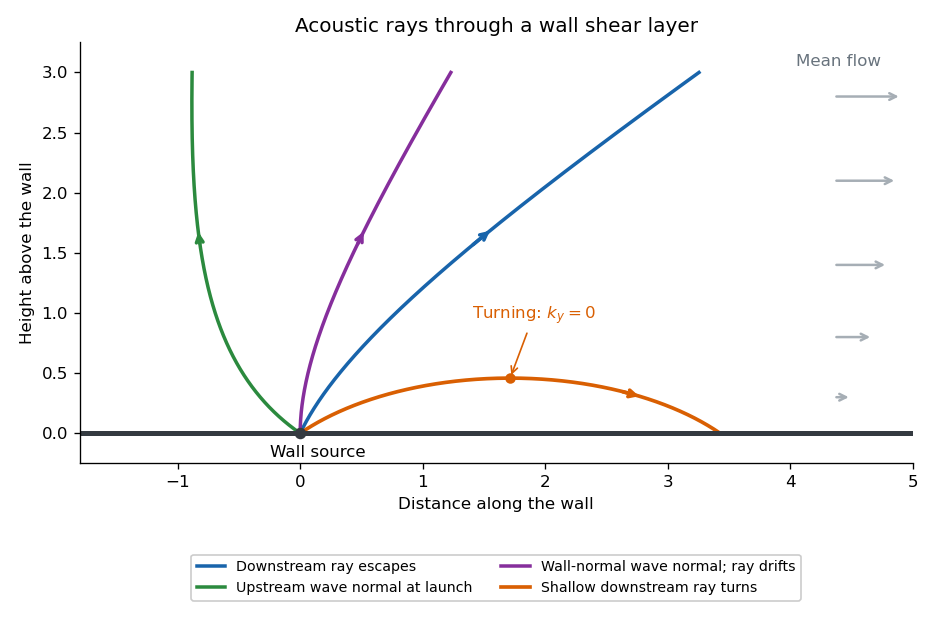
Acoustic energy rays through a wall shear layer, showing downstream escape, downstream turning and downstream drift of a wall-normal wave normal
. Details. 
For this sign of the viscous Burgers equation, the Cole-Hopf transformation is . Integrating the initial sinusoid gives ; the positive multiplicative constant cancels from . Set and . The Fourier series of the initial exponential and the heat equation yield the exact sinusoidal Cole-Hopf solution for negative-flux Burgers flow:Each harmonic decays by its heat multiplier, which can also be obtained directly by convolving it with the Gaussian heat-kernel convolution. At the first harmonic dominates:The error bounds use for real positive , also immediate from the Fourier-integral representation. Dividing, including the correction from the denominator, givesFor , the large-argument asymptotic expansion of a modified Bessel function gives . HenceThe sign is positive because the first Fourier harmonic of is negative, so its angular derivative is positive. For a fixed nonzero , the relative corrections vanish as and ; at the symmetry points both the exact solution and the leading expression vanish.
Put . For the Fay solution, . At the first harmonic therefore giveswhich agrees with the late-time limit in (i).
For the opposite limit, expand the reciprocal hyperbolic sine as a geometric series and interchange absolutely convergent sums at every :This exact positive-denominator form is useful near the shock. For small and , expand the denominator of the terms with small and use . The leading sum isFor the shock-layer scaling , the passage to this sum follows from dominated convergence: and for small provide a summable bound proportional to . The same leading expression matches the outer small-angle range . More generally, split the exact sum at with : the low terms have vanishing relative Taylor error, while the discarded exact and approximate tails are smaller than the leading expression by .
Now apply the partial-fraction identity for the hyperbolic tangent with :The Fay shock-layer asymptotics are thereforeThe angular shock thickness is , and its matched states are . At , both formulas vanish; the limiting slopes agree. The denominator throughout this derivation is as printed in the PDF, not the erroneous in the converted TeX.
Articles by others on the same topic
There are currently no matching articles.