At , the linear growth rate of a Fourier mode is . Its critical kernel of a linear map has . WriteFor a compatible periodic carrier, the slowly varying envelope is periodic on . Small carrier detuning can alternatively be included in the envelope wave phase.
With , and , all three terms , , first appear at . Balancing the time derivative thus requires . Since the linear growth rate near is , spatial detuning must be to contribute at the same order. ConsequentlyTreating independently, let on the fast carrier. Expansion of the linear operator givesThe term annihilates , since . At orders two through four there is no nonresonant forcing, and kernel of a linear map corrections can be absorbed into the definition of , allowing . At order five the equation for isThe fast operator is a self-adjoint operator on periodic functions. Its Fredholm alternative requires the right-hand side to have zero inner product with each kernel of a linear map mode , equivalently to have zero resonant Fourier coefficients. The coefficient of in is , and in it is . Therefore the solvability condition isThe conjugate condition supplies the same real equation for the negative mode. The remaining noncritical harmonics determine without obstruction. This is the cubic-quintic Swift–Hohenberg amplitude reduction; it retains quintic saturation because the small positive cubic coefficient makes the onset mildly subcritical.
Assume , as required for the subcritical case. The zero state exists for every . For a nonzero uniform real state, put . Its equilibrium point condition is , givingBoth are positive for . At , the lower branch reaches zero and the upper has . For only the upper branch is positive. Each positive represents real states , as well as their constant complex wave phase rotations.
The two nonzero branches merge atThe radial linearization is . It is negative on the upper branch and positive on the lower. The zero state is stable for and unstable for . Thus a subcritical pitchfork bifurcation branch leaves zero towards negative , and its fold connects to the stable finite-amplitude branch. Constant wave phase shifts are neutral for nonzero complex states; the stated attraction is in amplitude, with spatial wave phase perturbations damped except for that uniform symmetry mode.
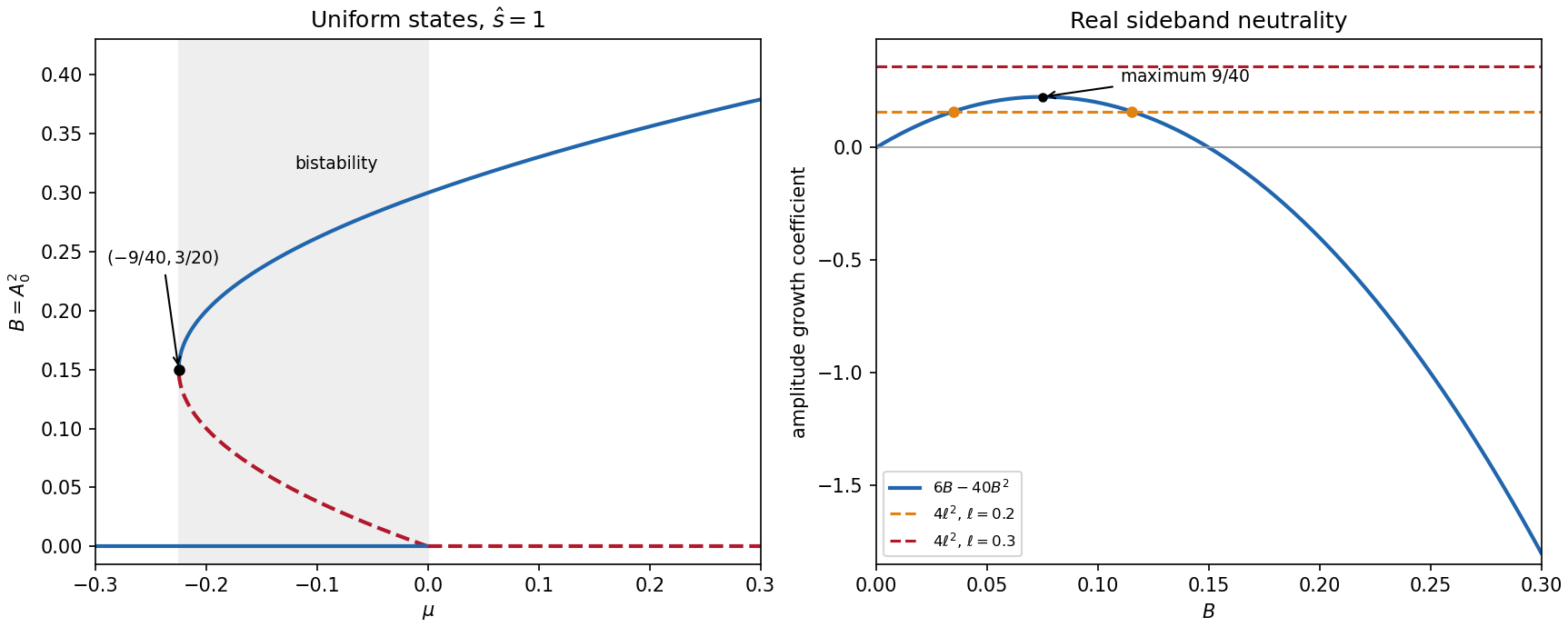
Uniform cubic-quintic amplitude branches and the maximum real-sideband growth coefficient
. Details. 
The linearized complex equation couples a perturbation and its conjugate, so a single complex Fourier mode by itself is not a closed perturbation ansatz. Equivalently use real amplitude and wave phase perturbations, with Fourier modes paired to make each real field. Writing and givesA real amplitude mode of slow wavenumber therefore becomes neutral whenFor a nonzero uniform state the equilibrium point condition eliminates , leaving amplitude growth . The wave phase mode growth is simply , so it cannot give a nonzero-wavenumber bifurcation from these undetuned states.
The concave quadratic has maximumThus a nonzero uniform state needs to have a modulation bifurcation. The slow domain length is , so . If its smallest positive wavenumber already exceeds this bound, none can become neutral. Since , the conclusion isThis is the modulation cutoff of a cubic-quintic uniform pattern. If the bound is reversed, candidate squared amplitudes are . They lie on the lower branch; the upper branch is already damped in amplitude and cannot undergo this stationary modulation bifurcation.
The word “nonzero” is necessary in the final claim. At , the equilibrium point exists independently of , and the mode growth is . It becomes neutral at for every finite domain. For example, take , : then , but the zero state has a first-sideband threshold at . Therefore the printed assertion, if read to include the trivial state, is false. The derived domain-size bound is the correct statement for nonzero pattern branches.
Articles by others on the same topic
There are currently no matching articles.