Put . At a nonzero equilibrium point the two equations form the homogeneous linear systemIts determinant must vanish, giving . ThusEach positive real polynomial root gives an antipodal equilibrium point pair; a negative polynomial root does not describe a real equilibrium point. A direction is specified by , , where , . This is the polar form of the cubic confinement model. The origin is always an equilibrium point.
The origin's eigenvalues are . A simple zero eigenvalue occurs on , except at . The symmetry of an odd function makes the generic steady bifurcation a pitchfork bifurcation. At a point on this circle with , vary . Expanding the radius equation gives . In a signed, unit-eigenvector centre manifold coordinate, the cubic coefficient therefore has sign .
On the lower semicircle the transverse eigenvalue is negative: the pitchfork bifurcation is supercritical for and subcritical for . On the upper semicircle it is supercritical for and subcritical for in the centre manifold direction, but its transverse eigenvalue is positive, so the bifurcating equilibrium points are not fully attracting. At the cubic vanishes. The radius equation instead gives , a nonzero quintic degeneracy with amplitude proportional to : these are degenerate pitchforks in the cubic confinement model.
A Hopf bifurcation occurs at , , with frequency . To determine its direction, first note that the divergence is . The Bendixson-Dulac criterion excludes every nonconstant periodic orbit for , since this divergence is negative except possibly at the origin. We can also calculate a nonzero saturation coefficient. Set , and . At the linear orbits are ellipses of constant . Direct differentiation givesOn a linear ellipse, write , . The angular speed is constant; the averages of and vanish, while . Averaging the cubic terms, or removing their oscillatory parts by a periodic change of coordinates in its normal form, gives for The cubic coefficient is strictly negative. Hence a small attracting limit cycle exists for , andFinally have a nonzero nilpotent matrix as their linearization with two zero eigenvalues. They are reflection-symmetric double-zero bifurcations where the Hopf bifurcation and steady thresholds meet; an ordinary nonzero-frequency Hopf bifurcation calculation does not apply there. These, the two degenerate pitchfork bifurcation points, and the generic pitchfork bifurcation/Hopf bifurcation loci above exhaust the origin's local loss-of-hyperbolicity possibilities.
The trace and determinant of the origin's linearization are and . Thus its open region of linear asymptotic stability isFor this means below the lower semicircle; for all negative lie in the open stable region. The origin is a saddle equilibrium inside the unit circle and a source outside it with positive .
For nonzero equilibrium points, put . Existence requires and . An equivalent region isInside the circle exactly one radius polynomial root is positive, giving two equilibrium points. Outside it, with and , both polynomial roots are positive, giving four. On with , the two radii coalesce in a saddle-node bifurcation at each antipodal point. On the circle a zero radius is the origin and is excluded from the nontrivial count. These distinctions are shown in the parameter sketch.
At the linearization has one simple zero and one negative eigenvalue, while the cubic centre manifold coefficient vanishes. The quintic coefficient is negative. It is a codimension-two bifurcation with a reflection-symmetric degenerate pitchfork bifurcation: a wedge of coexistence between an attracting origin and an attracting antipodal pair opens between a subcritical pitchfork bifurcation and the nearby saddle-node bifurcation curve. The intervening smaller-radius pair consists of saddles. Indeed at a nonzero equilibrium point, direct differentiation of the polar coordinates equations givesThe smaller-radius branch has negative determinant, while in the coexistence wedge the larger-radius branch has positive determinant and negative trace.
At critical boundaries the linear stability analysis test alone is inconclusive. The origin is nonlinearly attracting at a supercritical lower pitchfork bifurcation, at its stabilizing quintic endpoint, and at the supercritical Hopf bifurcation threshold, although decay is no longer exponential. It is unstable at the subcritical lower pitchfork bifurcation. The double-zero point is also attracting: the positive function hasnear the origin away from zero. Here and prove the bound. The other double-zero point has an unstable quartic potential, as the blow-up below shows. The shading records the open linear stability analysis regions; these boundary remarks distinguish nonlinear from exponential stability.
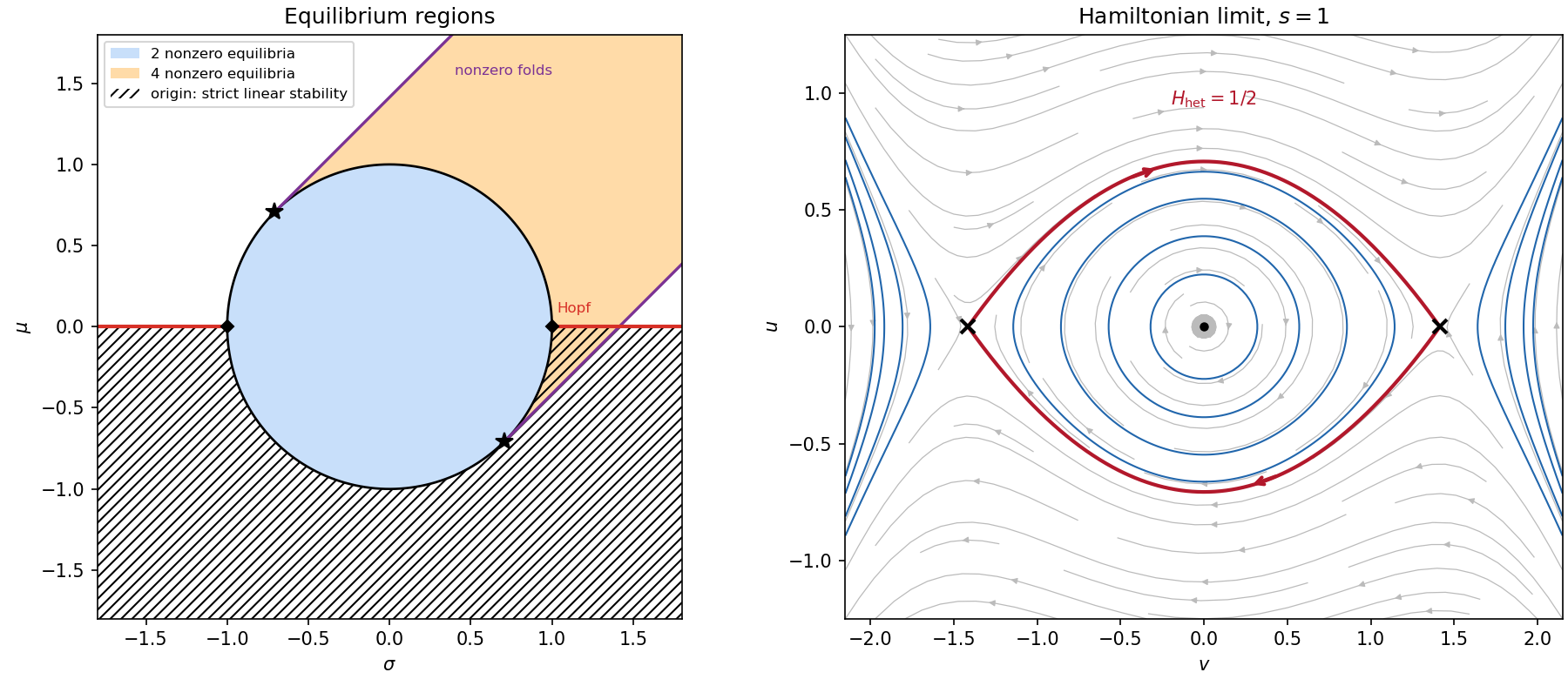
Origin stability, nonzero-equilibrium counts and the Hamiltonian separatrix of the cubic confinement model
. Details. 
At the origin's matrix is : it has a double zero eigenvalue and one eigenvector. Trace and determinant vary independently with and there, so two parameters are needed. The symmetry of an odd function removes quadratic terms, giving a reflection-symmetric cubic double-zero normal form. The quadratic nonlinearity required for a generic Bogdanov–Takens bifurcation vanishes.
Use a prime for differentiation with respect to the rescaled time. Direct substitution, with all rescaled variables written without tildes, givesAt , the equations are , . Fordifferentiation gives . This is the Hamiltonian blow-up of a reflection-symmetric double-zero point.
For , the equilibrium points are a centre equilibrium at and saddles at . The centre equilibrium has eigenvalues ; at either saddle equilibrium they are . Levels contain closed inner ovals around the centre equilibrium. The saddle equilibrium level hasThese two branches form a heteroclinic cycle connecting the saddles. The branch with runs from the lower saddle equilibrium to the upper one because ; the other runs back. Outside the potential well, trajectories are open. The right panel of the preceding figure uses the coordinates to display the well and these directed connections.
The rescaling resolves the small, nearby nonzero saddles while retaining the weak non-Hamiltonian terms. It allows the global stable manifold/unstable manifold connection to be studied as a perturbation of the explicit heteroclinic cycle, rather than searched for only in the original variables.
Differentiate the first integral using the first-order perturbation from part (c):On the positive unperturbed connecting branch, , soIntegrating the energy change from one saddle equilibrium to the other therefore givesThis is the heteroclinic Melnikov integral for a quartic Hamiltonian. It measures the first-order energy mismatch, equivalently the transverse splitting between the outgoing unstable manifold and the incoming stable manifold. A nonzero value means that the heteroclinic orbit has broken. A simple zero supplies the leading connection condition; smooth perturbation then shifts the curve by higher-order terms. The central inversion symmetry makes the two connections have the same condition, so both can be restored on one parameter curve.
For fixed , . The coefficient is affine in , has a unique simple zero, and changes sign across it. No explicit evaluation is necessary. Energy drift on the nearby closed Hamiltonian levels can similarly determine a periodic orbit and its stability; the cycle born at the supercritical Hopf bifurcation grows towards the separatrix and can terminate at this global bifurcation through a heteroclinic orbit. Translating the resulting balance curve back with , places it near the original double-zero point.
At a fixed point , the quadratic equation is . ConsequentlyThe Jacobian matrix is , and its Floquet multipliers solve . The Jury stability criterion requires and , . With , this becomes , . The lower branch never satisfies it; the upper branch is attracting precisely whenAt the lower boundary the two fixed points merge with Floquet multipliers , a saddle-node bifurcation for . At the upper boundary the upper point has Floquet multipliers , giving a generic period-doubling bifurcation for .
Its direction can be established explicitly. A distinct two-cycle alternates values satisfying , . Subtracting gives , and substitution givesIt exists beyond the fixed-point period-doubling bifurcation. The second-iterate Jacobian matrix has determinant and trace . Applying the same stability inequalities shows attraction for andThus the first period-doubling bifurcation is supercritical; the next upper boundary has a Floquet multiplier for the two-cycle. These are the fixed-point and two-cycle thresholds of the Hénon map.
At the map preserves phase-space area, so attraction is impossible. The fixed-point fold is at , with double Floquet multiplier , and is a conservative saddle-centre bifurcation. The upper branch is linearly elliptic for ; the lower branch is a saddle fixed point of a map. At , the upper branch has double Floquet multiplier and becomes a saddle fixed point of a map for larger . The two-cycle is elliptic for , then reaches double Floquet multiplier for the second iterate at . The partial sketch distinguishes elliptic, neutrally stable Floquet multipliers from attracting states. Resonances may require additional nonlinear analysis; unit Floquet multiplier moduli alone do not prove nonlinear Lyapunov stability.
The segment is a conservative Hénon stability boundary, not an ordinary nondegenerate dissipative Neimark–Sacker bifurcation. Indeed for constant phase-space area scaling is . A simple invariant closed curve would enclose a bounded invariant set of positive phase-space area, forcing . Thus no such closed invariant curve can bifurcate into within this constant-determinant family.
Generic folds and flips away from these degeneracies persist under sufficiently small smooth perturbations: their simple unit Floquet multiplier, transverse parameter crossing and nonzero leading nonlinear coefficient persist, while the other Floquet multiplier stays away from the unit circle. The implicit function theorem then continues the bifurcation curves and their criticality. The unqualified perturbation claim needs this restriction. Arbitrary perturbations need not preserve the conservative behavior. For example, in local complex coordinates at a nonresonant elliptic fixed point, the area-preserving map property gives a cubic normal form with zero cubic radial damping. Composing with the arbitrarily small radial perturbation introduces radial coefficient . Varying the modulus through one can now give a genuine Neimark–Sacker bifurcation. Conservative degeneracies and resonances are therefore not covered by a blanket structural-stability assertion.
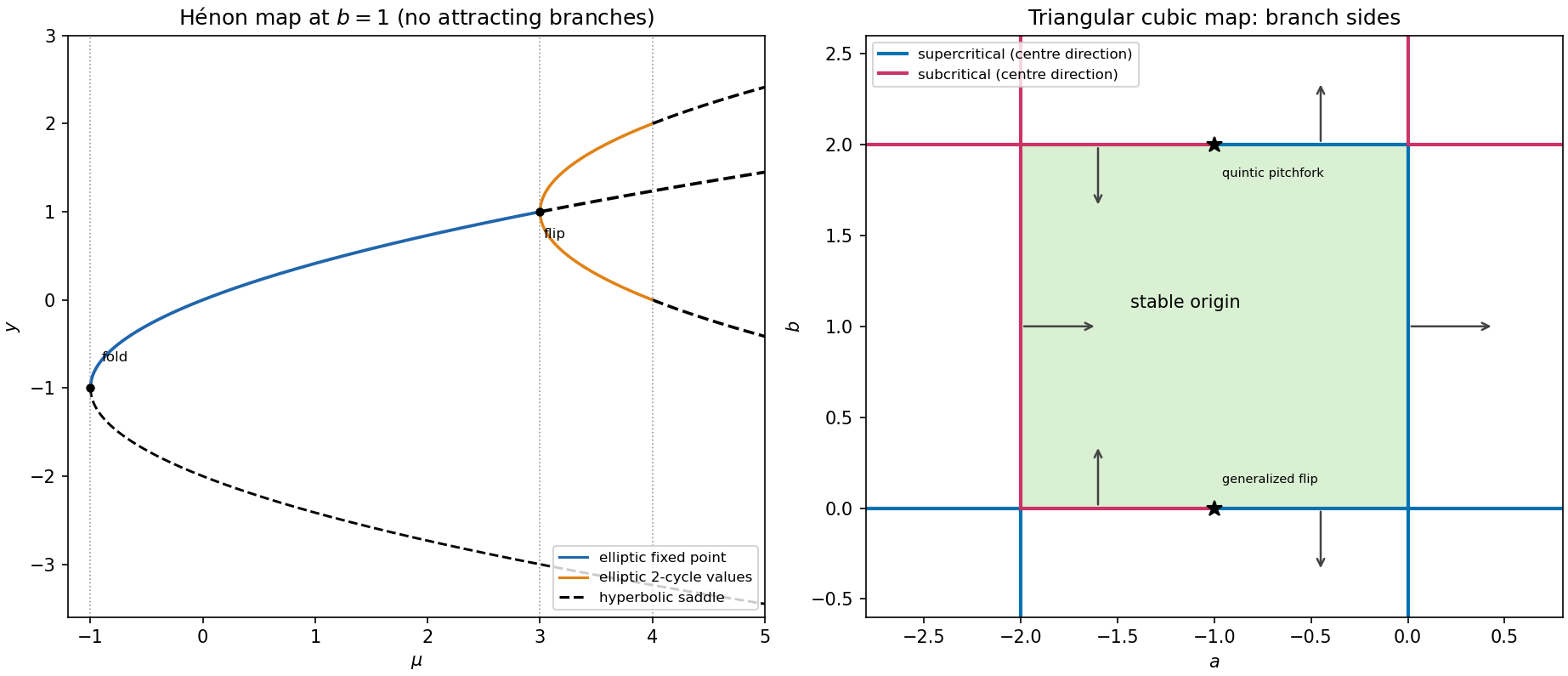
Hénon fixed points and two-cycles at unit area determinant, and local branches of the triangular cubic map
. Details. 
The origin's Jacobian matrix is triangular, , so its Floquet multipliers are , . It is attracting for , . The candidate codimension-one boundaries are , , , : respectively a or Floquet multiplier. No complex-pair crossing is possible at the origin.
The map is odd. To locate the nearby steady branches, write . The first fixed-point equation gives ; substituting into the second givesFor a symmetric two-cycle solve . Then andThese exact orbit equations for a triangular cubic map determine the amplitude and parameter side without confusing the original cubic coefficients with their centre manifold values.
On , with , steady states have and . The pitchfork bifurcation is supercritical for and subcritical for . Its centre manifold cubic coefficient is . In the stable-origin boundary segment , an attracting pair appears on .
On , with , the two-cycle has . The centre manifold map has cubic coefficient and Floquet multiplier . Since its unstable side is , the period-doubling bifurcation is supercritical for and subcritical for . In particular the boundary segment is subcritical: the nearby two-cycle lies on , where the origin is still attracting, and is unstable in the critical direction.
On , with , the steady branch hasIts scalar centre manifold map is . It is supercritical for , and subcritical for or . At the cubic vanishes: the exact equation gives , so this is a degenerate pitchfork bifurcation with destabilizing quintic coefficient and subcritical quartic amplitude scaling. It is not a generic point of the codimension-one curve.
On , with , put . The two-cycle satisfiesThe centre manifold map's cubic coefficient is . Thus the period-doubling bifurcation is subcritical for , and supercritical for or . In the stable-origin edge , a stable small two-cycle appears for . At the cubic vanishes, requiring the calculation below. All criticality labels concern the centre manifold direction; a bifurcating orbit is fully attracting only if the remaining Floquet multiplier is also stable. The sketch marks the small branches on the appropriate sides of each boundary of the stable-origin rectangle.
For clarity, these stability labels follow directly from one-dimensional derivatives. At a pitchfork bifurcation , the nonzero state has and Floquet multiplier to first order. At a period-doubling bifurcation , the symmetric cycle has and one-step derivative ; its two-step Floquet multiplier is . A supercritical branch lies on and is attracting in the centre manifold direction; a subcritical branch lies on and is repelling there.
At the Floquet multipliers are , so the degeneracy is not two simultaneous unit Floquet multipliers. On its centre manifold, and direct substitution gives . With small, the unfolding to leading weighted order isThis is a generalized flip bifurcation: one parameter crosses , and the other changes the cubic sign. Writing , its two-cycles obey . For a stable smaller two-cycle and an unstable larger two-cycle collide atThe intervening range contains both. For the period-doubling bifurcation is subcritical. At , the exact orbit equation is , so the unstable two-cycle exists for with . This proves both the codimension and the required quintic effect.
Write . The equilibrium points are a stable node and a saddle equilibrium , whose unstable and stable eigenvalues are and . The saddle equilibrium's local stable manifold is . When the right-going unstable separatrix returns at with , it lands exactly on that stable manifold, producing a homoclinic orbit of the saddle. Crossing this condition changes whether the returning trajectory is captured by the node or lies on the outgoing side of the saddle equilibrium.
Use an incoming section and outgoing section . For entry with , integrate the local flow:so the outgoing height isThe global excursion is smooth and transverse. Its return coordinate has expansion , with in these section orientations. Thus the local passage map near a dissipative saddle-node givesFor small , , hence and . If is small, the graph starts above the diagonal and, with slope less than one nearby, crosses it close to . More explicitly, , giving a unique small fixed point with Floquet multiplier . It corresponds to an attracting periodic orbit. For no such local crossing exists on ; the unstable branch returns to the node's side instead. The Poincaré return map panel shows this geometric fixed-point test.
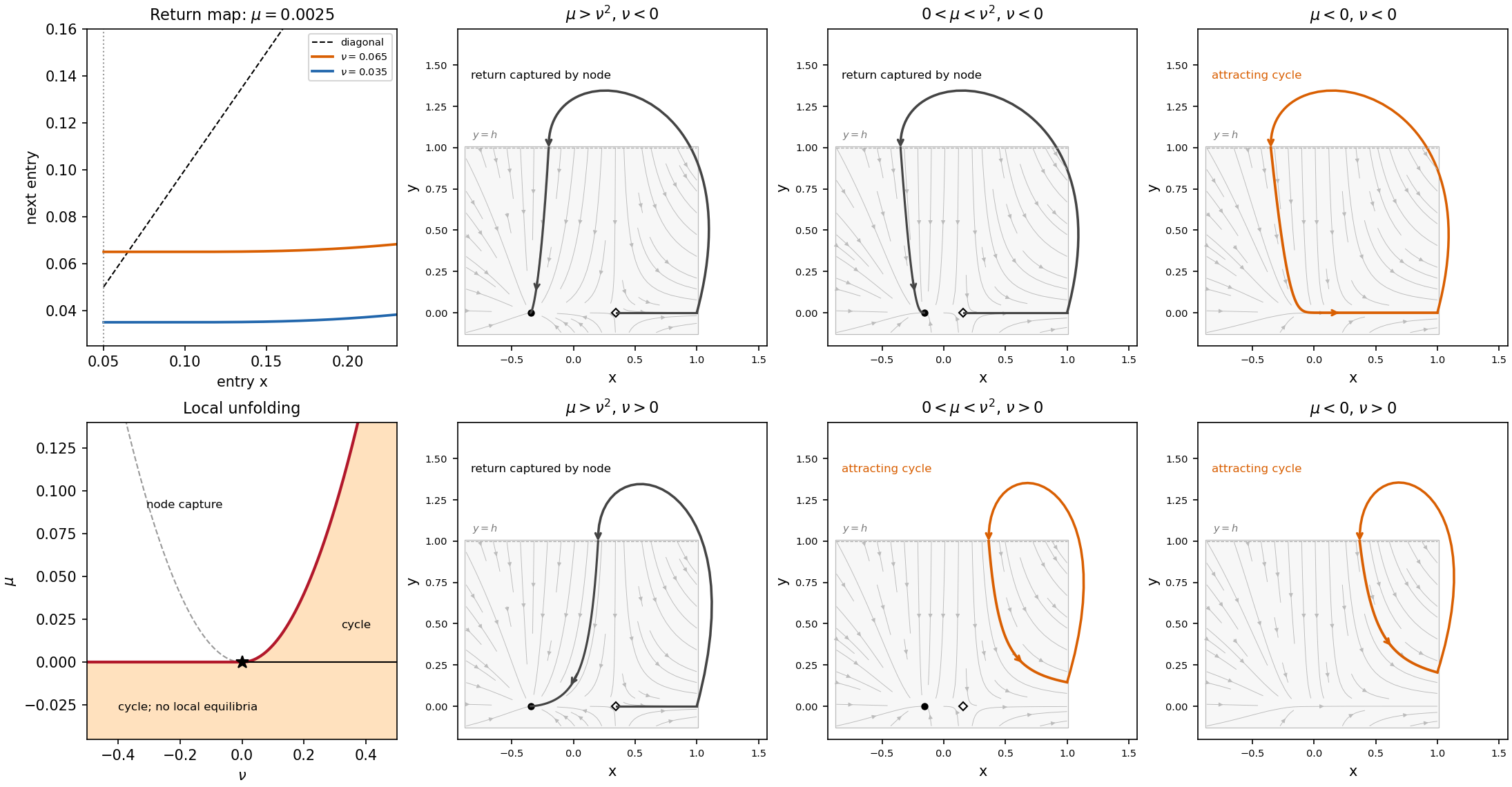
Local return map and six local phase portraits near a saddle-node separatrix-loop point; outer return arcs are schematic
. Details. 
For , put . There are no local equilibrium points and , so every incoming point passes through the local region. The same sections giveand again . The global return supplied by the problem closes the passage into a periodic orbit if this map has a fixed point.
Its derivative is strongly contracting: . To see the smallness uniformly near the codimension-two point, put and assume . The passage includes , on which , so . ConsequentlyFor a sufficiently small entry interval and all sufficiently small of either sign, maps the interval into itself and has derivative bounded strictly below one. The mean value theorem bounds differences by a factor strictly below one, while the endpoint signs of give existence of a fixed point. ThusHere “all ” means all return parameters in the neighborhood where the stated local/global construction applies, not arbitrarily distant global return geometries.
With and small negative , the returning trajectory enters to the left of the bottleneck, crosses the region around slowly, and exits to the right. Its height contracts towards throughout because . The local horizontal arrows point right everywhere. There is no equilibrium point; the schematic global excursion then returns the trajectory to the incoming section, giving the stable limit cycle shown in the negative-, negative- panel.
For fixed , the complete local bottleneck crossing takesThe actual entry coordinate is near a fixed negative . Replacing by that entry removes only a bounded time as , and the global excursion also takes bounded time. ThereforeThis is the inverse-square-root period law near a saddle-node bottleneck. The coefficient assumes fixed negative , or more generally . In a joint approach to the codimension-two point, the actual local time is , . If , the coefficient is instead; at entry it is . The fixed-negative- law is not uniform over all joint parameter paths.
For , the left equilibrium point is a stable node, the right equilibrium point a saddle equilibrium, and the saddle equilibrium's left unstable branch flows directly towards the node. The right branch takes the prescribed global excursion. Its landing relative to the two equilibrium points gives the six local portraits in the figure.
If , then for either sign of . The global branch lands between the equilibrium points and flows left into the node. There is no nearby Poincaré return map cycle, and the landing approaches the node from its right.
If and , the branch lands to the right of the saddle equilibrium. The contracting Poincaré return map has an attracting fixed point, giving a stable periodic orbit; the node also remains as a separate attractor with its own basin. If instead , the branch lands to the left of the node and approaches it from the left. There is no nearby periodic orbit in that case.
If , the two equilibrium points have vanished and a stable returning cycle exists for either sign of . For negative the cycle traverses the full bottleneck and has the divergent period in part (c). For fixed positive it enters to the right of the bottleneck; its local period approaches , so it need not diverge when . The outer arcs in the figure encode only the given return; the local equations do not specify the full vector field away from the origin.
The boundaries explain the codimension-two organization. On the saddle equilibrium has a homoclinic orbit. On , , the return passes through the semistable equilibrium point at a saddle-node bifurcation, producing a saddle-node bifurcation on an invariant circle. On , , the node and saddle equilibrium instead collide away from the persistent cycle. At , the returning separatrix hits the equilibrium point's strong stable manifold at the saddle-node bifurcation: this is the saddle-node separatrix-loop bifurcation. The curve changes which side of the node receives the returning orbit; unlike the positive branch, it is not a global bifurcation through a saddle homoclinic orbit.
At , the linear growth rate of a Fourier mode is . Its critical kernel of a linear map has . WriteFor a compatible periodic carrier, the slowly varying envelope is periodic on . Small carrier detuning can alternatively be included in the envelope wave phase.
With , and , all three terms , , first appear at . Balancing the time derivative thus requires . Since the linear growth rate near is , spatial detuning must be to contribute at the same order. ConsequentlyTreating independently, let on the fast carrier. Expansion of the linear operator givesThe term annihilates , since . At orders two through four there is no nonresonant forcing, and kernel of a linear map corrections can be absorbed into the definition of , allowing . At order five the equation for isThe fast operator is a self-adjoint operator on periodic functions. Its Fredholm alternative requires the right-hand side to have zero inner product with each kernel of a linear map mode , equivalently to have zero resonant Fourier coefficients. The coefficient of in is , and in it is . Therefore the solvability condition isThe conjugate condition supplies the same real equation for the negative mode. The remaining noncritical harmonics determine without obstruction. This is the cubic-quintic Swift–Hohenberg amplitude reduction; it retains quintic saturation because the small positive cubic coefficient makes the onset mildly subcritical.
Assume , as required for the subcritical case. The zero state exists for every . For a nonzero uniform real state, put . Its equilibrium point condition is , givingBoth are positive for . At , the lower branch reaches zero and the upper has . For only the upper branch is positive. Each positive represents real states , as well as their constant complex wave phase rotations.
The two nonzero branches merge atThe radial linearization is . It is negative on the upper branch and positive on the lower. The zero state is stable for and unstable for . Thus a subcritical pitchfork bifurcation branch leaves zero towards negative , and its fold connects to the stable finite-amplitude branch. Constant wave phase shifts are neutral for nonzero complex states; the stated attraction is in amplitude, with spatial wave phase perturbations damped except for that uniform symmetry mode.
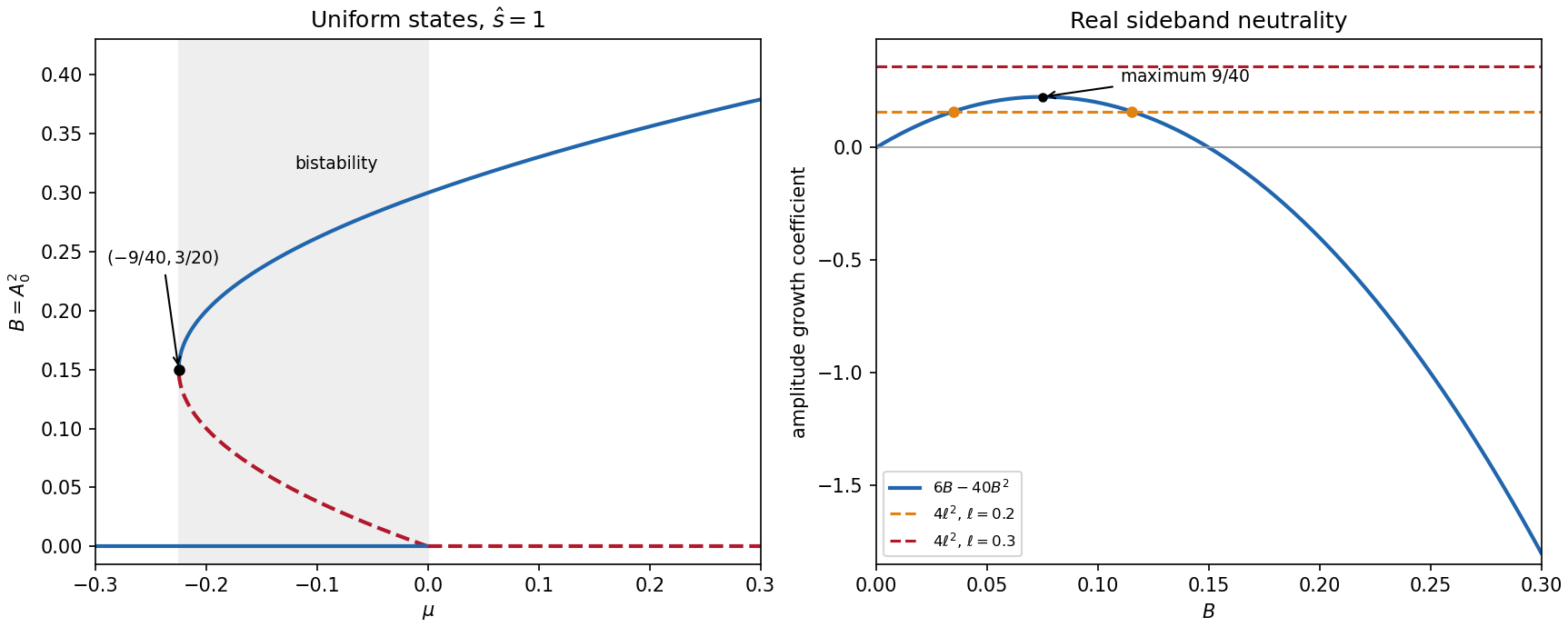
Uniform cubic-quintic amplitude branches and the maximum real-sideband growth coefficient
. Details. 
The linearized complex equation couples a perturbation and its conjugate, so a single complex Fourier mode by itself is not a closed perturbation ansatz. Equivalently use real amplitude and wave phase perturbations, with Fourier modes paired to make each real field. Writing and givesA real amplitude mode of slow wavenumber therefore becomes neutral whenFor a nonzero uniform state the equilibrium point condition eliminates , leaving amplitude growth . The wave phase mode growth is simply , so it cannot give a nonzero-wavenumber bifurcation from these undetuned states.
The concave quadratic has maximumThus a nonzero uniform state needs to have a modulation bifurcation. The slow domain length is , so . If its smallest positive wavenumber already exceeds this bound, none can become neutral. Since , the conclusion isThis is the modulation cutoff of a cubic-quintic uniform pattern. If the bound is reversed, candidate squared amplitudes are . They lie on the lower branch; the upper branch is already damped in amplitude and cannot undergo this stationary modulation bifurcation.
The word “nonzero” is necessary in the final claim. At , the equilibrium point exists independently of , and the mode growth is . It becomes neutral at for every finite domain. For example, take , : then , but the zero state has a first-sideband threshold at . Therefore the printed assertion, if read to include the trivial state, is false. The derived domain-size bound is the correct statement for nonzero pattern branches.
Articles by others on the same topic
There are currently no matching articles.