Multiply the first-order linear differential equation by the integrating factor . ThenIf in the remote past, then there. Integration from gives the necessary formulaWhen this integral exists and tends to zero as , differentiating verifies the equation and the past condition. Two such solutions differ by , which diverges at unless , proving uniqueness. This is the causal response of a first-order relaxation equation, a convolution with its decaying impulse response.
The phrase “general function” implicitly requires compatibility with the past condition: it does not guarantee existence for arbitrary . A sufficient condition is bounded forcing with as ; after setting , the integral is bounded by the supremum of before . For example, gives , so no solution has the stated past limit. Both forcings below vanish in the past and meet the intended causal condition, the impulse being interpreted distributionally.
Inserting the Dirac delta forcing into the integral gives the impulse responseIt is zero before the impulse and obeys the homogeneous equation afterward. Integrating the equation across zero gives , exactly the jump in this formula. Thus the formula also verifies the differential equation as a distribution; assigning a particular value at the jump does not affect that distribution.
For the Heaviside step function forcing, the integral begins at zero when :Before zero it vanishes. ThereforeThis causal response of a first-order relaxation equation is continuous at zero and approaches the new constant equilibrium exponentially.
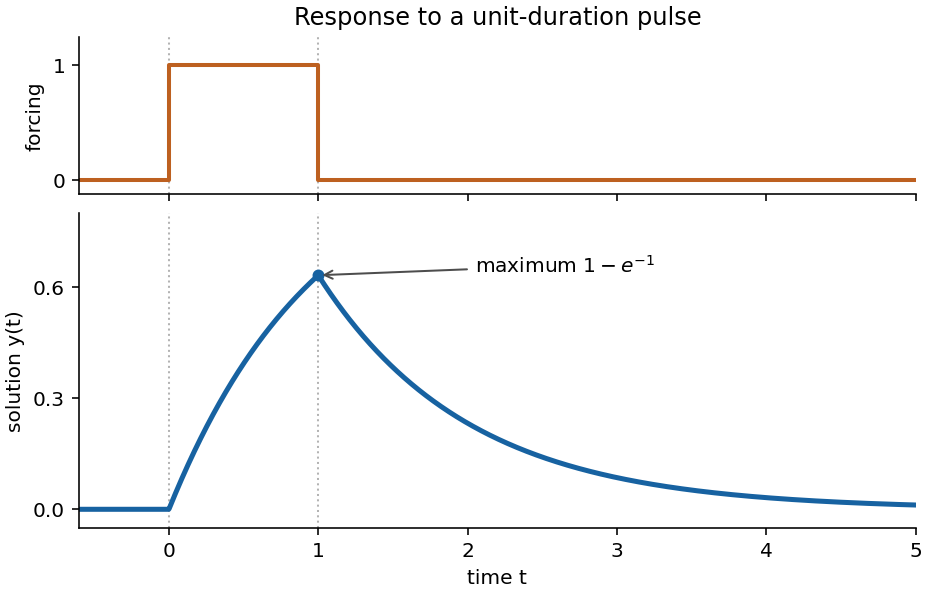
The forcing is a unit pulse on . For , the homogeneous equation and continuity with give . On , integration with gives . At the end of the pulse its value is , and the subsequent homogeneous decay must start at that value. ThusEquivalently it is the difference of two translated step responses, . The solution is continuous, rises concavely to its maximum at , and then decays exponentially to zero. Its derivative has jumps at the pulse edges; those are permitted because the right-hand side has step discontinuities.

Articles by others on the same topic
There are currently no matching articles.