Let be another complete orthonormal basis, and write . Orthonormality makes a unitary matrix, so . ThereforeThus the resolution of the identity is independent of the orthonormal basis. Equivalently, expanding any vector in the new complete basis shows that the sum of its orthogonal projections returns that vector.
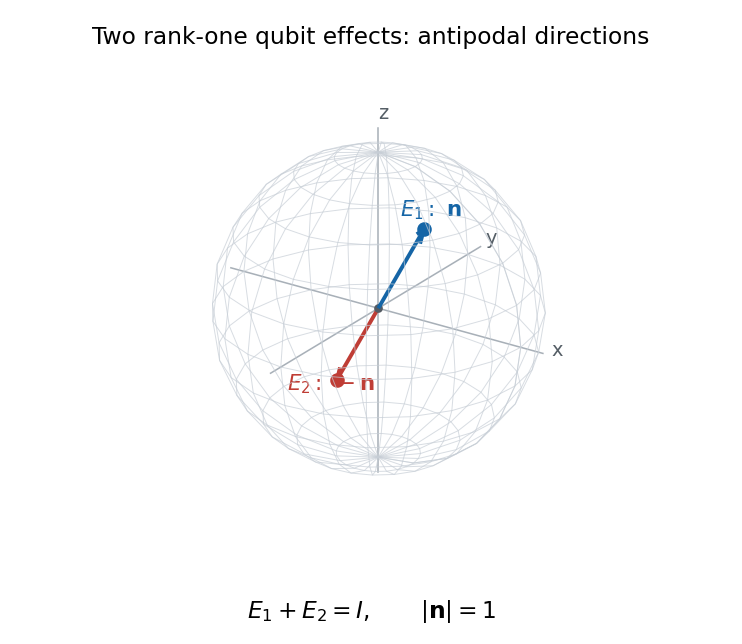
Normalize the vector defining the first effect and write . Since the two effects sum to , the eigenvalues of are along and on its orthogonal complement. For to have rank one, . Hence this binary rank-one qubit POVM is a projective measurement:The two Bloch vectors are antipodal on the Bloch sphere; the corresponding state vectors are orthogonal. The plot below chooses one representative unit vector. Rotating both directions gives every other case. The sphere represents the effect projectors' Bloch directions, rather than plotting their matrix entries.

A centre turns position into a displacement . If are a basis of the -dimensional vector space, every position has unique coordinatesThus linearly independent vectors are necessary and sufficient. Fewer vectors span a proper subspace and cannot represent arbitrary displacements. The coordinates use the field defining the space. For qubit tomography, the relevant parameter space is the real three-dimensional space of Bloch vectors, rather than the complex two-dimensional space of state amplitudes.
For one fixed POVM repeated on independently prepared copies, the Born rule gives outcome probabilities with one normalization constraint. An arbitrary mixed qubit density operator has three independent real parameters,The probability map is affine in . It can be injective on the full Bloch ball only if . If its rank is smaller, a nonzero undetected direction gives two nearby physical Bloch vectors with the same probabilities. Hence for an informationally complete POVM.
To attain this bound, take the four directionsThey are the vertices of a regular tetrahedron. The tetrahedral qubit POVM has effects , each positive and rank one, and . The observed probabilities areSince and , they recover the state byThis is the minimum for a single fixed measurement family. If the wording permits changing measurement settings between groups of copies, three binary projective measurements of the three Pauli observables also suffice, each with . That procedure is informationally complete three-observable qubit tomography, and it does not contradict the four-outcome bound for one fixed POVM. Tomography estimates probabilities statistically from many copies; a finite sample does not determine an arbitrary continuous state exactly.
Consider any POVM, not necessarily rank one, with two distinct reported outcomes intended to identify the two states. Its effects satisfy and ; equality holds for a two-outcome measurement. If , then positivity and completeness force . Taking a positive square root gives . Likewise, and imply , or .
Using Hermiticity,Thus perfect discrimination of pure states requires orthogonality, contradicting the proposed nonzero overlap. This proves perfect discrimination of pure states requires orthogonality for arbitrary generalized measurements. Measurements with an inconclusive outcome can sometimes identify nonorthogonal inputs unambiguously, but unambiguous quantum state discrimination has a nonzero failure probability and is not perfect deterministic discrimination.
Articles by others on the same topic
There are currently no matching articles.