Interpret as the ambient density: the PDF's phrase assigning it a “depth” is a typographical error. Take , and use a common reference density in inertia while retaining the density difference in buoyancy. This is the Boussinesq approximation, with reduced gravity . For the shallow water approximation, the lower-layer depth must be small compared with longitudinal variation scales, vertical accelerations must be negligible and pressure hydrostatic. The deep ambient is approximated as a hydrostatic pressure reservoir away from the nose; assume a uniform velocity over each lower-layer cross-section and neglect drag and entrainment.
Write the prismatic triangular area as with fixed , so the width at height is . The excess hydrostatic pressure force divided by reference density isThe prismatic-channel shallow water equations are thereforeFor positive depth, divide the first equation by and use it in the second to obtainThe coefficient matrix in variables is . Its two distinct real characteristic speeds areThus the system is strictly hyperbolic for and , though it degenerates at zero depth. Since , direct substitution in the two equations givesHence are the Riemann invariants conserved along their respective characteristic curves. The factor four, rather than the rectangular-channel factor two, comes from the triangular relation .
The layer equations describe long-wave adjustment behind the nose, but do not resolve the short region where the dense fluid pushes aside the ambient. A finite-height front cannot be determined by simply adjoining a vacuum solution of the one-layer momentum equation. The ambient pressure and turning flow provide additional nose physics.
In the nose frame, the material condition makes the adjacent current velocity equal to the front speed in the laboratory frame. The two interior characteristic speeds relative to that front are then : one characteristic brings information from the body and one brings a boundary condition from the nose. This is why a gravity-current front condition is needed. With a deep ambient, fixed channel shape and negligible viscosity, the local buoyancy depth supplies the velocity scale . A dimensionless closure therefore has the formwhere a constant is an idealization for a fixed geometry and chosen nose model. Dimensional analysis identifies the form but does not determine the coefficient.
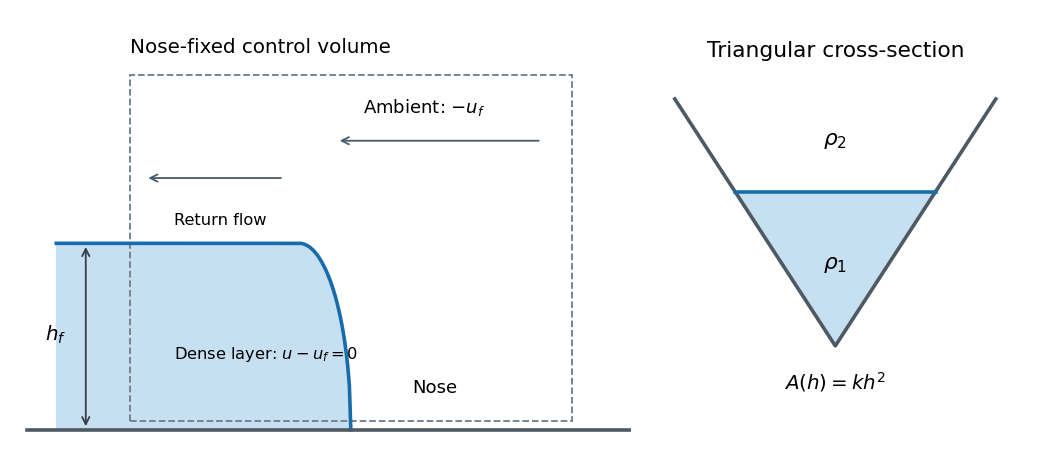
To determine an appropriate coefficient theoretically, take a control volume moving with the nose and bounded by sections far enough ahead and behind for hydrostatic pressure and approximately uniform section velocities to apply. Use the actual triangular wetted areas and integrated pressures. Conservation of fluid volume fixes the ambient return-flow velocities; integrated horizontal momentum balances the incoming and outgoing momentum fluxes against the pressure forces. A Bernoulli relation on an ambient streamline, with an explicit nose-loss assumption if needed, supplies the pressure or energy closure. The density-anomaly pressure contribution of the lower layer contains the integral derived above. Solving those balances gives and hence .
Alternatively, measured front speeds and consistently defined adjacent heights in a geometrically similar experiment can calibrate the closure. A rectangular-channel numerical coefficient must not be transferred to a triangular channel without checking those balances. The height definition and dissipative nose structure also matter; a primary study of gravity-current front conditions explains why different height conventions can lead to different inferred coefficients. No numerical value of is required for the following solution.
Let , as printed in the PDF. The converted TeX misrenders this expression. The undisturbed reservoir has , . The expansion fan moving into it is a simple wave with constant. On the other characteristic family, a self-similar fan satisfiesSolving these two equations givesThe fan begins at , where it matches the initially resting reservoir.
At the front, write . The nose closure is and the invariant gives . ThereforeA uniform region of this state connects the right edge of the fan, , to the advancing front . Its width is . The complete lower-layer solution for isandAhead of the front there is no lower-layer current, so its velocity is not a physical variable there. Both transitions inside the current are continuous; the finite-height nose is closed by the ambient-front condition, not by an unsupported vacuum jump. These formulas give the front-regularized triangular-channel dam break for any specified positive constant .
Initially the same expansion fan and constant-speed front apply. Its left edge reaches the closed rear wall at . After that, the infinite-reservoir solution would give a nonzero velocity at the wall and violates the no-through-flow condition. A reflected disturbance adjusts the interior while the finite initial volume is progressively spread over a longer, shallower current.
The nose does not respond instantaneously when the fan reaches the wall. Its first return signal follows a characteristic from through the undisturbed fan. There , so integrating givesIt reaches the uniform nose-adjacent region at , where . Crossing that region at speed , it catches the front at . Thus the initial nose remains uninformed about the rear wall until this return time. Subsequently its speed must adjust rather than remain constant indefinitely.
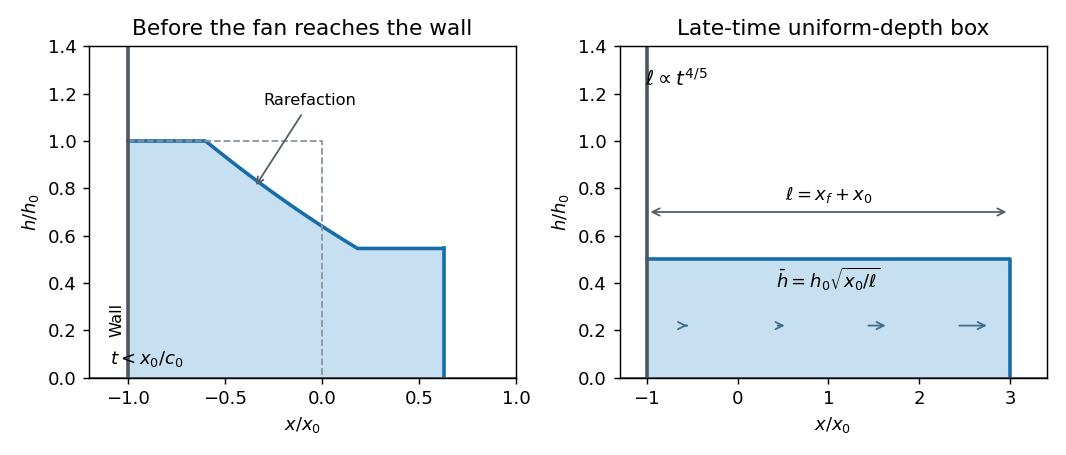


For late times use a prismatic triangular-channel gravity-current box model with uniform representative depth over length . The initial volume is . With no entrainment or loss,Apply the same front closure using that representative depth:Starting from a matching late-time state , integration gives finite-volume inertial spreading in a triangular channel:Hence , and the nose speed decays like . A simple initialized box approximation can instead set and , but it then deliberately replaces the exact early rarefaction rather than reproducing it.
The box's volume equation is compatible with a velocity increasing linearly from zero at the rear wall to the nose speed: . A flat-depth box with this velocity is not an exact solution of the full momentum equation during deceleration. It is an integral approximation that leaves the interior shape and nose dynamics unresolved while predicting late-time bulk scaling.
Articles by others on the same topic
There are currently no matching articles.