The layer equations describe long-wave adjustment behind the nose, but do not resolve the short region where the dense fluid pushes aside the ambient. A finite-height front cannot be determined by simply adjoining a vacuum solution of the one-layer momentum equation. The ambient pressure and turning flow provide additional nose physics.
In the nose frame, the material condition makes the adjacent current velocity equal to the front speed in the laboratory frame. The two interior characteristic speeds relative to that front are then : one characteristic brings information from the body and one brings a boundary condition from the nose. This is why a gravity-current front condition is needed. With a deep ambient, fixed channel shape and negligible viscosity, the local buoyancy depth supplies the velocity scale . A dimensionless closure therefore has the formwhere a constant is an idealization for a fixed geometry and chosen nose model. Dimensional analysis identifies the form but does not determine the coefficient.
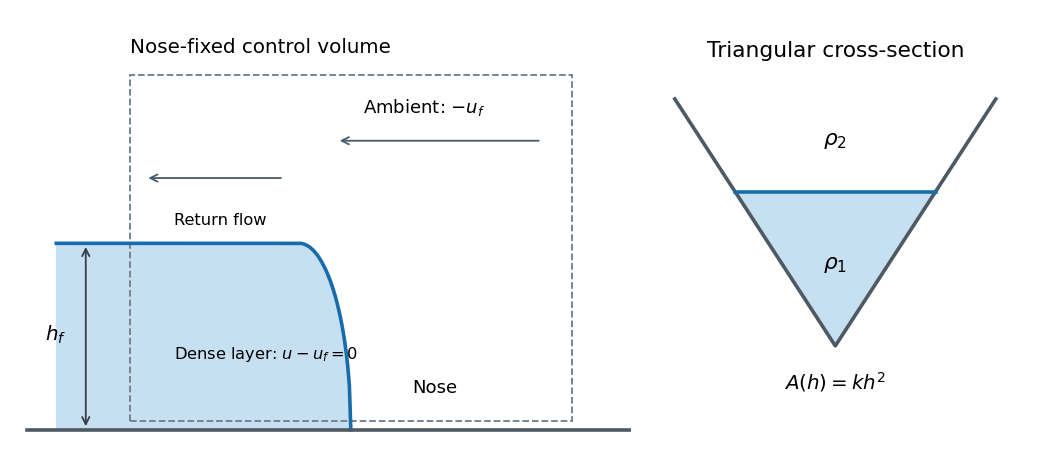

To determine an appropriate coefficient theoretically, take a control volume moving with the nose and bounded by sections far enough ahead and behind for hydrostatic pressure and approximately uniform section velocities to apply. Use the actual triangular wetted areas and integrated pressures. Conservation of fluid volume fixes the ambient return-flow velocities; integrated horizontal momentum balances the incoming and outgoing momentum fluxes against the pressure forces. A Bernoulli relation on an ambient streamline, with an explicit nose-loss assumption if needed, supplies the pressure or energy closure. The density-anomaly pressure contribution of the lower layer contains the integral derived above. Solving those balances gives and hence .
Alternatively, measured front speeds and consistently defined adjacent heights in a geometrically similar experiment can calibrate the closure. A rectangular-channel numerical coefficient must not be transferred to a triangular channel without checking those balances. The height definition and dissipative nose structure also matter; a primary study of gravity-current front conditions explains why different height conventions can lead to different inferred coefficients. No numerical value of is required for the following solution.
Articles by others on the same topic
There are currently no matching articles.