Assume an axisymmetric, geometrically thin disc in a fixed Keplerian rotation field, neglecting the disk's self-gravity. Write positive outwards and letThe ring supplies the local specific angular momentum. Its source per unit area iswhere the Dirac delta function is normalized so that . Define the positive outward viscous torque in an accretion disk byThe height-integrated conservation of mass and conservation of angular momentum equations areSubtract times the mass equation. Since is time-independent, this givesThe last term is zero as a distribution, because the source is supported where . Since , substituting the torque givesInserting this into the mass equation proves the Keplerian disk evolution with a ring source:The viscosity may be a prescribed function or a function of the local disk state; the conservation derivation is the same.
To track signs in the steady problem, define the inward mass fluxThen . Away from the source is constant, with on the inner side and on the outer side, where both loss rates are positive. Integrating through the source gives . Therefore
The outward angular momentum flux is . The steady angular-momentum equation gives . At the two torque-free boundaries its values are and . Integrating across the disk therefore yieldsEliminate and use . The two-boundary mass split of a ring-fed disk isThe complementary outward fraction is . Both fractions lie between zero and one for a source strictly between the boundaries.
As a local check, integrating the steady mass flux from each zero-torque boundary givesContinuity of this quantity at gives the same split. The split depends on boundary and source angular momenta, rather than on the detailed viscosity law.
Use a characteristic midplane temperature , density and disk scale height . For an ideal gas of fixed composition, dominant gas pressure gives , where is the sound speed. Vertical hydrostatic equilibrium and the alpha disk prescription giveNumerical factors in the vertical averaging do not affect the exponents. The stipulated opacity becomesFor an optically thick, radiatively efficient disk, radiative diffusion gives a cooling rate per unit area proportional to . The viscous heating rate is proportional to . ThusEquating heating and cooling gives , soAt fixed and central mass, . Therefore the gas-pressure alpha disk with inverse-density opacity satisfies
For thermal stability of an accretion disk, perturb at fixed and , since the thermal adjustment is faster than radial mass redistribution. The logarithmic heating and cooling slopes are respectively one and two. At equilibrium, a fractional temperature increase therefore makes the excess heating decrease, and the disk cools back. Thus the local thermal equilibrium is stable within the assumed gas-pressure, radiative-diffusion closure.
For viscous stability of an accretion disk, use the thermally equilibrated relation between viscosity and surface density. It givesLocally freezing the background radius in the Keplerian viscous diffusion equation, a short radial Fourier mode has growth rate . Density enhancements diffuse rather than grow, so the disk is locally viscously stable as well.
This part uses source-free viscous evolution of an accretion disk. Put and . The prescribed kinematic viscosity then becomesso . Since , the Keplerian viscous diffusion equation givesCanceling the prefactor and setting proves
Use the similarity ansatz with . Derivatives at fixed giveOn the branch , substitute . The two expressions reduce toEquality of the constant coefficients requires , and then the other coefficients agree as well.
The physical compact self-similar disk with square-root density viscosity uses this branch up to its outer edge and vacuum beyond it:Here is the positive part. The cutoff matters: beyond , the untruncated squared expression would have , and its right-hand side would no longer be the polynomial used above. At the moving edge, vanishes quadratically and vanishes cubically. The latter and its first derivative match the vacuum values continuously, so joining to zero creates no distributional mass-flux source. The joined profile satisfies the equation, including in the weak sense at the edge.
Returning to the surface density gives the explicit resultwith for . Thus the outer edge is and moves linearly in physical time, with speed . The density decreases monotonically with radius, has an integrable central cusp, and drops quadratically to zero at the outer edge. The formal origin boundary has zero viscous torque in an accretion disk, because there, even though the surface density diverges.
To characterize the spreading, let and integrate in . The disk mass and angular momentum areThe mass decreases while the angular momentum remains constant: matter accretes at the origin and the remaining disk spreads outward. More explicitly, with , the inward mass flux isIt is inward for and outward for . The dividing radius is , and the origin flux equals . The outer edge carries no flux beyond itself. This family is a self-similar accreting disk with finite mass at each positive time, rather than a regular finite-mass initial profile at .
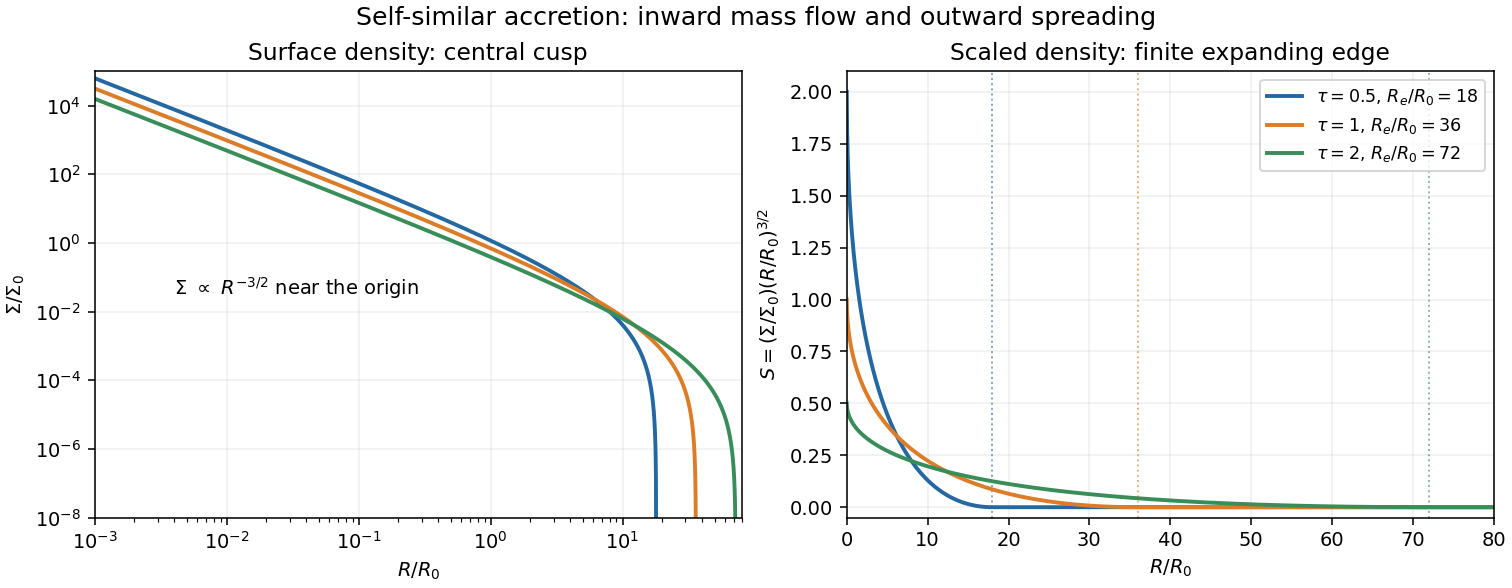
Surface density and scaled surface density of the compact self-similar accretion disc at three times
. Details. 
Each annulus has a torque proportional to , so its scalar product with is zero. Summing over annuli preserves this property even when the proportionality coefficient varies with radius. Therefore for the total torque due to Lense-Thirring precession.
The torque specified is the torque on the disk. Assuming a closed disk-plus-hole angular-momentum budget with no external torque, its reaction on the black hole has the opposite sign:Thus . The term describes precession, because it is perpendicular to both spins. Since , the hole precesses about the fixed total vector. The term changes the spin directions dissipatively. Writing for the disk component perpendicular to the hole, the vector triple product identity givesA positive removes this component from the disk and transfers it into the hole's changing direction. This is black-hole and disk alignment under internal torque.
Now differentiate the scalar product with the conserved total vector. The precession term contributes zero, and the vector triple product identity givesAlso , so constancy of givesFinally, is constant. Differentiating provesThus the disk's spin magnitude decreases while the hole's magnitude is fixed; their vector sum remains fixed as well.
For the alignment conclusion, assume and let . Since ,For a noncollinear initial state, , this integrates exactly toConsequently a fixed positive , or more generally a positive coefficient of divergent integrated strength, gives . In this persistent dissipative evolution, : the hole aligns asymptotically with the total angular momentum. The exactly antiparallel configuration is a stationary, nongeneric exception; when there is no total-vector direction to align with.
If the phrase allows arbitrary time dependence, positivity alone does not logically force complete eventual alignment. The persistent-torque criterion for asymptotic spin alignment is the needed qualification. For example, take , , and . The same torque equations give , with limit . The final configurations below use the intended persistent-torque regime, including constant positive .
Once the hole has aligned, conservation of angular momentum fixes the disk without any additional torque calculation:The disk and hole therefore finish parallel only if . If , they finish antiparallel: this is counteralignment of a black hole and accretion disk. In terms of the initial disk-hole angle , squaring shows that counteralignment occurs whenIf , the final disk angular momentum vanishes and has no spin direction. Thus alignment of the hole with the total vector does not imply alignment of both component spins.
The conserved total angular momentum is , and the black-hole spin magnitude isThe initial hole is noncollinear with the total vector, so persistent positive alignment torque leads to the positive direction. The final vectors areThe final disk magnitude is , smaller than its initial magnitude one, and its direction is parallel to the hole. Their sum remains .
Here the conserved total angular momentum is , while the black-hole spin magnitude remains . The hole again aligns with the positive direction in the persistent-torque regime. ThusSince , the disk points in the negative direction and has magnitude . This realizes counteralignment of a black hole and accretion disk even though the hole itself is aligned with the conserved total vector. The black hole and disk do not always finish with aligned spins.
Articles by others on the same topic
There are currently no matching articles.