Write , and let denote a matrix unit. The diagonal Cartan subalgebra consists ofFor a diagonal matrix, . Substituting into the symplectic relation shows that the following are root vectors:The zero weight space is spanned by . The symplectic equation pairs the remaining entries exactly as in this table; the displayed vectors and the are independent and span the algebra. This proves the root-space decompositionThere are roots of a root system, each with one-dimensional root space, giving .
The upper triangular root vectors select preciselyThe simple roots of this Cn root system areIndeed, the positive roots of a root system have expansionsThese expansions also identify the highest root:Normalize the coordinate inner product by . The simple coroots are for and . Solving gives the fundamental weightsIn the sum of the positive roots of a root system, the pair contributes , and the long root contributes another . Therefore the Weyl vector isThese are the Positive-root data for Cn.
For , the finite Dynkin diagram is a chain of vertices. The bonds between and for are single. The last bond is double, with its arrow pointing from the long root toward the short root . For the Extended Dynkin diagram, add at the other end, doubly bonded to , with arrow toward . The following Cn Dynkin diagrams include both ends and the low-rank cases.
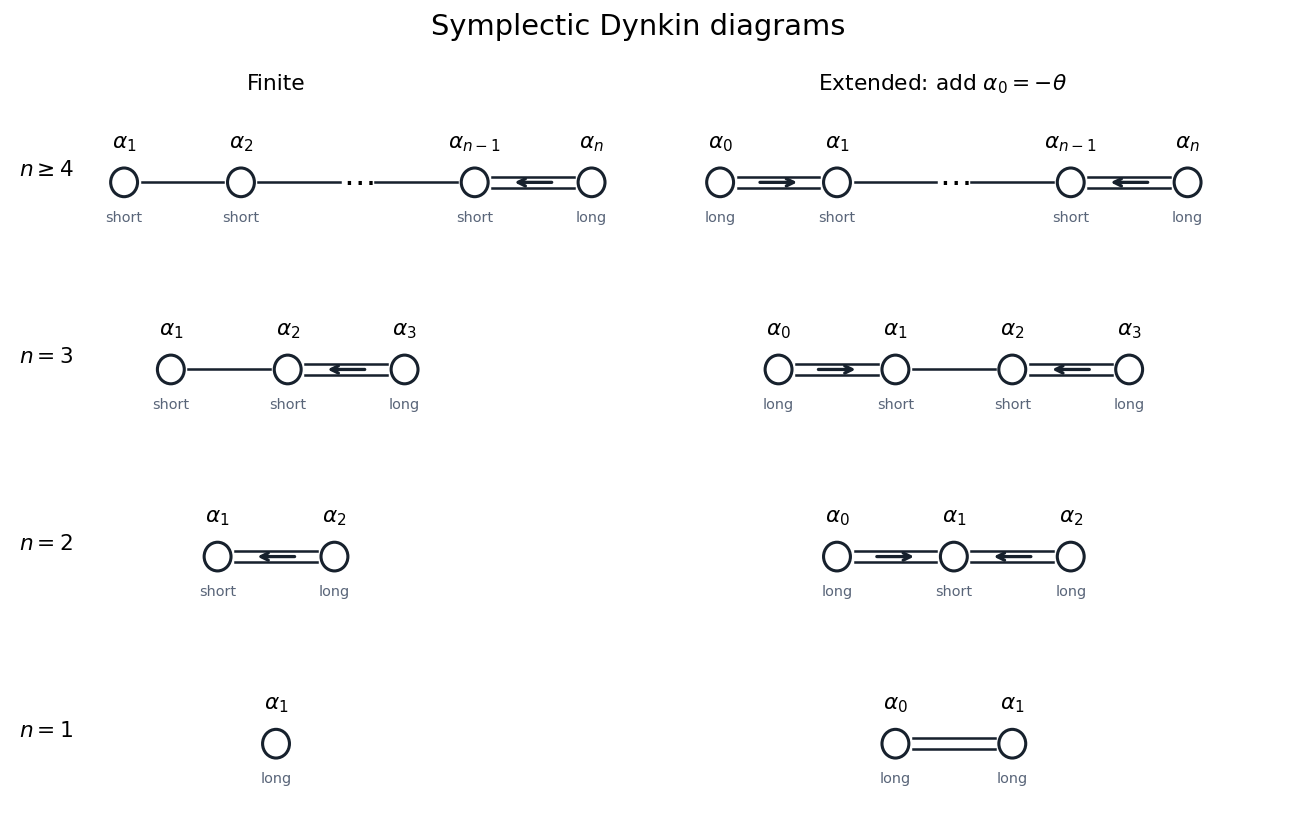
Finite and extended Cn Dynkin diagrams with arrows toward the short roots and separate rank-one and rank-two cases
. Details. 
At , there is just the root and one finite vertex. The affine Cartan matrix is ; its two vertices have equal root length, so the double bond has no arrow.
Let be a four-dimensional symplectic vector space, with a symplectic basis . Its invariant inverse-form bivector may be chosen as . Put , so . Define a symmetric bilinear form on the six-dimensional exterior square byIt is symmetric because both factors have degree two. It is nondegenerate: in the six-element wedge basis, every pairs nontrivially with the wedge of the complementary pair and with no other basis vector. Since , the orthogonal complementhas dimension five and inherits a nondegenerate bilinear form. It is the primitive exterior square, equivalently the kernel of the symplectic contraction of an exterior square.
The symplectic Lie algebra preserves . It also preserves , since its elements have trace zero and the induced action on is multiplication by that trace. The exterior-power Lie algebra representation therefore preserves and , giving a Lie algebra homomorphismTo show injectivity, suppose acts as zero on . It already acts as zero on the invariant line , so it kills all of . For any basis , this meansIf , choose distinct from ; the coefficient of forces . Thus is diagonal. The same identity gives for every pair. Applying this to three distinct indices forces each diagonal entry to vanish. Hence and is injective.
Finally and . Injectivity between these equal-dimensional vector spaces gives surjectivity. Every nondegenerate complex symmetric bilinear form on a five-dimensional space is equivalent to the standard one. We have therefore constructed the exceptional isomorphism between sp4 and so5:
Identify the Cartan subalgebra with the coordinate space used above. The root reflection in any root of a root system fixes the perpendicular hyperplane. For every root of the Cn root system, its complete coordinate action isEvery unlisted coordinate is fixed, and changing the sign of the root leaves its reflection unchanged. These formulas follow directly from , with the coroot regarded as a vector of the Cartan subalgebra.
The Cn Weyl group is the signed symmetric group: its elements permute the coordinates and independently change their signs. The Weyl reflections associated with the simple roots interchange consecutive coordinates for and negate the last coordinate for . Thus
Use the ordered alphabetwith weights and . The crystal of the defining symplectic representation is the chainThe label of an arrow is its simple root color; a Kashiwara operator follows an arrow of color and lowers the weight by .
Here is a grid description of the entire tensor product of crystals, valid for every . Put one vertex at row and column , in the alphabet order above. Let be the set of chain positions with outgoing color , and the positions with incoming color :Their indicators are and . Use the crystal tensor-product ruleAn arrow is omitted if the selected factor has no outgoing arrow of that color. Thus the complete grid has a downward color- arrow when and , and a rightward color- arrow when and . There are no other arrows. These two coordinate rules specify every vertex and every edge of the requested general-rank drawing. The following figure displays the full grid at , including all components, together with the standard chain; increasing uses exactly the same grid construction.
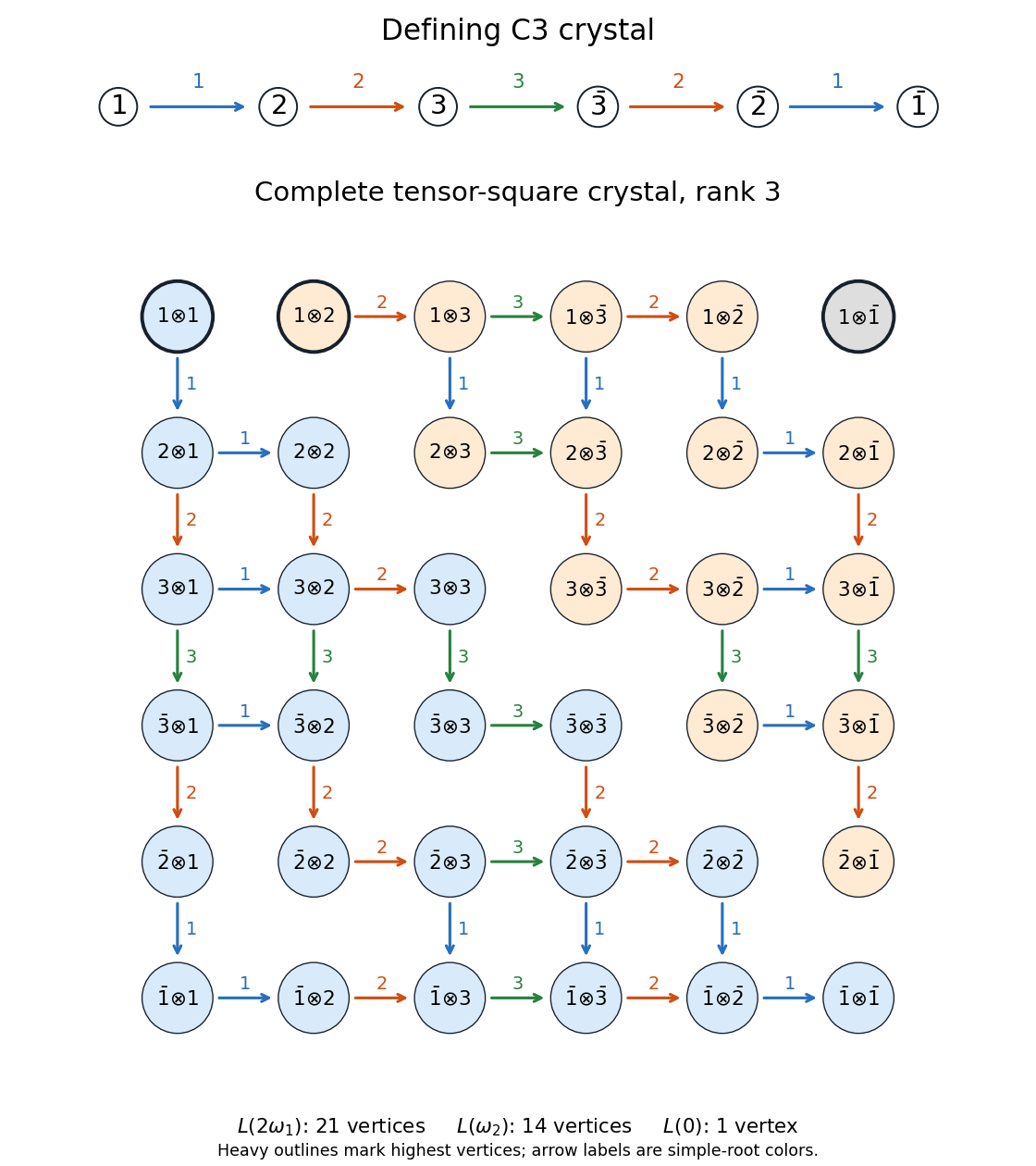
Defining C3 crystal and its complete tensor-square crystal with all colored arrows and the three highest-weight components
. Details. 
For completeness, highest vertices can be read from the raising rule, which selects the first factor when . If has an incoming edge of color , then ; either the raising operator acts nontrivially on , or and it acts nontrivially on . Thus a highest vertex must have . At , all vanish except . To be highest, the incoming color of , if any, must consequently be . For , the possibilities are exactlyTheir weights are , , and zero. Each occurs once. Connected highest-weight components of the crystal basis describe the irreducible representations in the tensor product of Lie algebra representations, soThis is the tensor-square decomposition of the defining symplectic representation. The symmetric square is ; the exterior square is the direct sum of its invariant inverse-form line and the primitive exterior square . Their dimensions are respectively , , and one, summing to . At , the chain has two vertices and the highest tensor vertices are only and : the decomposition is , of dimensions three and one.
Articles by others on the same topic
There are currently no matching articles.