First consider finite-dimensional Lie algebra representations. The operators representing an abelian Lie algebra commute. They have a common eigenvector: take an eigenspace for the first operator of a basis of the algebra, observe that every remaining operator preserves it, and repeat inside this nonzero space. The resulting line is an invariant subspace, so an irreducible representation must be one-dimensional. Its action has the form for a linear functional . Conversely, every such functional defines a Lie algebra representation, since both the Lie brackets in the algebra and the commutators of its scalar operators vanish. Distinct functionals give nonisomorphic representations. Thus the irreducibles are precisely the characters .
Even without a finite-dimensional assumption on the module, this conclusion for a finite-dimensional abelian Lie algebra follows from the Weak Hilbert Nullstellensatz: its universal enveloping algebra is the polynomial algebra . A simple module over a commutative algebra is its quotient by a maximal ideal, and every maximal ideal of this polynomial algebra over has residue field .
Indecomposable does not imply irreducible. For the one-dimensional abelian Lie algebra , let act on by the Nilpotent Jordan blockThe line spanned by the first coordinate vector is an invariant subspace, so the module is reducible. If it were a direct sum of two nonzero submodules, both would have dimension one; nilpotence would force to act as zero on both, contrary to . Thus it is an indecomposable representation.
For a finite-dimensional module , put and define its generalized weight spaces intrinsically byTo obtain the decomposition, choose a basis of , split into generalized eigenspaces of , and successively split each piece by . All the pieces are submodules because the acting operators commute. On one resulting piece, has a unique eigenvalue . The commuting operators can be simultaneously upper triangularized by repeating the common-eigenvector argument on quotients. Hence on this piece every is strictly upper triangular. Any linear combination is also strictly upper triangular, and its th power vanishes. Extending linearly therefore identifies the piece with . Different tuples give disjoint pieces; if a component has a different tuple from , at least one is invertible there. Consequentlywith only finitely many nonzero summands. Since the definition uses every rather than a chosen basis, this generalized-weight decomposition for a nilpotent Lie algebra is canonical. Its summands need not be irreducible, as the Jordan block example already shows.
The derived series of a Lie algebra isThe algebra is a solvable Lie algebra if for some . Here a bracket of subspaces means the linear span of their Lie brackets.
The Lie theorem states that a nonzero finite-dimensional representation of a complex solvable Lie algebra has a common eigenvector; equivalently, its operators can be simultaneously upper triangularized. Applied to an Irreducible Lie algebra representation, the common eigenvector gives a nonzero invariant line, which must be the entire module. A scalar action respects the Lie bracket exactly when . Thus, in the finite-dimensional setting,Every functional displayed gives a one-dimensional irreducible, and two such modules are isomorphic exactly when their functionals agree.
The finite-dimensional qualification is essential here, although the printed wording does not repeat it. For example, let and act on by and . These operators satisfy . A nonzero submodule stable under is an ideal . Stability under forces , so the two polynomials, having the same degree and leading coefficient, are equal. In characteristic zero a polynomial invariant under a nonzero shift is constant. The module is therefore an infinite-dimensional simple module for the two-dimensional affine Lie algebra. It rules out extending the one-dimensional classification to unrestricted representations.
Let be the given invariant bilinear form on a Lie algebra. Choose a basis and its -dual basis , so . The Casimir element isThe tensor is the inverse tensor of , so it is independent of the chosen basis. Multiplication in the universal enveloping algebra therefore makes independent of that choice as well.
For , write . Invariance means , whence . Thereforeby interchanging in the second sum. Since generates its universal enveloping algebra, is central. This argument does not require adding a symmetry assumption to the given bilinear form.
For the sl2 Lie algebra, takeThe cyclic identity for the trace gives . The form is nondegenerate, since , , and all the other pairings except are zero. The dual of is , soBy the classification of finite-dimensional sl2 representations, an irreducible of dimension has a highest-weight vector with and , where . Since , one obtainsCentrality and the Schur lemma then give the answer on the entire representation:This Casimir eigenvalue for sl2 depends on normalization. Choosing the Killing form instead, , scales the dual basis and the Casimir element by , giving .
Write , and let denote a matrix unit. The diagonal Cartan subalgebra consists ofFor a diagonal matrix, . Substituting into the symplectic relation shows that the following are root vectors:The zero weight space is spanned by . The symplectic equation pairs the remaining entries exactly as in this table; the displayed vectors and the are independent and span the algebra. This proves the root-space decompositionThere are roots of a root system, each with one-dimensional root space, giving .
The upper triangular root vectors select preciselyThe simple roots of this Cn root system areIndeed, the positive roots of a root system have expansionsThese expansions also identify the highest root:Normalize the coordinate inner product by . The simple coroots are for and . Solving gives the fundamental weightsIn the sum of the positive roots of a root system, the pair contributes , and the long root contributes another . Therefore the Weyl vector isThese are the Positive-root data for Cn.
For , the finite Dynkin diagram is a chain of vertices. The bonds between and for are single. The last bond is double, with its arrow pointing from the long root toward the short root . For the Extended Dynkin diagram, add at the other end, doubly bonded to , with arrow toward . The following Cn Dynkin diagrams include both ends and the low-rank cases.
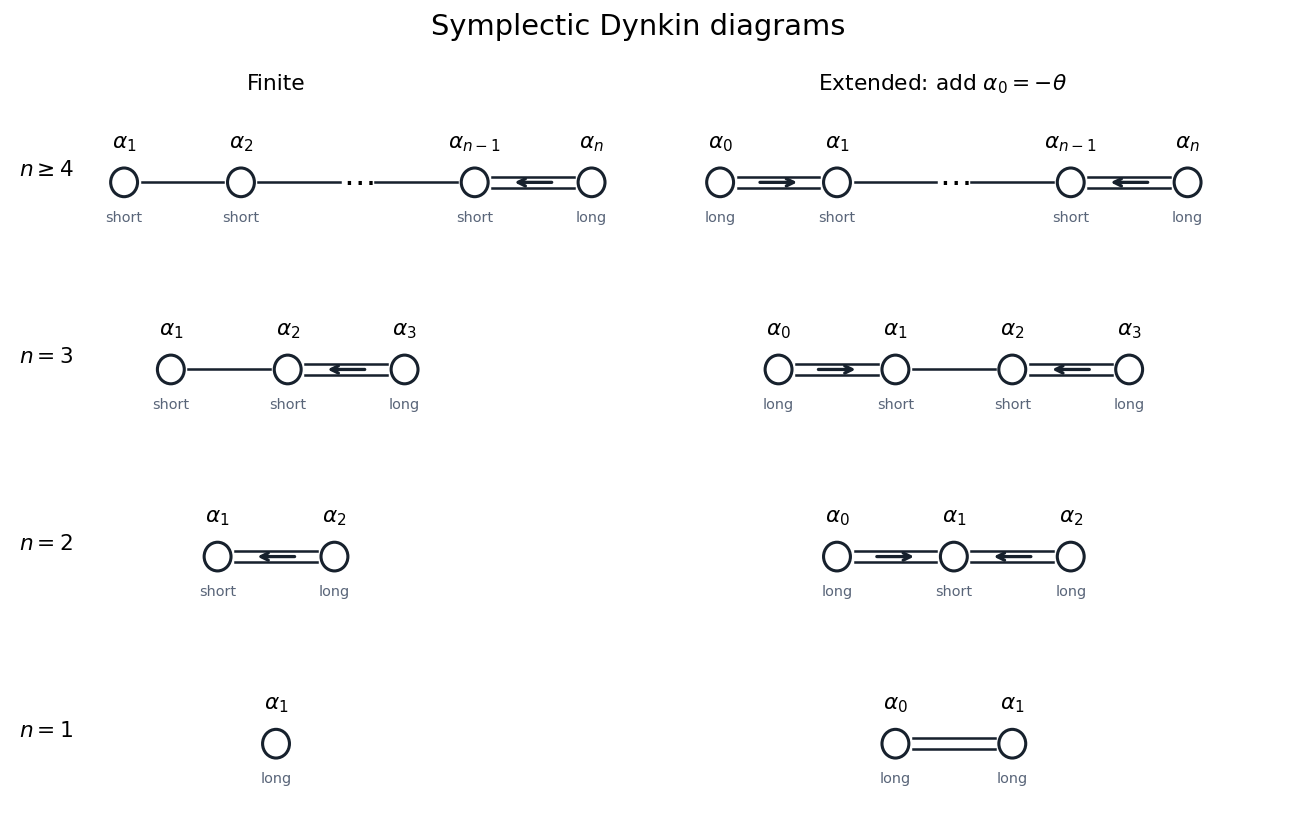
Finite and extended Cn Dynkin diagrams with arrows toward the short roots and separate rank-one and rank-two cases
. Details. 
At , there is just the root and one finite vertex. The affine Cartan matrix is ; its two vertices have equal root length, so the double bond has no arrow.
Let be a four-dimensional symplectic vector space, with a symplectic basis . Its invariant inverse-form bivector may be chosen as . Put , so . Define a symmetric bilinear form on the six-dimensional exterior square byIt is symmetric because both factors have degree two. It is nondegenerate: in the six-element wedge basis, every pairs nontrivially with the wedge of the complementary pair and with no other basis vector. Since , the orthogonal complementhas dimension five and inherits a nondegenerate bilinear form. It is the primitive exterior square, equivalently the kernel of the symplectic contraction of an exterior square.
The symplectic Lie algebra preserves . It also preserves , since its elements have trace zero and the induced action on is multiplication by that trace. The exterior-power Lie algebra representation therefore preserves and , giving a Lie algebra homomorphismTo show injectivity, suppose acts as zero on . It already acts as zero on the invariant line , so it kills all of . For any basis , this meansIf , choose distinct from ; the coefficient of forces . Thus is diagonal. The same identity gives for every pair. Applying this to three distinct indices forces each diagonal entry to vanish. Hence and is injective.
Finally and . Injectivity between these equal-dimensional vector spaces gives surjectivity. Every nondegenerate complex symmetric bilinear form on a five-dimensional space is equivalent to the standard one. We have therefore constructed the exceptional isomorphism between sp4 and so5:
Identify the Cartan subalgebra with the coordinate space used above. The root reflection in any root of a root system fixes the perpendicular hyperplane. For every root of the Cn root system, its complete coordinate action isEvery unlisted coordinate is fixed, and changing the sign of the root leaves its reflection unchanged. These formulas follow directly from , with the coroot regarded as a vector of the Cartan subalgebra.
The Cn Weyl group is the signed symmetric group: its elements permute the coordinates and independently change their signs. The Weyl reflections associated with the simple roots interchange consecutive coordinates for and negate the last coordinate for . Thus
Use the ordered alphabetwith weights and . The crystal of the defining symplectic representation is the chainThe label of an arrow is its simple root color; a Kashiwara operator follows an arrow of color and lowers the weight by .
Here is a grid description of the entire tensor product of crystals, valid for every . Put one vertex at row and column , in the alphabet order above. Let be the set of chain positions with outgoing color , and the positions with incoming color :Their indicators are and . Use the crystal tensor-product ruleAn arrow is omitted if the selected factor has no outgoing arrow of that color. Thus the complete grid has a downward color- arrow when and , and a rightward color- arrow when and . There are no other arrows. These two coordinate rules specify every vertex and every edge of the requested general-rank drawing. The following figure displays the full grid at , including all components, together with the standard chain; increasing uses exactly the same grid construction.
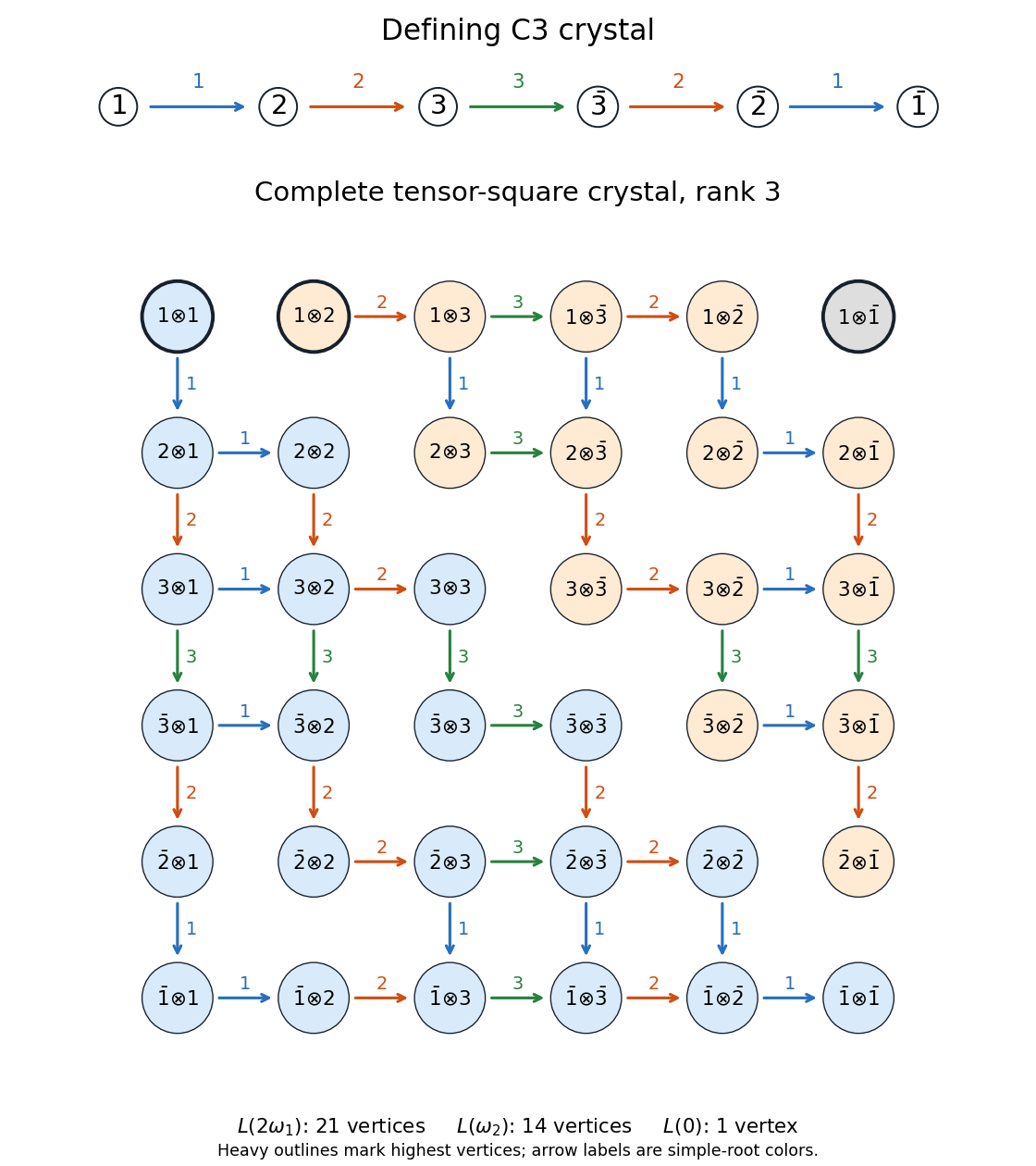
Defining C3 crystal and its complete tensor-square crystal with all colored arrows and the three highest-weight components
. Details. 
For completeness, highest vertices can be read from the raising rule, which selects the first factor when . If has an incoming edge of color , then ; either the raising operator acts nontrivially on , or and it acts nontrivially on . Thus a highest vertex must have . At , all vanish except . To be highest, the incoming color of , if any, must consequently be . For , the possibilities are exactlyTheir weights are , , and zero. Each occurs once. Connected highest-weight components of the crystal basis describe the irreducible representations in the tensor product of Lie algebra representations, soThis is the tensor-square decomposition of the defining symplectic representation. The symmetric square is ; the exterior square is the direct sum of its invariant inverse-form line and the primitive exterior square . Their dimensions are respectively , , and one, summing to . At , the chain has two vertices and the highest tensor vertices are only and : the decomposition is , of dimensions three and one.
Let be a complex semisimple Lie algebra, choose a Cartan subalgebra and positive root system , and put . For a dominant integral weight , let be the finite-dimensional highest-weight representation with highest weight . The Weyl dimension formula isHere is the coroot, the pairing is between a weight and a coroot, and is the Weyl vector. The inner product can be any Weyl group invariant normalization on each simple factor: its scaling cancels from the ratios. The dominance condition means that is a nonnegative integer for each simple root.
Number the simple roots so that is short and is long. In a Euclidean plane takeTheir squared lengths are , and their angle is . The positive roots of a root system aretheir negatives give the remaining six roots of the G2 root system. The three short positive roots of a root system are , , and .
Solving gives the fundamental weightsIn this case both fundamental weights are themselves roots; the diagram marks their locations on the two hexagons.
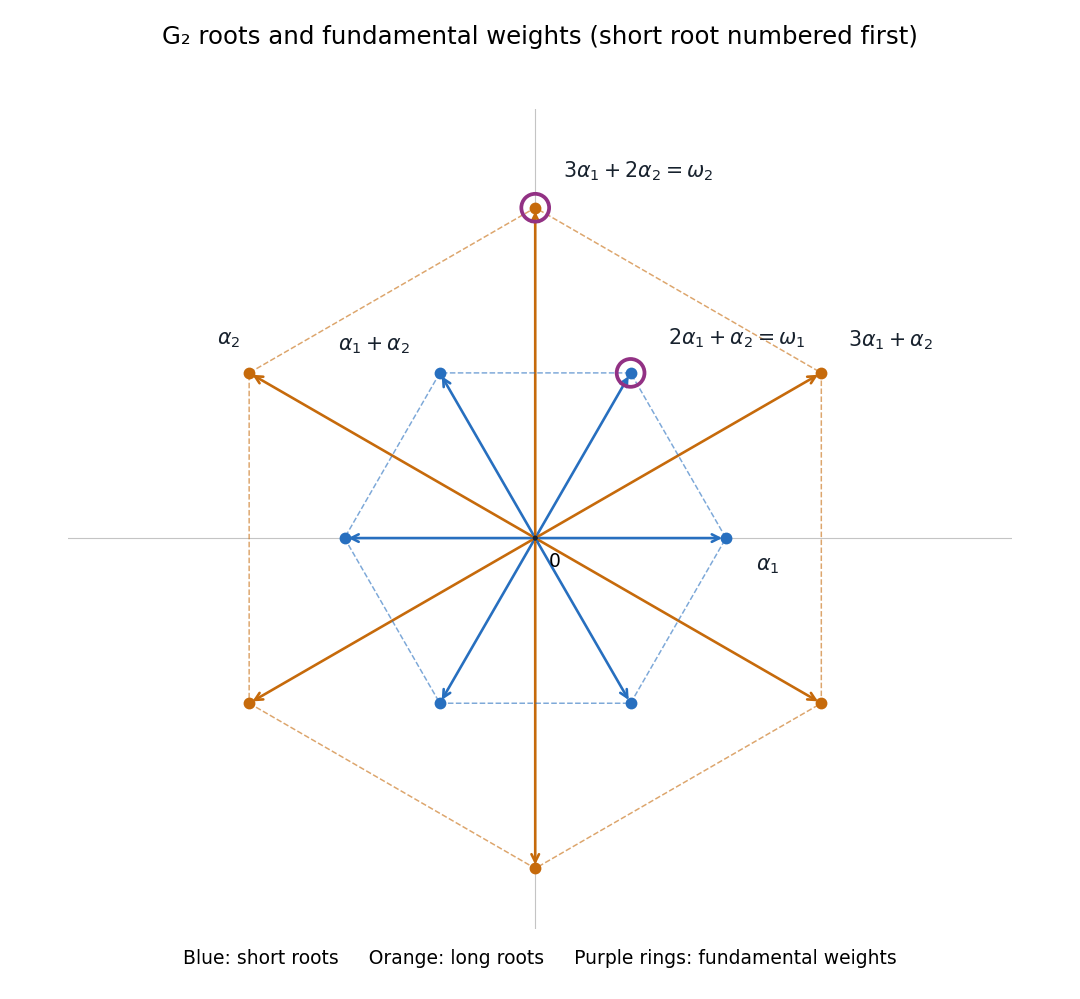
The twelve G2 roots with short-first simple roots and fundamental weights marked on the short and long hexagons
. Details. 
Let and . Relative to the simple coroots, the six positive coroots, in the root order above, have coordinatesFor example, has squared length one, so its coroot is ; the analogous length computation gives each other entry. Since , the pairings of with these coroots are , , , , , and . Their values at multiply to . The Weyl dimension formula therefore yields the G2 dimension polynomialThis holds for all nonnegative integers . In particular it gives dimensions and for and , and for . Reversing the numbering of the simple roots would interchange in the polynomial, so the short-first convention matters.
Use the generators of the sl2 Lie algebra with , , and . For a finite-dimensional Lie algebra representation, is diagonalizable with integral weights. Its formal character of a weight module isHere is a formal variable; equivalently the expression is , or the formal sum with . This records every weight multiplicity, rather than only the dimension.
The classification of finite-dimensional sl2 representations says that , the irreducible of highest weight , has the weight string , each with multiplicity one. HenceThe quotient denotes the displayed Laurent polynomial and has the removable value at . Formal characters are additive on direct sums, so these formulas determine the character of every finite-dimensional module.
Choose a Cartan subalgebra, simple roots , and root vectors normalized by . LetHere the coroots lie in the Cartan subalgebra, and . This last identity is the Weyl vector identity applied to the dual root system. For distinct simple roots, is not a root, hence . ConsequentlyThese are exactly the sl2 Lie algebra relations. For nonzero the resulting homomorphism from is nonzero and therefore injective, since is simple. Its image is a Principal sl2 subalgebra. Equivalently its raising element is a principal nilpotent element, a nilpotent element with Lie algebra centralizer of dimension equal to the rank. The construction works for a semisimple Lie algebra with several simple factors by taking the triple in every factor, giving one diagonally embedded . This is the construction of a principal sl2 triple.
For a representation , restrict to this subalgebra and take its formal character. If is the weight space for the original Cartan subalgebra, the resulting q-character of a highest-weight representation, or the analogous q-character for any finite-dimensional representation, isIt is independent of conjugating the chosen principal triple. In particular a root has grading . Some conventions use instead; that convention divides all exponents here by two. The normalization above agrees with the ordinary sl2 Lie algebra character in the preceding part.
Under the Principal sl2 subalgebra, a root space of root has -eigenvalue , where the height is the sum of its simple-root coefficients. The six positive roots of a root system of the G2 root system have heightsEach positive and negative root space has dimension one. The two-dimensional Cartan subalgebra contributes two copies of the zero weight. Therefore the Principal q-character of the G2 adjoint representation isEquivalently,The classification of finite-dimensional sl2 representations therefore gives the actual restricted-module decomposition , of dimensions . In the convention using , the same result is . Both forms encode the same two weight strings.
Articles by others on the same topic
There are currently no matching articles.