At a critical point of a twice continuously differentiable function, the linear term in the Taylor expansion vanishes:The real symmetric Hessian matrix has an orthonormal basis of eigenvectors. If all its eigenvalues are positive, its quadratic term is bounded below by a positive multiple of , giving a strict local minimum. If all are negative, it gives a strict local maximum. If positive and negative eigenvalues both occur, directions along their eigenvectors give values on both sides of , so the point is a saddle point of a scalar function. The non-singularity assumption excludes zero eigenvalues; with them the quadratic test may be inconclusive and higher-order terms are needed.
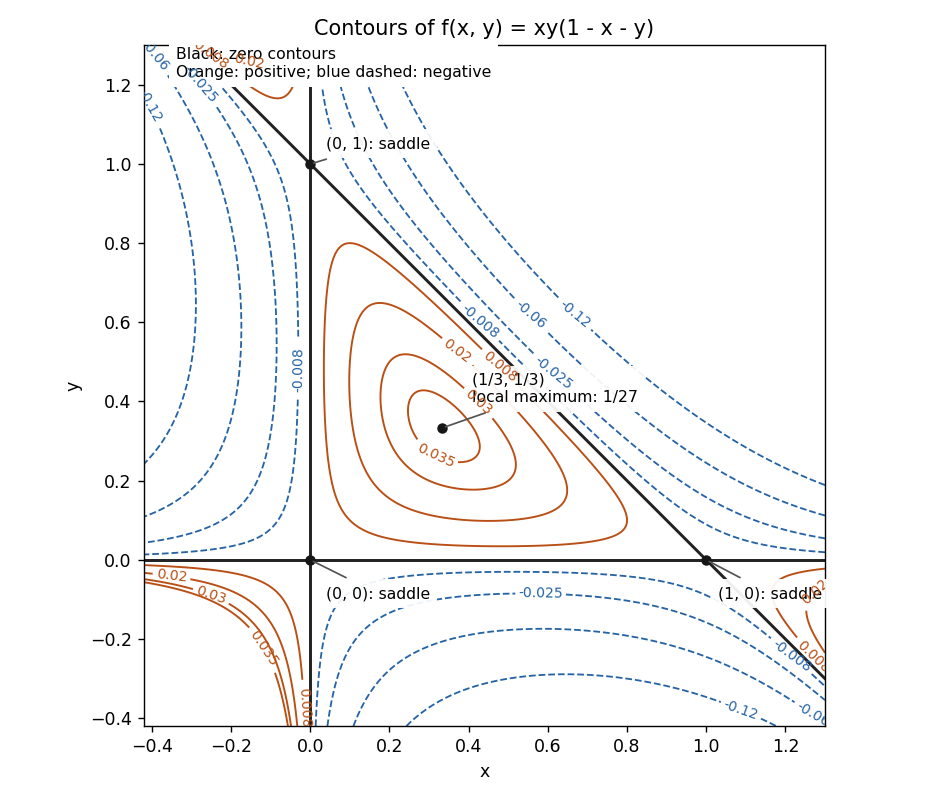
The gradient components areIf or , their simultaneous zeros give . If , solving , gives . These are all the critical points. The Hessian matrix isAt each of its determinant is , so its two eigenvalues have opposite signs. All three are saddle points of a scalar function. At ,This point is a strict local maximum, of value .
The zero level set is exactlyThese three lines form a triangle containing the maximum. Inside it ; near the maximum positive level sets are nested closed curves, with their leading shapes elliptical because the Hessian matrix is negative definite. At each vertex the zero lines cross, separating alternating signs, and nearby nonzero level sets have hyperbolic branches. For example, the leading quadratic terms are at , for at , and for at .

Put and . The polynomial becomesThere are no terms of degree one or two, so the gradient and the entire Hessian matrix vanish at . It is a critical point with singular Hessian matrix. The lowest nontrivial approximation isunderstood as the fourth-degree leading term rather than a uniform ratio asymptotic along its zero directions.
On the path the exact value is for . On the path it is for sufficiently small nonzero . Both paths approach the point, where . It is neither a local maximum nor a local minimum; it is a degenerate saddle point of a scalar function. The higher-order saddle test supplies the conclusion the singular Hessian matrix cannot supply.
Articles by others on the same topic
There are currently no matching articles.