Use standard Brownian motion, started at . Fix , and divide into equal subintervals. Its Brownian increments are independent centred normal random variables with strictly positive variance, so each is nonnegative with probability . A nondecreasing path on the entire interval must have every one of these increments nonnegative. Hencefor every , and therefore this probability is zero.
There are only countably many pairs of rational endpoints . Take the union of the corresponding null events. Every interval of positive length, even one selected depending on the path, contains an interval with rational endpoints. Outside that single null event no such interval can be nondecreasing. ThusApplying the same argument to also rules out nonincreasing intervals, the full nowhere monotonicity of Brownian motion property.
For each deterministic , the Brownian reflection principle givesso is finite almost surely; . Here is the standard normal cumulative distribution function. The same reflection formula at levels decreasing to zero gives for every . Taking a countable intersection over shows that Brownian motion exceeds zero arbitrarily soon after its start.
By the Strong Markov property at the finite stopping time , the process is fresh standard Brownian motion. It therefore exceeds zero arbitrarily soon. Path continuity gives , and the preceding fact gives the reverse inequality. ConsequentlyThe exceptional event may depend on ; this does not imply simultaneous equality for all levels.
To exhibit the difference, set , a random level. The reflection formula gives almost surely. Also almost surely: if were the maximum, the reversed increment process would be nonnegative throughout . This process has the law of standard Brownian motion, whose probability of staying nonnegative from zero is zero by reflection and symmetry. The level is attained at some time strictly before one, so . It is not exceeded by time one, and continuity with gives a further positive interval before it can be exceeded. ThusAll these passage times exist simultaneously on the probability-one event where the Brownian path is continuous and unbounded above, obtained by intersecting the finite-hitting events for positive integer levels.
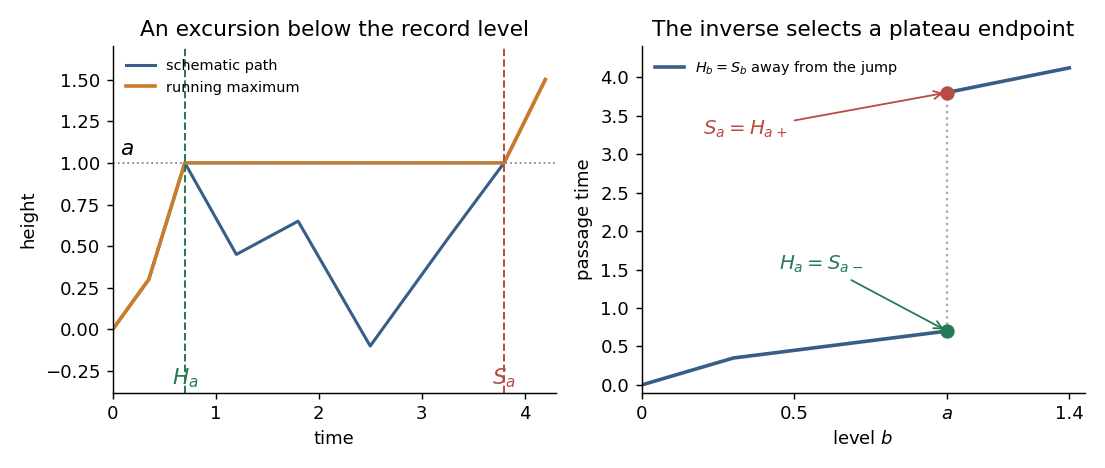

The illustration shows the pathwise mechanism. The Brownian running maximum stays flat during an excursion below an attained record. The non-strict inverse chooses the beginning of that plateau, while the strict generalized inverse of a nondecreasing function chooses its end. The curve is a schematic of this mechanism, not a claim of piecewise linear Brownian paths. The fixed-level equalities give the modification of a stochastic process relation, while the random-level discrepancy rules out indistinguishability of stochastic processes. This is fixed-level versus simultaneous Brownian passage-time equality.
Under the path convention used here, a real Lévy process starts at zero, has independent increments and stationary increments, is stochastically continuous, and has càdlàg paths almost surely. We verify all four requirements for .
The immediate positive excursions proved in part (b) give . For a deterministic , is an almost-surely finite stopping time, and continuity gives . The Strong Markov property implies that is a fresh Brownian motion independent of the information up to . For ,No crossing of could have occurred before . The increment thus has the same law as and is independent of the past. Apply this successively at a finite increasing sequence of deterministic levels to prove stationary independent increments.
For and , part (b) and reflection giveHence in probability. Stationarity of the increments gives stochastic continuity at every level, from either side where defined.
For path regularity, on a single probability-one event the Brownian running maximum is continuous, nondecreasing and unbounded, andThis inverse is nondecreasing. If , then . For any , some has ; for all sufficiently large , , so . Thus , proving right continuity at every level simultaneously. On each bounded level interval it is bounded by the finite value at a larger integer level. Monotonicity then gives finite left limits. ThereforeThe Brownian first-passage subordinator is the level-indexed increasing process, rather than a process indexed by the original Brownian time.
For , the inverse relations for a continuous running maximum areFor example, if then ; while for , and any has . Taking limits gives . Similarly for , and a crossing of any level strictly above before a given bounds from above for sufficiently close to . This proves . These are the non-strict inverse of a continuous nondecreasing function identities.
At the random level in part (b), , so fails right continuity almost surely. Thus it is not a Lévy process under the stated càdlàg-path convention. It does have the same finite-dimensional distributions and stochastic continuity as , so definitions of a Lévy process that require only the increment and stochastic-continuity properties would call a Lévy process with a càdlàg modification. The reason for excluding the particular version here is its path regularity.
The printed assertion is false in the usual pointwise meaning of nowhere continuous. The original PDF explicitly has this wording. Part (c) proves that has nondecreasing càdlàg paths; such paths can have only countably many discontinuities, so they are continuous at uncountably many levels. We prove the precise valid statement:For countability, fix a path and a bounded level interval . A discontinuity is a jump , since right continuity is already known. The sum of any finite family of these jumps is at most . Thus there are only finitely many jumps of size at least , for each positive integer . Taking the countable union over and over integer proves that all discontinuities form a countable set.
For density, work on the common probability-one event of Brownian continuity, unboundedness above, and the conclusion of part (a). The inverse is strictly increasing: for every level , path continuity gives , so two distinct levels cannot have the same passage time. Suppose there were a nonempty open level interval on which had no discontinuity. Choose inside it. Its restriction to would be continuous and strictly increasing, hence onto . For every time in this positive-length interval there would be a unique with , and then . Increasing increases , so the Brownian path would be nondecreasing throughout . This contradicts part (a).
Therefore every open level interval contains a jump. This establishes Countable dense jumps of the Brownian first-passage subordinator, and in particular rules out any interval on which is continuous throughout. It does not rule out continuity at an individual level. In fact, for every fixed deterministic , part (b) gives almost surely, so is almost surely continuous at that specified level. Its dense discontinuities occur at random levels.
Articles by others on the same topic
There are currently no matching articles.