Assume a steady, locally plane-symmetric galactic disk, with negligible radial tilt term in the vertical Jeans equation. Write for the stellar mass density, and for the upward gradient of the Newtonian gravitational potential; the actual vertical gravitational acceleration is . Constant vertical velocity dispersion givesIntegrating the plane-parallel Poisson equation for Newtonian gravity from the symmetry plane gives . Outside most of the mass, this tends to for , where the surface density includes both sides of the galactic disk. Treating this field as constant and integrating the vertical Jeans equation yieldsThis exponential is the thin-sheet approximation or the outer tail, not the exact profile at every height. To see the distinction without an additional assumption, set with . The Poisson equation for Newtonian gravity becomes , with , and is solved bySince , the exact self-gravitating isothermal slab has . At large , , recovering precisely the boxed scale height; near the plane its slope vanishes, whereas an exponential has a cusp.
In the thin-sheet regime, the gas scale height is . Hence radius-independent gas velocity dispersion givesFor an exponential galactic disk, , soThe gas therefore exhibits galactic disk flaring as stellar surface density falls outward. Stellar galactic disks, by contrast, commonly have roughly constant thickness over their main optical region; applying the same scale height relation to the stars requires , or for an exponential galactic disk. This comparison does not follow by imposing a radially constant stellar velocity dispersion: that extra assumption would predict stellar galactic disk flaring too. The constancy used in the vertical calculation is constancy with height locally, not a mandatory constancy with radius.
The thin-sheet field used above requires the gas to sample heights beyond most of the stellar mass, while the stellar galactic disk still dominates vertical gravity and is approximately locally plane-parallel. In inner regions a cold gas layer can lie inside the thicker stellar layer, where reflection symmetry gives rather than a constant field. The vertical Jeans equation, or gas hydrostatic equilibrium, then givesHere is the Gaussian width and is the vertical epicyclic frequency; in a locally flat galaxy rotation curve, . A stellar layer of approximately fixed thickness then gives , rather than the inverse surface density law.
At large radii, the dark matter halo or the gas's own gravity can exceed the dwindling stellar restoring force, so replacing the total force by fails. A nearly spherical dark matter halo instead gives near its plane, and for a flat galaxy rotation curve, much slower than exponential galactic disk flaring. Warps, radial gradients across a thick gas layer, non-equilibrium disturbances, and height-dependent velocity dispersion also invalidate the locally plane-parallel steady isothermal approximation. The inverse stellar surface-density law applies only while its force and geometric assumptions apply.
Measure the number-density profile and vertical velocity dispersion of a tracer stellar population. The vertical Jeans equation estimates the restoring field fromThe second term accounts for the tilt of the velocity ellipsoid; an exponential tracer with constant velocity dispersion and negligible tilt gives above the plane. The tracer need not supply all the gravitating mass. To infer the dynamical surface density from vertical stellar motions, integrate the axisymmetric Poisson equation for Newtonian gravity:For a nearly flat galaxy rotation curve with a small radial correction, this reduces to . Estimate stellar surface density independently from counts, the initial mass function and faint objects, and add the gas surface density and stellar remnants. The residuallimits the allowed unseen material within the same height interval. A fitted dark matter halo contributes too: measurements at several heights help distinguish its extended density from a thin dark component in the galactic disk. Under a specified decomposition, the disc dark-matter fraction is the inferred dark-disc surface density divided by the total disc surface density, with uncertainty or an upper limit if the residual is consistent with zero. Selection effects, disequilibrium, the tilt term and uncertain baryonic counts must enter the error budget; an excess alone does not establish that all of it is in the galactic disk.
Let be the star formation rate, the remaining gas mass, and the mass put into stars. With zero returned bulk gas, pristine galactic gas inflow, and no galactic outflow, mass conservation givesA well-mixed gas reservoir loses existing metals at rate and gains newly synthesized metals at rate ; the incoming gas brings none. ThusFor , eliminate time and integrate:The proportional-infall model of galactic chemical evolution therefore gives, for initially pristine gas,The displayed form requires ; more generally . Also for an initially star-free reservoir, so is not the gas fraction of a galaxy . As a check, the limit is the closed-box model of galactic chemical evolution relation ; at the gas mass is constant and one must instead solve . Retaining a nonzero stellar yield while setting bulk mass return to zero is the prescribed trace-metal approximation, not a literal claim that stellar ejecta have no mass.
For , the gas-phase metallicity relation reduces to . Elimination of from mass conservation givesWith a fixed initial mass function, let be the number of surviving low-mass tracer stars per unit formed stellar mass. Successive stars inherit the monotonically increasing gas-phase metallicity, so the cumulative and differential counts are respectivelywhere is the abundance at the epoch when star formation stops. Above the cumulative count is constant, and the differential count vanishes. In the complete gas-exhaustion limit, and , so the normalized metallicity distribution function is on ; at a finite stopping epoch it is . The distribution is flat in linear metallicity. A logarithmic metallicity distribution instead satisfies and is not flat.
The closed-box model of galactic chemical evolution has and , giving . To compare shapes without confusing different total stellar counts, the figure normalizes both metallicity distribution functions to unit integral after complete gas exhaustion and uses :The right panel also shows the corresponding cumulative fractions, and .
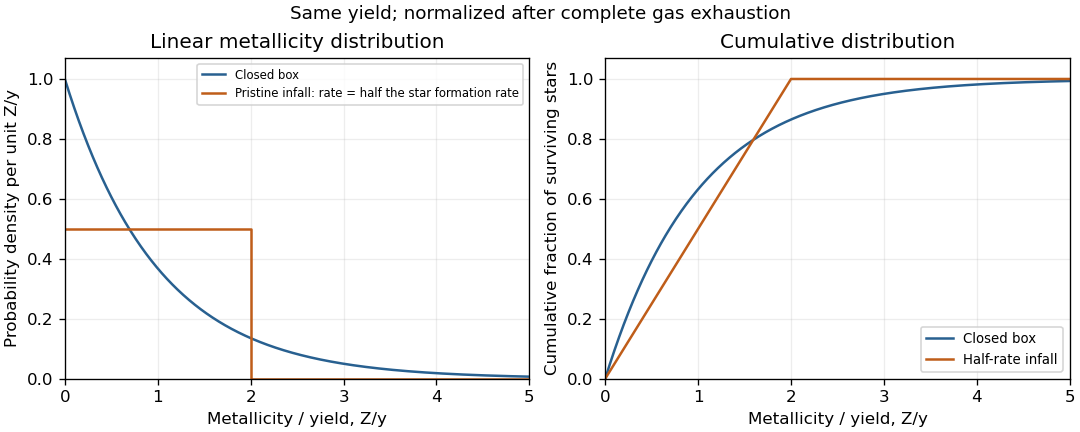
Normalized linear metallicity distributions and cumulative fractions for closed-box and half-rate pristine-infall models
. Details. 
Pristine galactic gas inflow replenishes the fuel and dilutes freshly produced metals, so enrichment per unit newly formed stellar mass is slower and asymptotes to . More stars are formed at later abundances; the proportional-infall model of galactic chemical evolution makes twice as many stars as the closed box for the same initial gas mass in this limit. Consequently the normalized low-abundance fraction is smaller: for , it is rather than approximately . Their unnormalized actually agree at for the same , which is why stating the normalization matters. At a finite stopping abundance , use for infall and for the closed box, each truncated at its own chosen stopping point.
The G-dwarf problem is the observed shortage of metal-poor, long-lived disc stars relative to a simple closed-box model of galactic chemical evolution. In the fully evolved comparison, the half-rate proportional-infall model of galactic chemical evolution lowers the low- fraction from to , and prevents the closed-box tail from extending to arbitrarily high stellar metallicity. It therefore reduces the relative weight of the earliest metal-poor generation and the very metal-rich tail.
This particular constant-proportional-infall model is an improvement, not a complete fit. It still forms a metal-poor population immediately from its initially pristine reservoir, with nonzero constant all the way down to zero, and predicts a broad linear distribution followed by an abrupt upper cutoff instead of a generally smooth, concentrated observed distribution. Comparison with observed abundance histograms must first use the same coordinate: its logarithmic metallicity distribution rises in proportion to up to that cutoff, rather than remaining flat in logarithmic bins. Local G-dwarf measurements exhibit a prominent logarithmic-abundance peak and a paucity of low-abundance stars; translating iron abundances into total also requires an abundance-ratio model. More realistic histories can vary the galactic gas inflow and star formation rate, allow recycling and delayed enrichment, and account for migration and selection of different stellar populations; simply tuning a constant stellar yield does not remove all these shape deficiencies.
Let be a characteristic radius enclosing mass , and let denote a one-dimensional velocity dispersion. Gravity and random-motion support give a relation , where the dimensionless structure coefficient depends on the chosen radius and density profile. A crossing-based galactic dynamical time is thereforeThe scaling follows by equating acceleration scales and , not by identifying a complete orbital period with a crossing time. An explicit scale-free example checks the coefficient: constant circular speed and spherical symmetry give and . With isotropic constant velocity dispersion, the Spherical Jeans equation becomesso , , and . This is the singular isothermal sphere scaling, valid over an interior radial range; a literal infinite model has no finite total mass, and a hard finite boundary needs a pressure term or an outer transition. A free-fall time of a uniform sphere or orbital period changes the numerical factor. The subsequent estimates use the nominal scale , keeping these order-unity structural uncertainties explicit.
Using the given constants, the mass is and the velocity dispersion is . The nominal galactic dynamical time isThus the collapse clock is a few tens of millions of years, of order years, with years in the interior singular isothermal sphere convention. The nominal radius is a plausible galactic scale. A full stellar orbit takes several crossing times, giving order years near a galactic disc radius, whereas the age of the Milky Way is of order years. Many orbital passages therefore fit into the lifetime of the galaxy, as expected; a galactic dynamical time need not equal either its full orbital period or its age.
Putting the whole assumed gas reservoir into stars during the nominal galactic dynamical time givesAn order-unity shorter collapse clock would raise this to a few thousand solar masses per year. The Milky Way's present star formation rate is only of order a few solar masses per year; for example, A determination combining Galactic measurements finds about with a specified initial mass function. The extreme rapid-collapse rate is therefore roughly three orders of magnitude larger, resembling an intense short-lived starburst galaxy phase rather than ongoing ordinary disc star formation. This estimate assumes all the quoted mass can form stars; it would be smaller if some mass were nonbaryonic dark matter or if the conversion efficiency were below unity.
For an isolated final system with isotropic one-dimensional velocity dispersion , the random kinetic energy is . The virial theorem gives and total energy . Starting from a diffuse, almost unbound gas reservoir with , conservation of energy therefore requires the radiative energy of virialized gravitational collapseIt is the decrease in total energy, not the whole final magnitude , that is lost; half of the binding-energy magnitude remains as kinetic energy. Assuming radiation carries most of this loss, the average luminosity during the nominal galactic dynamical time isusing . This is comparable in order of magnitude to the stellar luminosity of a characteristic galaxy in the Schechter function, often of order with a band-dependent definition. The equality is an energy-scale comparison: ordinary present starlight is powered mainly by stellar nucleosynthesis, whereas this estimate concerns gravitational energy lost during formation. Appreciable initial binding energy, mass loss or external stresses alter the coefficient, and the finite-boundary singular isothermal sphere cannot be used as an isolated exact virial equilibrium without its boundary term.
The assumed central black hole mass is . A mass alone does not fix radiated energy: specify a formation mechanism and its radiative efficiency of black-hole accretion. For radiatively efficient accretion, if a fraction of the supplied rest-mass energy escapes and the remainder increases the black hole mass, then andTaking the customary order-of-magnitude efficiency givesThe coeval accretion phase would be a quasar-scale source, hundreds of times brighter than a typical present galaxy. Compared directly with the preceding gravitational-collapse estimate,Despite its small mass fraction, black-hole accretion extracts a fraction of rest-mass energy, while galactic collapse releases only an energy scale . The numerical luminosity is conditional: a radiatively inefficient accretion flow, direct collapse or assembly by mergers need not radiate this amount over the galactic clock, and the question supplies no unique efficiency.
Older disc stellar populations generally have larger velocity dispersions, partly through accumulated galactic disk heating, so random-motion stresses supply more of their support against gravity. The radial Jeans equation then requires a smaller mean rotation than the circular speed, producing larger stellar asymmetric drift than in dynamically colder young stars.
Low-mass main sequence stars live for much of the Milky Way's age, retaining representatives of many generations, while phase mixing disperses their birth associations around their orbits. In an approximately axisymmetric galactic disk, a sufficiently complete local census can therefore sample the mixed annular stellar population at the Sun's radius despite its small volume. This is a representative local-radius sample, not automatically an unbiased whole-disc census: different vertical scale heights, selection effects and radial migration require corrections when inferring integrated population fractions.
Metal absorption lines depend on the temperatures, ionization states and luminosity weights of the contributing stellar populations, as well as their stellar metallicity. A young stellar population dominated by hot luminous stars can have weak metal absorption lines even at substantial abundance, so weak lines alone do not establish low metallicity, an aspect of the age-metallicity degeneracy.
Typical present elliptical galaxies are dominated by old stellar populations: their brightest short-lived stars have disappeared, leaving faint long-lived stars and stellar remnants, so luminosity per unit stellar mass is low. Ongoing star formation in many spiral galaxies and irregular galaxies supplies luminous young stars, giving a smaller stellar mass-to-light ratio in a fixed band; dark matter, the initial mass function and aperture must also be specified if the quoted ratio is dynamical.
Many open clusters are weakly bound and are dispersed by two-body relaxation, stellar evaporation and tidal heating, including encounters with molecular clouds in the galactic disk, so their present age histogram preferentially retains young survivors. More massive compact globular clusters can survive much longer, while the released low-mass stars remain as old field stellar populations: disruption removes clusters from the catalogue without removing their stars from the disc.
In the radial-residual convention , boxy isophotes have and disky isophotes have , since negative extends the diagonal directions and positive extends the fitted axes. Massive elliptical galaxies tend to have slowly rotating, anisotropic stellar structures associated with dry galaxy mergers, whereas rotating embedded galactic disks, often associated with dissipation in gas-rich galaxy mergers, favour disky structure in lower-mass elliptical galaxies. These are population trends, as in Central structure measurements, rather than a universal mass rule, and brightness-residual Fourier coefficients must first be converted to this radial convention.
The neutral-hydrogen 21-centimeter line traces cold gas far beyond the bright stellar galactic disk, where a dark matter halo contributes strongly to the galaxy rotation curve. With relatively small random velocities, this gas approximately follows circular orbits, allowing its Doppler velocities to measure the circular speed after inclination and pressure corrections, whereas stellar dispersions require an orbital-anisotropy model. Its extended radial reach and comparatively simple force tracing make neutral gas especially useful for outer-halo constraints, although warps and noncircular motions can invalidate that simplicity.
Many lower-luminosity elliptical galaxies have dense central stellar cusps, giving far more photons and kinematic tracers near a central black hole than the shallow depleted cores common in massive elliptical galaxies, as measured in Central galaxy profiles. Thus central surface brightness can make the smaller black hole easier to measure, despite its smaller mass, whereas sparse central tracers and uncertain stellar orbital anisotropy weaken measurements in a large core. This is not a universal mass ordering: the black-hole sphere of influence must still be sufficiently resolved in angle, so distance, velocity dispersion and angular resolution also matter.
Articles by others on the same topic
There are currently no matching articles.