Let the longitudinal variation scale be . The stress-free boundary condition gives at each face. Incompressibility implies , so is smaller than a putative by . The leading Stokes equation and the two shear-free conditions therefore make independent of ; its thickness-dependent correction is smaller-order. Symmetry gives at , and incompressibility integrates toVertical momentum makes the leading normal stress independent of . With the normal directed from liquid into gas, the upper-face curvature is to leading order. The Young–Laplace equation givesThe Newtonian fluid stress tensor also gives . Hence andThe factor four is the planar extension factor: both the longitudinal viscous stress and the pressure adjustment from transverse contraction contribute.
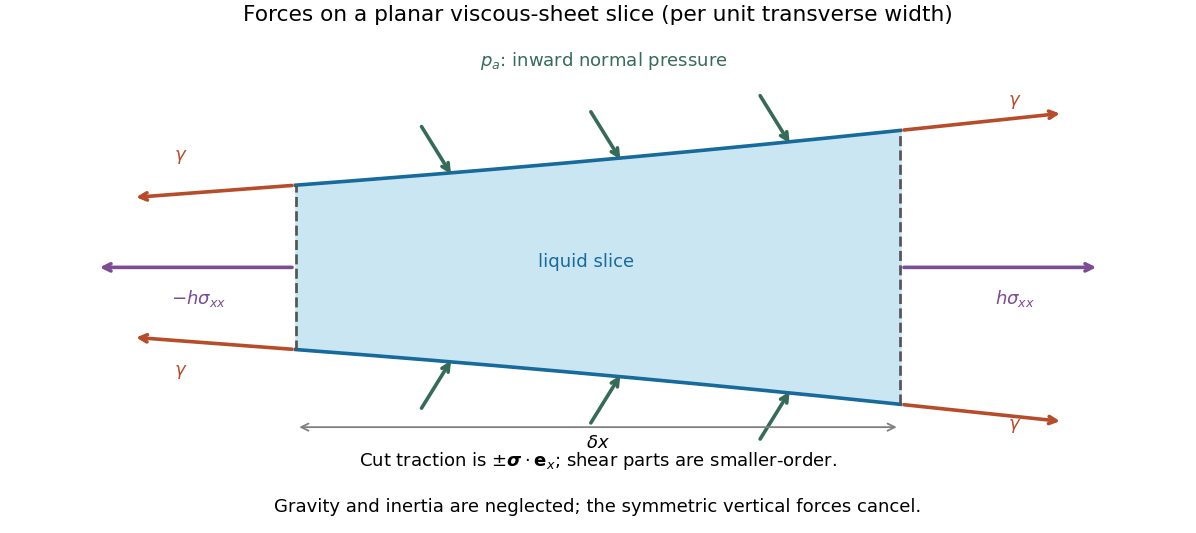

For force balance on the illustrated slice, the vertical cuts give . Pressure on the sloping broad faces gives horizontally. Each of the two interfaces exerts a tangential surface tension pull at each cut, with horizontal component , where . Thus the horizontal force balance is the derivative of the effective tensionto the retained small-slope order. The ambient-pressure contributions cancel in this excess tension. Differentiating cancels the two terms, leaving the planar viscous-sheet stretching equationsThe upper-face kinematic condition is . Combining it with gives the second equation,which is conservation of mass per unit transverse width.
For the two bubbles, let be the common gas pressure and the surrounding liquid pressure away from the sheet. A cylindrical bubble has one nonzero principal curvature, so the Young–Laplace equation gives . In the nearly flat sheet the normal stress is , giving liquid pressure . The extensional correction is small compared with because the transition scale will satisfy . Thus , and this capillary pressure difference drives liquid out through both ends.
For a spatially uniform flat sheet, , so the longitudinal equation gives . Reflection symmetry at selectsHere is the outward speed at the positive end. The mass equation then gives , independent of , so initially uniform thickness remains uniform. Writing it as ,The end transitions determine , as derived in the following parts.
Articles by others on the same topic
There are currently no matching articles.