For two incompressible Stokes flows and with the same viscosity and no body forces, the Lorentz reciprocal theorem for Stokes flow statesIndeed the divergence of their difference is zero: stress divergences vanish, pressure contracts with zero velocity divergence, and the two symmetric strain-rate contractions cancel.
Apply it to the decaying disturbance around the sphere and an auxiliary translating sphere of velocity . On the body surface, . Using normals from the body into the fluid, the given auxiliary traction is ; reversing both normal conventions does not change the reciprocal equality. The background traction integrates to zero because it is regular inside the sphere. The disturbance's hydrodynamic force is consequently , where is the externally applied force. The rotational term integrates to zero. Thus for arbitrary ,Therefore .
The background Stokes equations imply and . The spherical mean of a biharmonic function gives exactly , evaluated at the sphere center. One can obtain it from Taylor expansion and ; every subsequent spherical average contains and vanishes. This requires the background to be regular throughout the enclosed ball. Hence the Faxén relation isThe printed denominator omits . The given traction integrates to , fixing that factor; the printed force term also fails dimensional consistency unless its force were redefined, which the question does not do.
Use the Papkovich–Neuber representation in the conventionIt gives and . Additive pressure constants are immaterial.
Let , with symmetric and traceless. The harmonic vector is a derivative of . The scalar is a decaying degree-two harmonic because is a harmonic homogeneous quadratic. These Papkovich potentials for a strained sphere have precisely the strain symmetry and decay required for the disturbance, so trySubstitution givesAt , require . The independent vector structures give and . The disturbance for a sphere in a uniform straining Stokes flow isIt decays at infinity and satisfies no slip exactly at the sphere. Its leading far field is a stresslet, of velocity scale .
A force-free sphere in a linear background translates with , by Faxén's first law, and a couple-free sphere rotates with the background rigid-body rotation , by Faxén's rotational law. Uniform translation and solid-body rotation can then be matched without disturbance. The remaining relative boundary velocity is exactly . The Linearity of Stokes flow and Uniqueness of Stokes flow therefore give the same disturbance. The pure strain produces no resultant force or couple, by its symmetric degree-two angular structure.
The shear has . The separation between centers is , so in the leading stresslet from part b, , and the radial vector's component is . Evaluating the other sphere's disturbance at the positive center givesThis is the first method of reflections for Stokes flow approximation. The next multipole in part b and the receiver's Faxén Laplacian contribute at ; changes to the incident strain from further reflections are smaller, . The hypothesis ensures well-separated spheres throughout the encounter.
The leading horizontal velocity is . Dividing and using on the right at first order givesIntegrating from negative infinity,The correction increases until and decreases afterward. ThusThe expansion gives as . More generally, reversible scattering of two spheres in simple shear gives no net transverse shift for this smooth, noncontact, deterministic two-sphere encounter: reflection reverses the imposed shear, and time reversal restores it. Uniqueness makes the incoming and outgoing branches mirror images. Brownian motion, contact forces or finite inertia would remove the assumptions behind this conclusion.
Take pressure positive in compression, outward normal on the upper interface, and curvature . The external-minus-internal traction convention gives the base pressure . For the symmetric Fourier perturbation, the linearized upper-surface conditions areIsotropic base stress cancels all terms due merely to rotating the normal. Velocity is even and odd in .
Use the same Papkovich–Neuber representation as in Q1, with and symmetric harmonic potentialsSuppress the common exponential. They giveThe zero tangential stress is , where . Hence , and the normal stress becomes . Eliminating using the kinematic condition gives the Van der Waals rupture instability of a viscous sheet rateAttraction destabilizes thickness variations; curvature pressure opposes them.
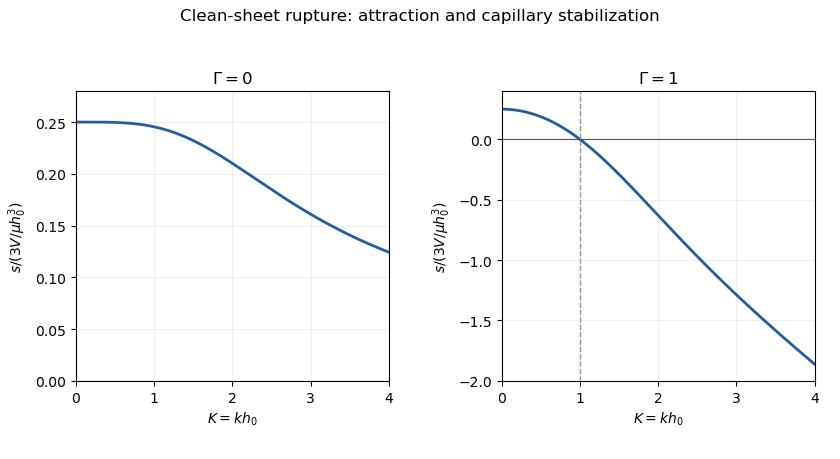
Clean-sheet rupture growth rates without capillarity and with Gamma equal to one
. Details. For the clean-sheet long-wave rupture plateau, writing , the rate is . Without capillarity, the curve decreases toward at large ; with it changes sign at and behaves as . Thus short waves are weakly unstable without surface tension, but stabilized by it. The largest clean-sheet rate is approached at long wavelength. The strictly uniform thickness change is not an admissible fixed-volume Fourier mode; this is the limit of nonzero waves. Stress-free surfaces permit extensional, nearly plug-like motion whose mobility compensates the weak long-wave pressure gradient. Unsteady inertia eventually matters in that limit; finite sheet extent, drainage, gravity, surface elasticity/viscosity, surfactant transport and molecular-scale corrections can also modify wavelength selection.
For the comparison with surfactant, keep the same equilibrium tension . Flow away from a thinning neck stretches the surface, diluting its surfactant and raising tension there. Convergence into thicker regions concentrates surfactant and lowers tension. The resulting Marangoni stress points back toward the neck, opposing the draining surface motion. It therefore reduces mobility and the rupture rate relative to the clean constant- sheet. This mechanism needs surface transport to sustain concentration gradients; instantaneous concentration equilibration would remove it.
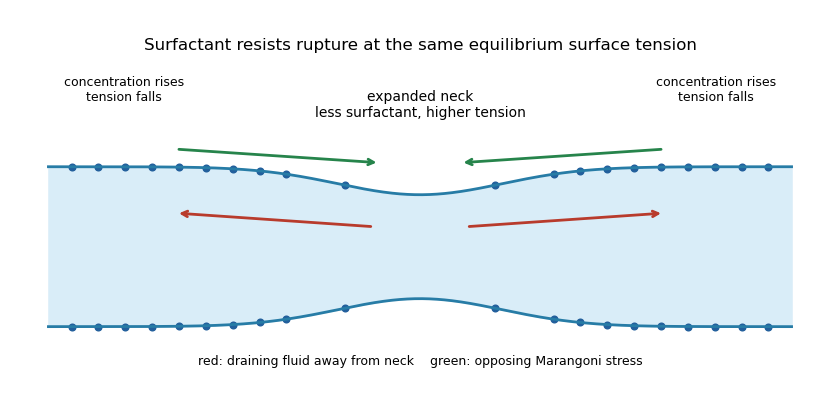
For the supplied strong-surfactant rate, unstable waves satisfy . When , all of them have . Expanding its mobility factor givesMaximizing in yields the strong-surfactant long-wave rupture maximumHere is the equilibrium tension in the soap-film comparison. Surface immobilization removes the clean long-wave plateau and selects a finite long wavelength. The growth timescale is lengthened by a factor about compared with the clean maximum. A linear rupture-time estimate is , not a universal bubble lifetime: drainage and changing thickness, initial defects and nonlinear rupture also matter.
For a slender viscous thread, leading axial velocity is uniform over a section. Incompressibility gives . The radial and azimuthal strain rates are , and the axial one is . The Newtonian fluid stress tensor then has . Matching the inviscid exterior normal stress requires , so . The coefficient three is the Trouton ratio.
A short section has end-stress resultant . The side's hydrostatic traction adds , and gravity adds . Neglecting inertia and capillarity, their sum is zero:Since , the balances areThe second is cross-sectional volume conservation, equivalently . Small interface slope justifies the sectionwise extensional approximation; the slow-flow assumption is additionally needed to neglect inertia.
For steady nonzero flux, , so . Substitution in the slender viscous thread force balance givesIf , thenHence . This argument does not divide by , so it also applies at turning points of the axial velocity. The symbol here has dimensions inverse length-time; it is not itself a speed.
With no net body force, the tensile resultant is constant along the thread: . In material coordinates , volume conservation gives . ThusThe material Jacobian satisfies . Integrating with givesThis remains valid while . The even profile now specified ensures symmetric endpoints .
For and , direct integration yieldsFor , instead . A constant tensile gives and the finite blow-up timePut and . For fixed nonzero , the arctangent tends to , whereas for the uniform profile the whole length has the same thinning. Consequently the localized-neck and uniform-thread stretching exponents areA nonuniform thread's divergent integral is concentrated in a material interval near its quadratic minimum. Its width shrinks like while the Jacobian grows like , yielding . The remote ends no longer affect this leading coefficient, explaining independence from . For every element contributes the same stretch. The limits and do not commute.
Take positive counterclockwise in the plane and put , . The bottom cylinder surface moves locally at ; the wall moves at . In the lubrication approximation,The leading equations are , and incompressibility. No slip gives the Couette-Poiseuille flow in a thin gapThe steady gap flux is independent of . Equal leading pressures at the two matched outer ends require . Let . Then , and . The velocity field and flux determine the normal velocity by incompressibility and no penetration.
At the wall and cylinder, respectively,Here ; the fluid force on the cylinder has the opposite traction sign from that on the wall. Since ,The shear and pressure force partition in cylinder lubrication explains why these two shear forces need not balance: pressure on the sloping cylinder surface supplies an equally important tangential component. Its contribution isBoundary terms vanish under outer matching. Thus the total cylinder force is , and it balances the wall force once pressure is included. Pressure acts normally through the circular cylinder's center and gives no torque; leading shear torque is .
The effective weight per unit length is in the falling direction, with zero applied couple. Force and couple balance give . Finite outer-region torque can generate smaller rotation; the leading singular gap resistance is what fixes this result.
For , andThe pressure is odd, negative for and positive for with the wall moving toward decreasing , and tends to the common reference pressure at either end. The cylinder shear changes sign at . For , the velocity isFlow is entirely wall-directed near the neck, while a reversed layer next to the cylinder exists for . These changes are the separation and reattachment points shown in the stream-function sketch.
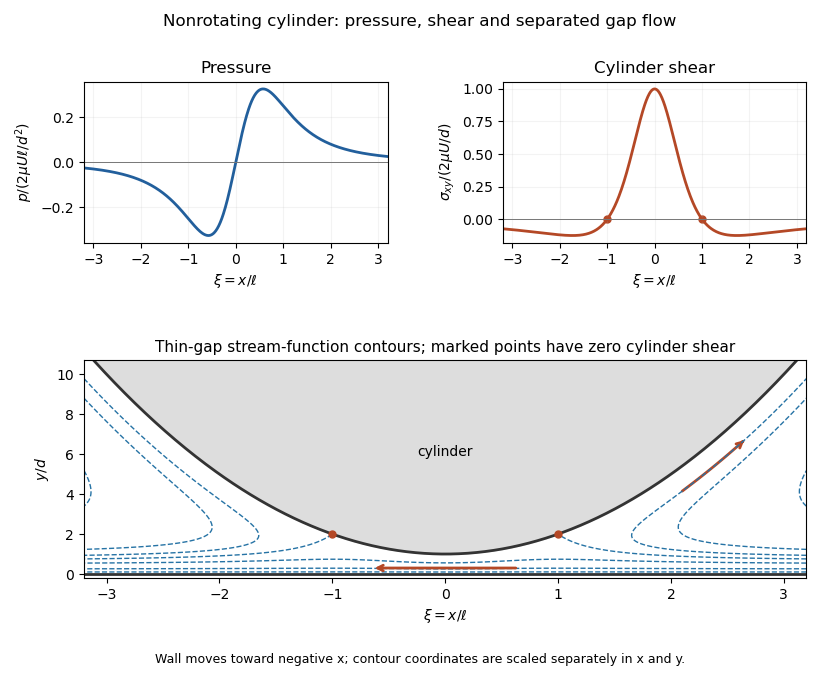
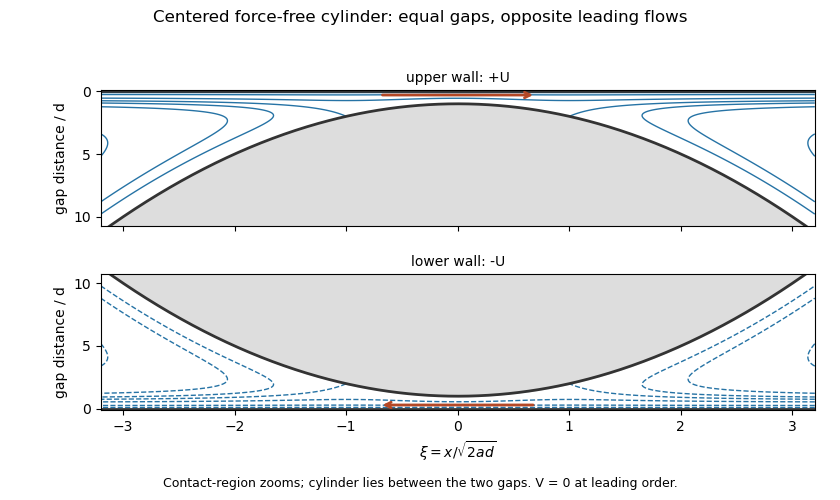
For the final Couette flow, the printed center is an offset parallel to the walls. Translational invariance removes it; the centered two-gap symmetry gives the literal answer for every . A dependence on requires a transverse position, evidently the intended . With that repaired interpretation, the lower and upper gaps are and .
In the translating cylinder frame the wall velocities are and . Each leading tangential drag is times its wall velocity, independent of the rotation. Hence zero net force requires , where . For the intended transverse offset,This formula assumes both gaps remain lubrication gaps, with fixed . It gives at and motion toward the faster nearby wall otherwise.
At , the lower-gap flow is the previous flow and the upper gap its reversed mirror, with fluxes . Their leading translational shear torques vanish. Any finite outer-fluid Couette torque is , while the sum of the gap rotation torques is . Balancing them explains . Leading gap analysis alone does not determine its prefactor.


Articles by others on the same topic
There are currently no matching articles.