Write for the vertical displacement of the sea ice, and take the undisturbed water surface as , with water occupying . The elastic plate has areal mass and bending stiffnessHere is Young's modulus and is Poisson's ratio. We neglect in-plane prestress, viscosity and plate shear deformation, and linearize about hydrostatic equilibrium. These are important assumptions: perfect elasticity alone does not specify every term in a floating-plate model.
For a plane wave , , potential flow in deep water has velocity potential . This solves Laplace's equation and decays downwards. The kinematic boundary condition gives . Linearizing the water pressure at the displaced interface gives an upward excess loadThe elastic plate equation is . Substitution and multiplication by therefore give the flexural-gravity wave dispersion relationEquivalently, with and ,This determines the positive wavenumber implicitly for prescribed positive angular frequency. It is unambiguous: the derivative of is , while runs from zero to infinity.
The phase velocity and group velocity areFor open-water deep-water gravity waves, , and hence and . At large period the ice-covered curves approach these straight lines. At shorter period, plate bending raises the speeds, so both ice-covered curves turn upward as period decreases. In the bending regime with negligible plate inertia, and ; in the formal plate-inertia-dominated limit, and . The latter extrapolation eventually leaves thin-plate validity and should not be read as a prediction at arbitrarily small wavelength.
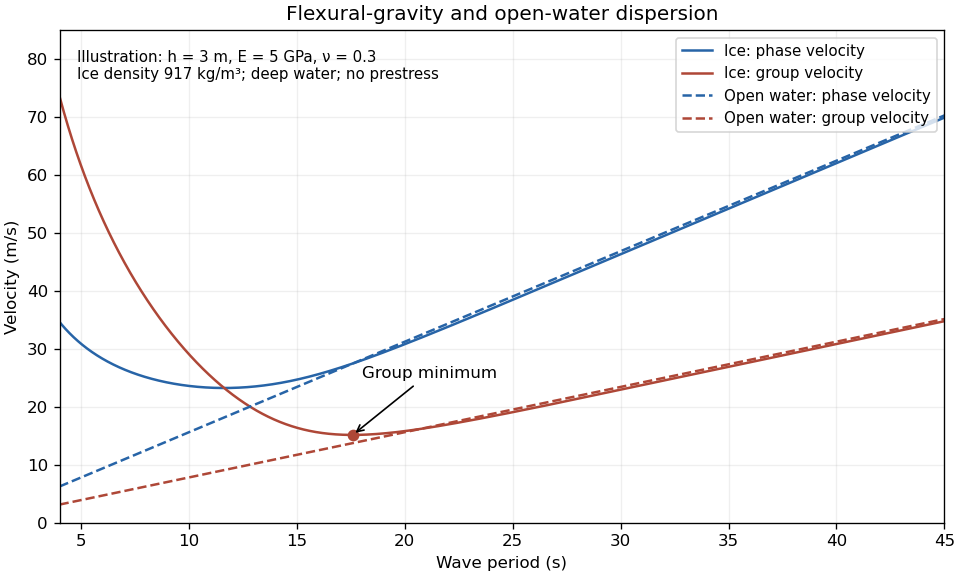

The plotted parameters are illustrative rather than measured at the observation site. They give a group-velocity minimum of a flexural-gravity wave near at period . There is no arbitrarily slow wave-energy branch under a continuous elastic sheet. Energy put into a localized disturbance travels away at at least this minimum group velocity; a slowly moving wind system cannot retain a wave packet indefinitely beneath itself. This reduces the opportunity for sustained local growth compared with slow, short open-water waves, and the continuous cover also prevents direct wind forcing of an exposed water surface. Incoming long swell can still propagate.
A group-velocity minimum of a flexural-gravity wave is not by itself a universal minimum wind speed for wave generation. A steadily translating forcing pattern requires a phase velocity matching its translation speed, so the minimum of , not , supplies the corresponding resonance threshold. Random wind forcing, dissipation and aerodynamic coupling must be specified before making an absolute generation claim.
The sea ice acts as a frequency-selective filter. Over a long path, wave attenuation in sea ice is generally much stronger for shorter surface gravity waves, through repeated scattering, internal ice losses and water-side dissipation. Their amplitude can fall below the tiltmeter's detection level even if the source initially generated them. Thus the long-period swell survives while the shorter-period tail does not.
The disappearance near 14 s is an attenuation and detectability limit, not a forbidden-frequency interval of the ideal elastic plate. The flexural-gravity wave dispersion relation admits a real positive wavenumber for every positive angular frequency. In an impulsive-source picture, shorter-period deep-water gravity waves also arrive later because their group velocity is smaller, but delayed arrival alone does not explain a persistent observed cutoff.
Use a common emission time and a path length , and treat each observed period as a narrow wave packet. For deep-water gravity waves, its group velocity is , not the phase velocity . Therefore the dispersive swell source inversion givesThus period decreases hyperbolically, while frequency increases linearly. The elapsed time between the two observations is , soThe frequency slope is . Initially ; at 14 s it has slowed to . The inferred emission was before the first arrival, namely 19 March at 1710 UT. Both observed endpoints give this same time.
A northward-propagating swell with this distance scale points to a remote energetic storm south of the high Arctic rather than local wind acting on continuous sea ice. Along a meridional route, 3,000 km is about of latitude, putting the source on the scale of the northern North Atlantic and adjacent open seas. A route through Fram Strait is plausible, but longitude and refraction are not supplied, so no particular storm or unique source position follows. Long swell arriving first and steadily increasing frequency are the expected signatures of remote wave dispersion. The distance and time are conditional on an approximately impulsive source and open-water propagation speeds; passage through ice, currents and finite storm duration produce corrections.
Articles by others on the same topic
There are currently no matching articles.