An adiabatic mode corresponds locally to a common displacement along the background history. Its density changes obey for every component. The cosmological perfect-fluid continuity equation then implies that is common to all fluids. Thus, in the common comoving gauge in cosmology relevant to the growing superhorizon mode,Equivalently, the relative entropy perturbation vanishes. A common time-slicing shift preserves this relation because it changes both normalized density perturbations by the same amount.
The flat background Friedmann equation gives . During radiation domination, and the matter background is negligible. Substituting the adiabatic relation into the density equation therefore givesWith , the indicial equation is , so the modes are and .
During matter domination, and the radiation background is negligible. The same calculation giveswhose indicial equation is . Its modes are and . Thus the superhorizon growing density mode of adiabatic matter and radiation satisfies in both eras. The common conformal-time exponent does not imply the same scale-factor dependence: it is in the radiation era and in the matter era.
Once a mode is well inside the horizon, radiation pressure opposes gravitational collapse. For an ideal radiation fluid its cosmological sound speed is , and its density perturbation undergoes subhorizon radiation acoustic oscillations with frequency approximately . Unlike the superhorizon growing mode, its amplitude does not acquire sustained gravitational growth. Free-streaming relativistic components can additionally phase-mix the perturbation; the acoustic-fluid description is the appropriate idealization for the stated system.
During deep radiation domination, the radiation source in the dark-matter equation oscillates rapidly compared with a Hubble time. Its accumulated late-time effect averages away. More quantitatively, an oscillatory source of magnitude gives a rapidly varying particular solution of order when . It can therefore be neglected in computing the slowly varying homogeneous dark-matter growth, although its forcing near horizon entry fixes the integration constants.
The dark-matter self-gravity term is also subleading while . Keeping the leading expansion drag and averaging the radiation source yieldsConsequentlyThis logarithmic growth of matter perturbations during radiation domination is the Mészáros effect. It is the leading behavior well after horizon entry but before equality; close to equality the neglected self-gravity matters. The radiation perturbation is not small simply because it is radiation: its rapid oscillations, rather than a small radiation background density, justify dropping its source for this slow mode.
In matter domination, the radiation source is negligible and cold matter has negligible pressure. The comoving density equation consequently contains no Jeans-pressure term proportional to . On every linear scale, including superhorizon and subhorizon modes, it reduces toThe matter-era growing and decaying density modes are thereforeThe absence of a -dependent pressure term makes the time dependence scale-independent; the coefficients still depend on wavenumber and on the earlier radiation-era evolution. This is linear growth in the stated cold-matter model, before nonlinear collapse or any additional late-time component changes the evolution.
Write for the dimensionless power spectrum. A radiation-era mode enters the horizon at . The early superhorizon law gives : the and factors cancel.
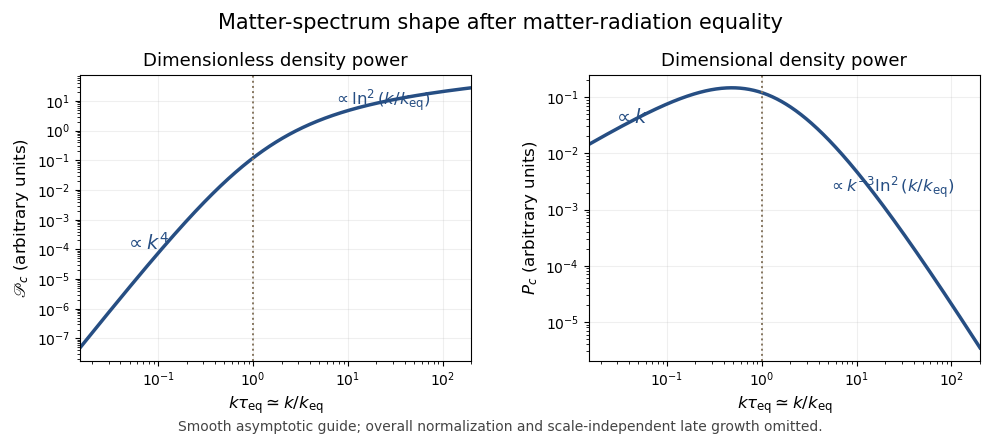
For , the mode remains outside the horizon throughout the radiation era. Its amplitude grows as both before and after equality, and continues with the same scale-independent growing factor even if it later enters during matter domination. Hence the low-wavenumber shape is preserved:For , horizon entry occurs during radiation domination. Its subsequent logarithmic amplitude growth supplies a factor by equality. During the matter era the amplitude grows by . Squaring gives the logarithmic high-wavenumber density-spectrum transfer:The horizon-entry and equality matching fixes order-one coefficients and additive constants inside the logarithm. The displayed branches capture the requested leading spectrum and share its schematic normalization; their asymptotic forms must not be joined literally at , where the high- logarithm alone vanishes.
Thus the present dimensionless power spectrum rises as on large scales and only as on small scales, with a smooth bend near the matter-radiation equality scale, . The ordinary dimensional cosmological density power spectrum instead satisfiesIt has a turnover near equality; the dimensionless spectrum does not. The following comparison of dimensional and dimensionless matter spectra across equality uses a smooth guide with the correct asymptotes, not an exact solution through the transition. Overall vertical normalization and the later scale-independent growth factor are suppressed.

Articles by others on the same topic
There are currently no matching articles.