Put and . Integrating the cosmological perfect-fluid continuity equation for the separately conserved cosmological fluids givesIn particular, is constant. At the present epoch the flat Friedmann equation implies . Nonnegative fluid densities therefore require .
The conformal time relation gives the conformal Hubble parameter . ConsequentlyOn the expanding branch, divide by and use :Eliminating the matter term yields the conformal Riccati equation for matter and a coasting fluid,The nonnegative square root fixes the convenient parameter convention; only enters the differential equation.
For , choose the Big Bang to occur at and retain the expanding solution. The first integral found above isUse . Substitution gives , so . This gives the flat matter-coasting-fluid Friedmann solution:Integrate , with the same zero of time:As a check, , and the identity verifies . Also exactly. At early times and , reproducing the matter-dominated relation .
The endpoint is obtained by taking the smooth limit: and . At the coasting cosmic-string universe instead has and . Its Big Bang is at , so a finite conformal-time origin at the bang is no longer available; choosing at gives and . The physical-age limit remains regular.
Normalize the present scale factor to one. For , the parametric solution givesThus the age of a flat matter-coasting-fluid universe isA direct age integral proves the bound more transparently than manipulating inverse hyperbolic functions. Since ,For and , one has , henceIntegrating givesEquality on the left is the pure pressureless matter universe, ; equality on the right is the pure coasting fluid, . These are all physically allowed density fractions for the nonnegative two-fluid model. The integrand decreases with , so the coasting-fluid age bound is approached continuously between those endpoints. In the closed expression the apparent singularities cancel using ; as , the term vanishes. The limits are respectively and .
Neutrino decoupling occurs when the interaction time ceases to be short compared with the expansion time, or . In natural units, this givesUsing the supplied high-temperature estimate ,Here is the unreduced Planck mass. The scaling explains the direction of the transition: interactions maintain thermal equilibrium at high temperature, but become ineffective as the universe cools. The extra species changes only by a small amount compared with the precision of the estimate.
A collisionless relativistic species redshifts with . The coupled plasma instead obeys cosmological entropy conservation, , and is heated relative to a decoupled species as massive particles annihilate. The effective number of relativistic energy degrees of freedom and effective number of relativistic entropy degrees of freedom coincide while all species share a common relativistic temperature. Use for the Standard Model bath, excluding the already decoupled extra species.
Just before ordinary neutrino decoupling, the coupled bath contains two photon states, four electron/Positron states and six ordinary neutrino/antineutrino states. ThereforeThe extra-neutrino temperature relative to that bath is then . After the ordinary neutrinos decouple, electron/Positron annihilation heats only the photon bath: its entropy count changes from to . Both neutrino populations miss that last heating, soThis is the two-stage entropy dilution of an early-decoupled neutrino. Numerically . Relative to ordinary relic neutrinos it is cooler by .
Let count the extra neutrino's populated helicity and antiparticle states. For one conventional neutrino plus antineutrino species , the same state count as photons. The Fermi-Dirac distribution supplies the number-density factor, soThus a two-state species has about of the photon number density. Stating explicitly also covers a different choice of populated states.
Since the species decouples while relativistic, its comoving particle number is conserved. Once it becomes nonrelativistic, its energy density is . With ,This is a density bound on a relativistically decoupled massive relic. Using literally the printed energy-density coefficient, the supplied number-density coefficient gives . For and ,The estimate scales as . At the bound the particles are safely nonrelativistic today, so neglecting their kinetic energy is consistent.
There is a physical normalization defect in the printed coefficient. Direct integration of the Bose-Einstein distribution giveswhich is also the coefficient consistent with the supplied expansion-rate formula. It implies , rather than . With this physically normalized photon gas, the same density bound on a relativistically decoupled massive relic becomes , or about using the rounded coefficients with in place of . The two estimates differ by the printed factor of ten; the entropy-dilution result is unaffected.
The preceding bound applies to a species that freezes out while relativistic, retaining an unsuppressed thermal number density apart from entropy dilution. It need not apply to a species that is already massive while reactions remain rapid.
For , the interaction strength is sufficient to keep the species in thermal equilibrium through its relativistic-to-nonrelativistic transition. At , the relativistic scaling would give . Subsequent annihilation removes most particle-antiparticle pairs while equilibrium remains possible. At negligible chemical potential, the nonrelativistic equilibrium number density isThis Boltzmann suppression of a nonrelativistic relic can make the eventual abundance much smaller than the relativistically decoupled value. Freeze-out now occurs when , with a nonrelativistic cross-section, rather than by extrapolating the massless rate indefinitely. A large mass can therefore have an acceptably small energy density: a hot-relic mass bound is not a universal bound on a heavy thermal relic.
Compatibility depends on the annihilation rate and any conserved particle-antiparticle asymmetry; the supplied relativistic rate alone does not determine the heavy relic's final abundance. Efficient annihilation is the mechanism that permits large masses within the standard expansion and thermal history.
A light inflaton behaves approximately as a scalar field in de Sitter space while a wavelength is well inside the Hubble radius. Its Bunch-Davies vacuum has quantum fluctuations. Cosmic inflation stretches each Fourier mode until , after which its physical wavelength exceeds the Hubble radius. The nearly constant growing field mode has a typical fluctuation per logarithmic wavenumber interval .
A field fluctuation changes the local position on the rolling background trajectory. Neighboring regions therefore reach the same field value, and the end of inflation, at slightly different times. A clock displacement of magnitude becomes a difference in local expansion of order . Equivalently, in a conventional sign choice the comoving curvature perturbation is related to the field fluctuation on spatially flat slices byChanging the sign convention for spatial curvature changes the sign of , but not its spectrum. This is the inflaton clock-shift origin of curvature perturbations. For a single-field slow-roll attractor there is no independent entropy mode. On a super-Hubble scale, gradient terms are negligible and the superhorizon conservation of single-field comoving curvature preserves the growing adiabatic mode, so fluctuations generated near exit persist as primordial curvature perturbations. This conservation requires the attractor and adiabatic assumptions; a freely chosen non-attractor background would not have the same conclusion.
The slow-roll approximation neglects relative to and kinetic energy relative to the potential. It is self-consistent on the attractor when the potential slow-roll parameter and the second potential slow-roll parameter . ThusHere, as in the inflaton equations, denotes the reduced Planck mass, not the unreduced mass used in the thermal calculation. The slow-roll curvature power spectrum becomesso
To differentiate with respect to horizon-exit scale, write , increasing with physical time. Along the slow-roll trajectory,The difference between differentiating with respect to and contributes only at second slow-roll order to the tilt. Since ,Therefore the scalar spectral index in potential slow-roll parameters isAll background quantities in these expressions are evaluated when the particular mode exits the Hubble radius.
For the quadratic-potential slow-roll solution, , so . Inflation ends when , giving . The slow-roll e-fold count remaining before that endpoint isWith , this gives and . The quadratic-inflation amplitude calibration isMatching the supplied amplitude therefore givesTaking , this is . Retaining produces the small correction; dropping it gives almost the same leading slow-roll estimate.
The scalar spectral index isIt agrees with the supplied central value and lies well inside the stated uncertainty interval. This conclusion concerns the scalar tilt; the tensor prediction is a separate test of the same model.
Divide the primordial tensor power spectrum by the slow-roll curvature power spectrum:Differentiating the scalar-field Friedmann equation and using the inflaton equation gives . Hence . For the quadratic model at 50 remaining e-folds,This is above the supplied upper bound, so the model fails the stated tensor constraint, despite its satisfactory scalar tilt and adjustable scalar amplitude. Calibrating does not reduce , since the coupling cancels from the ratio.
An adiabatic mode corresponds locally to a common displacement along the background history. Its density changes obey for every component. The cosmological perfect-fluid continuity equation then implies that is common to all fluids. Thus, in the common comoving gauge in cosmology relevant to the growing superhorizon mode,Equivalently, the relative entropy perturbation vanishes. A common time-slicing shift preserves this relation because it changes both normalized density perturbations by the same amount.
The flat background Friedmann equation gives . During radiation domination, and the matter background is negligible. Substituting the adiabatic relation into the density equation therefore givesWith , the indicial equation is , so the modes are and .
During matter domination, and the radiation background is negligible. The same calculation giveswhose indicial equation is . Its modes are and . Thus the superhorizon growing density mode of adiabatic matter and radiation satisfies in both eras. The common conformal-time exponent does not imply the same scale-factor dependence: it is in the radiation era and in the matter era.
Once a mode is well inside the horizon, radiation pressure opposes gravitational collapse. For an ideal radiation fluid its cosmological sound speed is , and its density perturbation undergoes subhorizon radiation acoustic oscillations with frequency approximately . Unlike the superhorizon growing mode, its amplitude does not acquire sustained gravitational growth. Free-streaming relativistic components can additionally phase-mix the perturbation; the acoustic-fluid description is the appropriate idealization for the stated system.
During deep radiation domination, the radiation source in the dark-matter equation oscillates rapidly compared with a Hubble time. Its accumulated late-time effect averages away. More quantitatively, an oscillatory source of magnitude gives a rapidly varying particular solution of order when . It can therefore be neglected in computing the slowly varying homogeneous dark-matter growth, although its forcing near horizon entry fixes the integration constants.
The dark-matter self-gravity term is also subleading while . Keeping the leading expansion drag and averaging the radiation source yieldsConsequentlyThis logarithmic growth of matter perturbations during radiation domination is the Mészáros effect. It is the leading behavior well after horizon entry but before equality; close to equality the neglected self-gravity matters. The radiation perturbation is not small simply because it is radiation: its rapid oscillations, rather than a small radiation background density, justify dropping its source for this slow mode.
In matter domination, the radiation source is negligible and cold matter has negligible pressure. The comoving density equation consequently contains no Jeans-pressure term proportional to . On every linear scale, including superhorizon and subhorizon modes, it reduces toThe matter-era growing and decaying density modes are thereforeThe absence of a -dependent pressure term makes the time dependence scale-independent; the coefficients still depend on wavenumber and on the earlier radiation-era evolution. This is linear growth in the stated cold-matter model, before nonlinear collapse or any additional late-time component changes the evolution.
Write for the dimensionless power spectrum. A radiation-era mode enters the horizon at . The early superhorizon law gives : the and factors cancel.
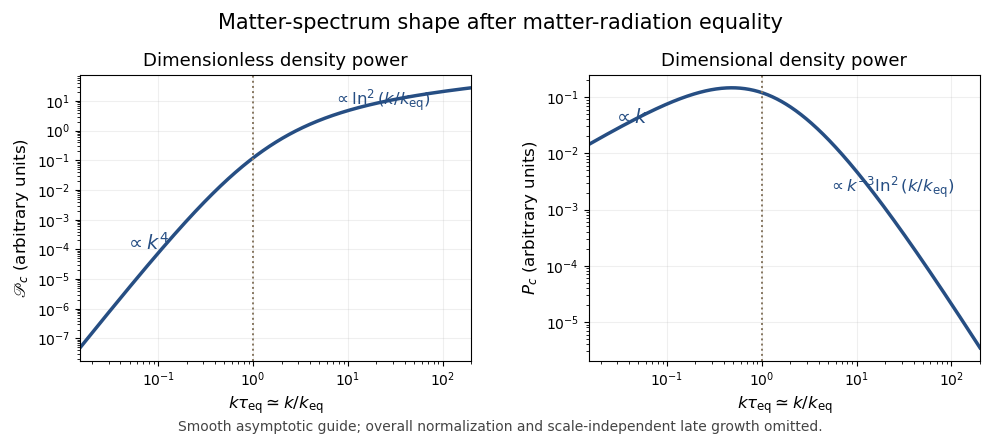
For , the mode remains outside the horizon throughout the radiation era. Its amplitude grows as both before and after equality, and continues with the same scale-independent growing factor even if it later enters during matter domination. Hence the low-wavenumber shape is preserved:For , horizon entry occurs during radiation domination. Its subsequent logarithmic amplitude growth supplies a factor by equality. During the matter era the amplitude grows by . Squaring gives the logarithmic high-wavenumber density-spectrum transfer:The horizon-entry and equality matching fixes order-one coefficients and additive constants inside the logarithm. The displayed branches capture the requested leading spectrum and share its schematic normalization; their asymptotic forms must not be joined literally at , where the high- logarithm alone vanishes.
Thus the present dimensionless power spectrum rises as on large scales and only as on small scales, with a smooth bend near the matter-radiation equality scale, . The ordinary dimensional cosmological density power spectrum instead satisfiesIt has a turnover near equality; the dimensionless spectrum does not. The following comparison of dimensional and dimensionless matter spectra across equality uses a smooth guide with the correct asymptotes, not an exact solution through the transition. Overall vertical normalization and the later scale-independent growth factor are suppressed.

Articles by others on the same topic
There are currently no matching articles.