Take the sky frame and disk frame to be right-handed orthonormal bases, with positive angular displacement measured from toward . In particular, positive is toward the observer, so material crossing the sky plane with positive is at the ascending node. Write , , , and . The disk frame's first unit vector lies along its ascending node, and its second has positive component. The orbital-frame rotation from inclination and node therefore givesEach column is a disk-frame unit vector in sky coordinates, so and the inverse is . At the disk's ascending node, the component of its tangential velocity is positive, confirming the sign of the tilt.
Let define a provisional planet frame whose first axis is the planet's sky-plane ascending node. Its normal is . Expressing that normal in the disk orthonormal basis, with , givesThe last component is the dot product of the two orbital normals, hence the cosine of the mutual inclination. The mutual ascending node points along : motion there has positive disk-normal component. SetThen , and the quadrant-correct longitude of ascending node is . ThusThe tangent alone cannot fix the quadrant, and is undefined for exactly coincident orbital planes.
For the two rotation routes, define as the oriented angle, within the planet's orbital plane, from its sky-plane ascending node to its disk-plane ascending node. If are the first two columns of , take . Both routes describe the same planet orthonormal basis:The left route goes through the disk frame; the right goes through the sky-node planet frame. Comparing their third columns gives the two boxed relations, while comparison of first columns fixes the extra in-plane angle.
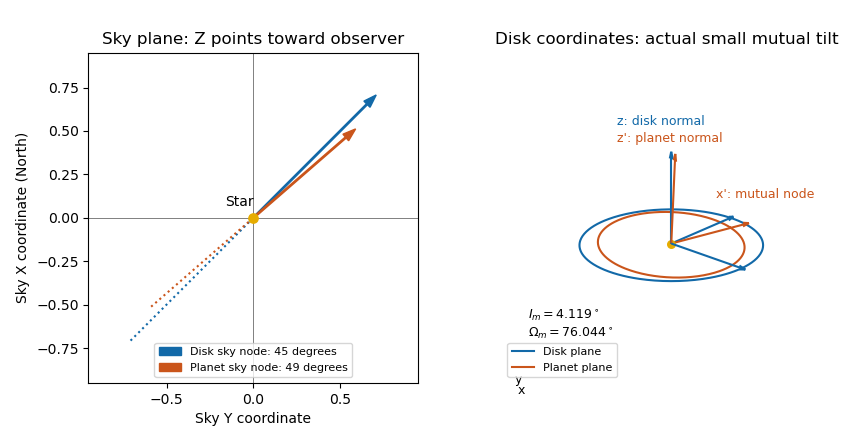
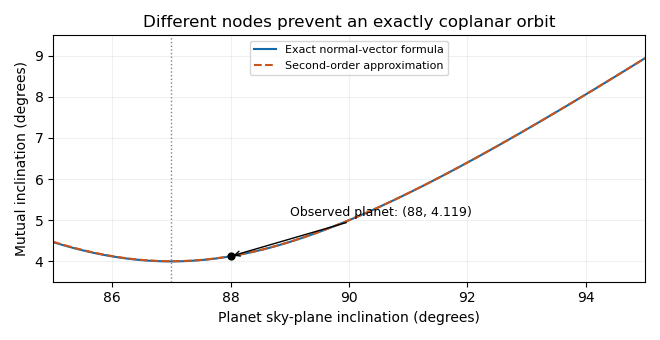
Put and . A second-order Taylor expansion gives , and therefore the mutual inclination of nearly edge-on orbits satisfiesAll expansion angles are in radians. For plotting in degrees this is . The given planet has exact and . The exact minimum occurs at , with . At and , the second-order values are and .
For the disk evolution, neglect disk self-gravity, collisions that align the planes, and back-reaction on the planet. In the initial disk plane, use the complex inclination for a ring and for the planet. Linear Laplace-Lagrange secular theory has forced inclination and solution for initially flat rings. For an inner circular perturber, the Laplace coefficient formula is , with . Its quadrupole approximation uses , yieldingIn the plot referenced to the initial disk, every ring runs clockwise on the same circle centered at , starting at the origin. Inner rings advance more quickly. If the axes are instead referenced to the planet's plane, the relative tilt is : these circles are centered at the origin, and the mutual inclination is constant. Both conventions describe the same nodal precession; they should not be mixed.
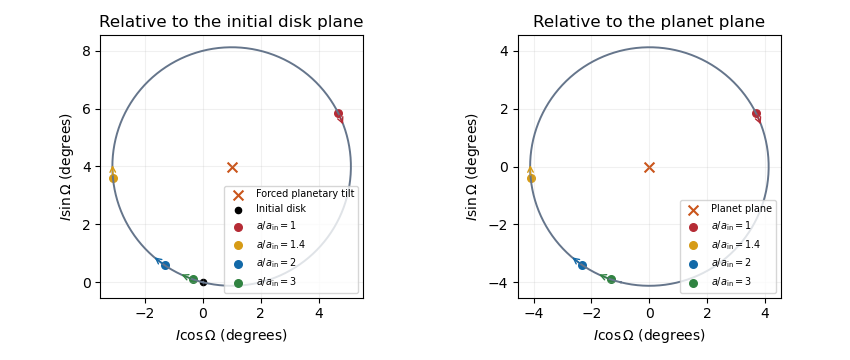
At an intermediate epoch, rings with have tilted substantially while outer rings with remain near the original disk plane. This radial variation is a planet-induced debris-disk warp. The characteristic affected radius grows like . Conservative differential nodal precession preserves each ring's tilt relative to the planet, so it does not by itself align every orbit; an unresolved inner region can acquire a mean plane near the planetary plane through phase mixing. The secular interpretation is also described in Wyatt's planetary dynamics lectures.
Let , , and restrict first to . The radiation-pressure coefficient reduces the grain's central gravitational parameter to , whereas the planet's is approximately . Their mean motions obey . Setting this ratio to gives the radiation-pressure shift of a mean-motion resonance:It lies interior to the planet exactly when , or . Equality puts the frequency commensurability at the planet's radius. For every such commensurability is exterior.
There is a frame qualification in the printed encounter formula. The circular inertial speed of the grain at is . Subtracting the planet's inertial velocity at conjunction gives the local planet-relative inertial speedThis is the velocity used in the question's two-body gravitational assist calculation. In a frame actually rotating about the star at , the grain's tangential velocity is instead , with magnitude . In particular its nonradiating shear is , rather than . Thus the requested expression uses a local translating, inertial encounter convention despite the source's rotating-frame wording. The following derivation consistently uses that convention, and its coefficients are an encounter estimate rather than an exact rotating-frame result.
Take impact parameter and a small gravitational scattering angle . Expanding the supplied hyperbolic scattering relation gives . Initially the relative tangential velocity is ; after the deflection it has tangential component . The relative speed is unchanged in the local hyperbolic Kepler orbit, but the stellar-frame kinetic energy changes. Taking the dot product with the planet's velocity givesThe specific orbital energy of the grain is . Comparing it immediately before and after the encounter at the same position givesConsequentlyThe encounter increases the grain's semi-major axis within this geometry. These steps assume , , and an orbital kick small enough for the subsequent linearization.
Choose the initial conjunction longitude as zero. The synodic period is , and the planet's longitude accumulated by the next conjunction isThese are unwrapped longitudes, counting complete revolutions. The second uses the new mean orbital period while neglecting the encounter's immediate phase offset and the difference between true and mean conjunction. A comparison reduced modulo could not implement the stated one-turn sensitivity test.
For , , so and . Conjunction-longitude sensitivity to an encounter givesRequiring this to exceed gives . At a high-index first-order mean-motion resonance, , henceThe interpretation of the resonance-overlap encounter estimate is loss of coherent encounter phases: a small kick changes the next synodic encounter time by more than one planetary revolution. Resonant protection by repeatedly meeting at controlled orbital phases can then fail, allowing irregular kicks and diffusion. This sensitivity criterion motivates an unstable region; it is not a proof that every orbit or resonant phase in it must escape.
For a quantitative sketch with radiation, put and . Differentiating the conjunction formula and substituting the kick givesEvaluate this at the positive and take as the critical-index curve. At small , increased encounter speed weakens planetary scattering, moving the threshold to larger . As rises further, the radiation-pressure shift of a mean-motion resonance brings each commensurability closer to the planet, strengthening the close encounters. The curve turns over and approaches the exterior-limit boundary . Larger planetary mass produces stronger kicks and a lower critical index. These competing effects are shown below; the curves retain the factors in , so their intercepts differ slightly from the leading high- formula. The boundary for disappearing exterior commensurabilities is geometric; divergence of the encounter approximation near should not be read as a precise physical scattering rate.
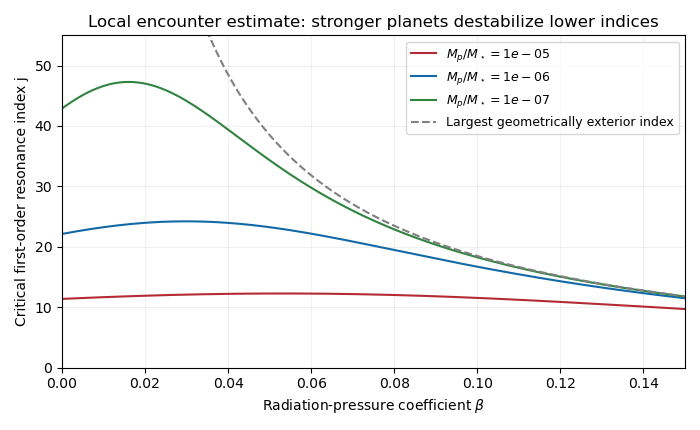
Encounter-estimate critical resonance index versus radiation pressure for three planet-to-star mass ratios
. Details. Write for the physical planet radius and for the debris-cloud radius; the source uses for both even though their stated size orderings are opposite. A central transit duration of a small planet on a nearly circular Kepler orbit is . Kepler's third law, with , givesA noncentral planetary exoplanet transit is shorter, so within the small-radius and nearly circular approximations, a duration requiringis too long for the planet alone and favors extended debris. For a central cloud transit with , the path length is approximately . Using the Hill radius gives , hence the Hill-cloud transit mass estimateThis equality assumes a central cloud chord. An orbit described merely as nearly edge-on need not have central cloud crossings. If its projected cloud impact distance is , the measured half-chord is , so the boxed mass is multiplied by . It is a lower estimate when that geometry is unknown.
For the dynamical calculation use , , and . The derivatives in the supplied Lagrange planetary equations hold the other osculating orbital elements fixed:Since , the physical mean-longitude equation for a first-order resonant term isThe source's epoch notation needs care when varies. Literally differentiating adds ; one cannot retain that definition and also identify the printed with . A consistent version writes and assigns the displayed correction to . Equivalently, the canonical mean-longitude equation for a first-order resonant term follows from the disturbing function directly. The result for is the intended physical equation under that convention.
Away from resonant-argument libration, neglect changes in on one slow cycle to this order. With the reference mean motion, the signed slow frequency isThis is the near-resonant transit-timing superperiod. Choose . Differentiating with the semi-major axis equation givesLet and . Direct integration giveswith zero initial mean longitude. The constant and linear terms are absorbed into the fitted transit ephemeris: the measured mean frequency is . This distinction avoids mistaking an arbitrary initial frequency for the long-term fitted period.
For , the double-integrated frequency term dominates the direct term provided stays finite. Relative to the fitted linear ephemeris, givesHere denotes the fitted mean period at the retained order. The signed-frequency convention fixes the phase sign. Replacing by changes the sign of the signed when needed; a nonnegative amplitude hasUsing a signed instead gives the source's signed proportionality . The leading implicit transit equation can equally use inside the sine, since the difference is higher order in the perturbation. This is the eccentricity-enhanced near-resonant transit-timing variation; its derivation assumes small longitude oscillations, at fixed resonance coefficients, and the effectively fixed eccentricity used in this truncated model. Dominance over forced-eccentricity timing terms typically also requires at fixed . A full transit calculation also includes forced orbital eccentricity and the conversion from mean longitude to the actual sky-crossing angle. Those are lower order in this eccentricity-enhanced regime, rather than identically absent; broader near-resonant formulas are derived by Lithwick, Xie and Wu.
Inside a mean-motion resonance, undergoes resonant-argument libration and its evolution must be solved together with . The constant circulation frequency and the associated expansion then fail. At approximately fixed eccentricity, the resonant resonant pendulum approximation has libration frequency of order , up to numerical factors. The transit-timing variation follows that libration period and depends on its libration amplitude of a resonant argument. Exactly at a resonant equilibrium there need be no libration signal; near a separatrix the period grows, and eccentricity dynamics can modify the simple estimate. Resonant amplitudes remain controlled by the bounded resonant motion rather than diverging as the circulating detuning tends to zero.
Let be the mass processed by catastrophic impacts in logarithmic bin . Steady mass conservation requires the same downward mass flux across every interior size threshold. A scale-independent fragment redistribution function makes the transfer kernel depend only on the number of logarithmic bin steps. Consequently a self-similar interior steady collisional cascade has , independent of size: a constant processed mass per bin supplies the constant flux, with the same kernel-dependent proportionality at every bin. This is the constant mass flux in a collisional cascade result, away from injection and removal cutoffs. Size-independent fragmentation does not eliminate boundary waves at the very ends of a finite distribution.
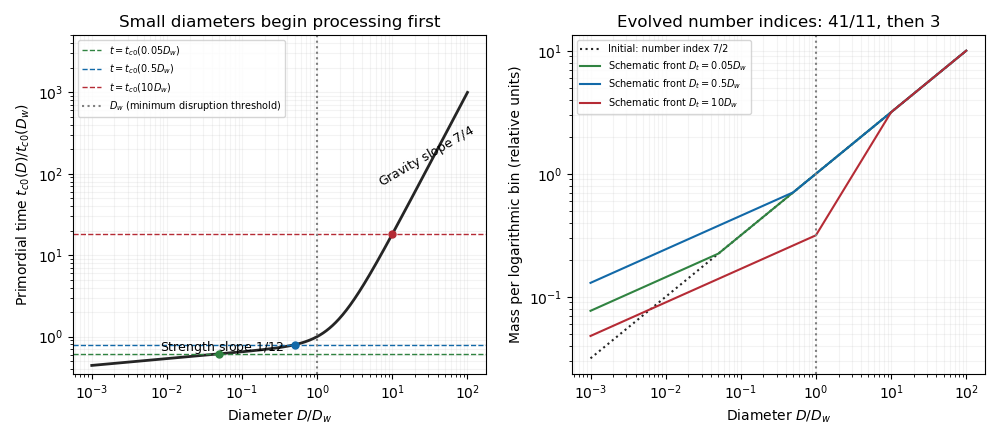
For equal-density planetesimals, body mass is proportional to and a fixed logarithmic bin contains a number proportional to . The mass per logarithmic size bin is therefore . With the given catastrophic planetesimal collision rate, givesConstant mass flux in a collisional cascade sets the exponent to zero, yielding the strength-dependent steady collisional-cascade slopeThe time to change an order-one fraction of a bin's mass is . Its collisional-cascade relaxation time is thus . The contemporaneous projectile population must be used when a different part of the distribution has already evolved.
For the primordial differential-number index , the collisional-cascade relaxation time isIt has asymptotic logarithmic slope in the strength regime and in the gravity regime. It increases monotonically: its logarithmic derivative is , ranging from to . In particular the minimum of the catastrophic disruption threshold at is not a minimum of the collision time. The strength-gravity disruption transition obeysSmall sizes start evolving first. Before , the whole distribution is nearly primordial. At intermediate times, a transition diameter with separates processed small sizes from mostly primordial larger sizes. The steady strength-regime index is , while the gravity-regime index is . Thus a plot of mass per logarithmic size bin has slopes and in the two evolved regimes, compared with the primordial slope . Once , both steady slopes appear below the remaining primordial tail. The transition moves to larger sizes, and the normalization eventually decays as the largest bodies are depleted. Sharp joined power laws are a schematic description; detailed kernels produce smooth transitions and possible waves.


For the uniform depletion, the binary-collision evolution operator is quadratic in all bin masses: . Let be the undepleted trajectory and suppose . Differentiating verifies the exact scaling within this fixed-kernel collision model,Immediately after depletion the shape is unchanged and the catastrophic planetesimal collision rates are reduced by . Further evolution therefore proceeds times more slowly on the original trajectory. The processed-to-primordial transition initially remains at , then advances on the stretched collision clock.
A collision-only model starting with the smaller initial normalization has trajectory . Matching the observed depleted distribution requires . Hence the collisional age after uniform dynamical depletion isThe lower observed normalization would make it appear that slow collisions had taken much longer to produce the existing break. Shape and normalization alone cannot determine without independent information about age, initial mass, or depletion history.
Finally, count all impacts exceeding the strength threshold , including impacts which also disperse the target. This is the source's inclusive rubblising convention; a bound-remnant rubblising collision alone would exclude the dispersing impacts. In the evolved gravity-regime projectile approximation, , so the given threshold-rate law gives the rubblising-to-dispersal collision-rate ratioAt the collisional front , the age is of order one catastrophic collision time. Thus the expected number of strength-shattering impacts has the large- scalingThis is the requested scaling. It is not an exact unit-coefficient identity from the stated assumptions: using the true minimum diameter gives . The actual cumulative number is , not automatically , and its coefficient depends on evolution of the projectile population. The estimate also assumes the relevant projectiles sample the gravity-regime slope; sampling the strength or primordial slope changes the exponent. The steady-cascade framework and evolving transitions are developed by Wyatt, Clarke and Booth.
Articles by others on the same topic
There are currently no matching articles.