Take positive upwards and let denote axial body force per unit volume. With inertia and surface tension omitted, the extensional equations for a slender Newtonian column areMass conservation gives the first equation. The second uses the Trouton ratio three: the leading radial velocity is , the radial normal traction gives , and the axial stress is . An axial control volume balance then gives the displayed equation. The approximation requires a slender column and slowly varying radius.
Let . Since the container base is closed, the total volume flux at every section is zero. The column carries flux , so the annulus carries and has mean speed of order . Its interfacial shear stress is therefore of order . Transmitting this stress through the core produces an axial velocity variation of order . The plug-flow criterion for a column in a low-viscosity annulus is consequently
Use modified pressure , removing the annular fluid's hydrostatic pressure. In a local planar gap, with at the column and at the container wall, lubrication theory givesThe required return flux per unit circumference is to leading order in . Its pressure-driven component is larger than the Couette component by , so the annular return flow around a slumping column givesThe annular shear contribution to the integrated axial force is smaller than this pressure-gradient term by . Retaining the leading terms and substituting gives the dimensional equationsThe boundary conditions are at the base and at the free upper end; the latter expresses zero excess axial extensional stress.
For , defineThis function records the leading thin-annulus resistance; differences from curvature and the Couette term enter at the already neglected relative order . Choose the extensional screening length of a slumping column and the associated scales asHere denotes the initial annular gap in this question. With , and , the dimensional equations reduce to
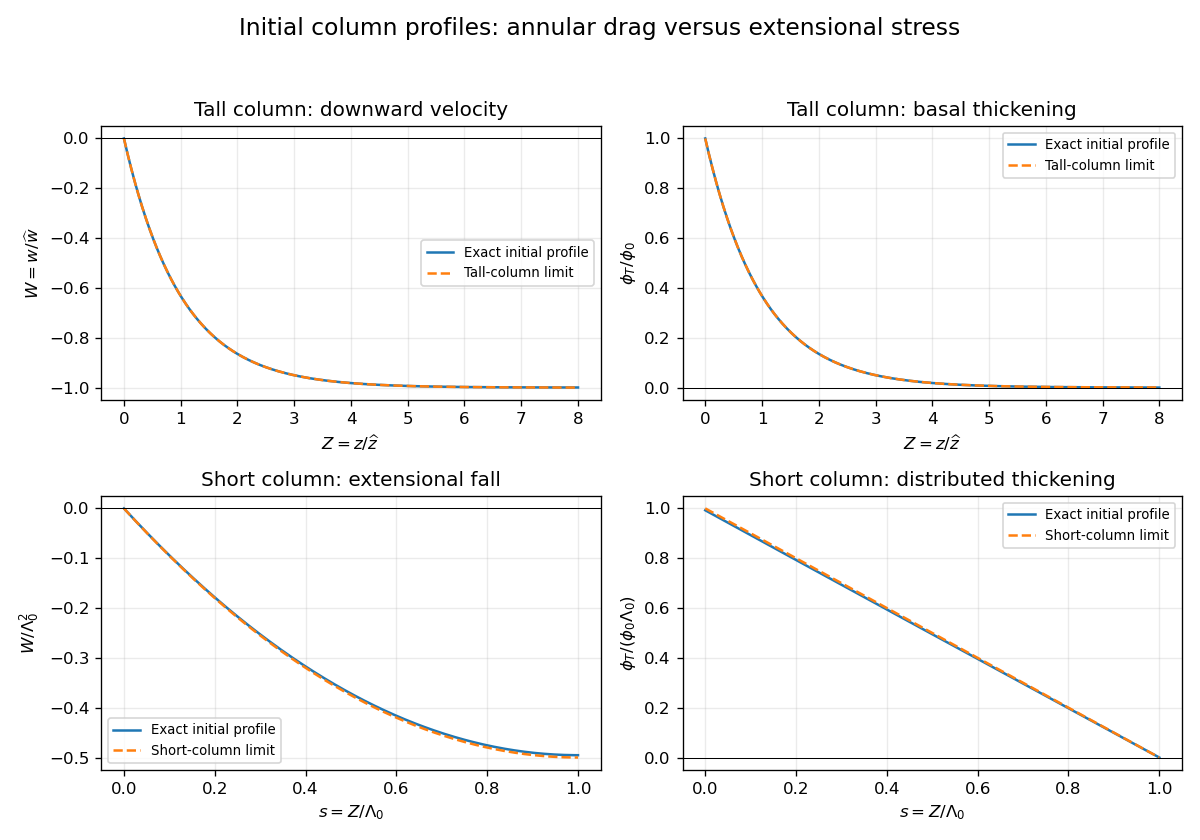
Initially and , so , with and . The initial velocity profile of an annularly confined column isThe column thickens everywhere below its stress-free top, while that initial thickening rate is zero at the top.
For a tall column, , the limiting forms away from exponentially small end corrections areThe bulk falls at approximately , where excess weight balances annular hydraulic resistance. Extensional stresses adjust this velocity to zero in a basal boundary layer of thickness ; almost all thickening occurs there.
For a short column on this scale, , while still slender, the limits areThe annular-resistance term is small, so excess weight is balanced predominantly by extensional viscous stress. The top speed is , recovering the zero-annular-viscosity result. Thus is the vertical distance over which extensional stress communicates the basal constraint before annular resistance screens it. The sketches below use separate natural normalizations for the two limits.
Articles by others on the same topic
There are currently no matching articles.