Take positive current around , so it runs upward through the bar. With , the oriented magnetic flux is and the motional electromotive force is . Ohm's law therefore givesIf , the bar current is ; if , it is . The induced part opposes the battery for a bar moving to the right when .
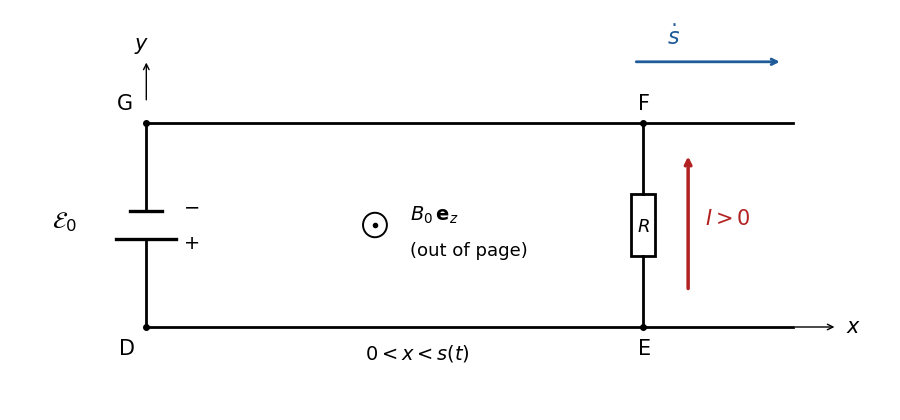
Sliding-bar circuit with positive current upward and magnetic field out of the page
. The Lorentz force on the current-carrying bar isThere is no friction force along the rails. The battery part accelerates the bar rightward for positive , whereas the induced-current part is the opposing force .
For , Newton's second law givesDefine the exponential relaxation time and terminal velocity . Solving the first-order equation for and then integrating givesBoth prescribed initial values hold. The current approaches zero as the bar approaches terminal velocity. If , there is no magnetic force and instead , ; the constant current is .
For and , and . The instantaneous Joule heating isHence the energy dissipated up to time and its infinite-time value areThe remaining kinetic energy is , so kinetic energy plus dissipated heat equals the initial kinetic energy at every time. The magnetic field redirects charge motion, and the circuit transfers mechanical energy to heat through the electric forces; there is no battery input in this case. If , no current is induced, no energy is dissipated, and all the initial kinetic energy remains.
For motion to the right in , , the induced current is clockwise. Its own magnetic field points into the page inside the circuit, opposing the increase in external flux, as required by Lenz's law. As that current changes, its changing flux also produces an electromotive force opposing the change in current: the circuit has inductance.
Consequently the algebraic current law used in parts (i)-(iv) must be replaced by a dynamical circuit equation that includes the derivative of the self-flux. The induced current cannot in general adjust instantaneously to the bar velocity. Energy is temporarily stored in the self-field and can later return to the motion or be dissipated; the simple exponential braking law can change. Self-field forces and changes of inductance with circuit geometry may also matter. The magnetic self-field changes the transient dynamics but does not create energy: mechanical energy, magnetic-field energy and Joule heat must be included in the conservation balance. A quantitative answer would require the circuit's inductance and its dependence on .
Articles by others on the same topic
There are currently no matching articles.