A permutation representation is a group homomorphism , equivalently a group action on a set . The left regular action takes and . Each such map is a bijection, and . If is the identity, evaluating at the identity element gives . Thus the representation is faithful. Numbering the elements of identifies with the symmetric group , proving Cayley theorem:For a nonabelian simple group, compose this faithful representation with the sign of a permutation homomorphism . Its kernel is a normal subgroup of , hence either trivial or all of . A trivial kernel would embed in a group of order two, contradicting noncommutativity. Therefore every represented element is even, and the same representation embeds in the alternating group .
Finally let act on the two cosets of its normal subgroup . An even permutation fixes both cosets, whereas an odd permutation exchanges them. This gives with kernel ; explicitly, send even permutations to the identity and odd permutations to .
The sequence has uniform convergence on if there is a function such thatThe same must work for every . Equivalently, the supremum of the error over tends to zero. In pointwise convergence, is allowed to depend on .
For each fixed , , so the pointwise limit is . Howeverfor every fixed . Hence the error has infinite supremum on and the convergence is not uniform. This does not contradict uniform convergence on any smaller closed interval , , where the error is at most .
For , , and the numerical series converges. The Weierstrass M-test therefore gives uniform convergence to . More explicitly,The bound is independent of , including points arbitrarily close to one.
For each fixed real , , so the pointwise limit is zero. But for every . Alternatively, gives error one whatever is. Thus the convergence is not uniform on . It is uniform on each bounded interval, where .
The pointwise limit is zero, including at . Differentiation givesso the maximum on is attained at and equals . Thereforeand the convergence is uniform, even though the domain is unbounded.
The convention in this question counts a point whenever every open neighbourhood meets , without excluding the point itself. These are adherent points, whose set is the closure ; they differ from limit points under the convention that requires a different point of in each neighbourhood.
If is a closed set and , the open set is a neighbourhood of disjoint from . Thus every adherent point lies in . Conversely, if every adherent point lies in , each has an open neighbourhood disjoint from . Their union is , which is open. Hence is closed exactly when it contains all the points specified in the question.
The interior of a set and closure areThe neighbourhood description of the closure follows because failure to be adherent is equivalent to lying in an open set disjoint from .
For closure of a connected set, suppose were a separation into two nonempty relatively open sets. Their intersections with the connected subset would separate unless one intersection were empty. Say . Choose and an open set with and . Since , the set meets , contradicting . Thus the closure of a connected set is connected. The empty-set case holds directly.
Use Fourier inversion with the stated Fourier transform convention:For , close the contour integral in the lower half-plane, where decays. Jordan lemma eliminates the large semicircle. The contour is clockwise, so the residue theorem supplies times the residue at . That simple pole hasConsequentlyThe minus sign uses both the clockwise orientation and the residue ; it is consistent with the full odd function away from zero.
For a finite triangulation of a surface of the sphere, Euler formula for a sphere iswhere , and count vertices, edges and triangular faces. Since each face has three edges and each edge borders two faces, also .
Let and count the pentagonal and hexagonal faces. Counting incidences of edges with vertices and faces givesThe Euler formula for a sphere also applies to this polygonal decomposition: triangulating a polygon by adding one diagonal increases both and by one, preserving . Substitution givesThus there are exactly 12 pentagons, independently of the number of hexagons.
Lift the angular coordinate continuously to a real coordinate and write and for a prescribed winding number . Assume for the calculation; reversing the endpoints changes no length. The arc length functional on the circular cylinder isThe Euler-Lagrange equation says is constant. This expression is strictly increasing in , so is constant. The candidate is the helixIt is a global minimum within the chosen winding class: the integrand is strictly convex, and Jensen inequality bounds the functional below by , with equality only for constant slope. Equivalently, unrolling the cylinder makes the minimizing path a straight segment.
The signed pitch of a helix, measured for an increase of in angle, isIts geometric magnitude is . If only the physical endpoints are fixed, choose the integer minimizing ; opposite points may give two equally short helices. If the lifted endpoint angles are prescribed, use that winding class. A zero angular increment gives a straight generator, the limiting infinite-pitch case.
Away from , a Green function for this second-derivative operator is linear in . The left boundary condition makes it on , and the right Neumann boundary condition makes it constant on . Continuity gives . Integrating the distributional equation through the Dirac delta function gives the jump , so . ThereforeApply the Green function to the forcing:Evaluation yieldsIndeed , so , and . A difference of two solutions is linear with these homogeneous boundary conditions, hence zero; the boundary value problem has a unique solution.
For a particle of mass , the probability density and one-dimensional probability current areThe Schrodinger equation and its complex conjugate, for real , giveThe potential terms cancel precisely because is real. Thus , the continuity equation for probability. Integrating over an interval says that its probability changes by the incoming current minus the outgoing current.
The global time-dependent phase cancels from the probability current. Put . Direct multiplication givesThe second term is real, because the expression in parentheses is purely imaginary. HenceThe first plane wave travels to the right with incident current ; the second travels to the left with reflected current . Their wave interference changes the probability density but cancels from the net current. The current vanishes for , is positive for , and is negative for . These plane waves are scattering states, not individually normalizable bound states.
Let and let be the first visit to strictly after , with if there is none. Put . The Strong Markov property at each finite first return time gives, by induction,The number of visits, including time zero, is . By Tonelli theorem for nonnegative terms,If , this geometric series is , and is the probability of never returning. If , every term of the final series is one and both sides are infinite. Thuswith the prescribed infinite-value convention. This covers both transient states and recurrent states.
The real and imaginary parts of the operator are uniquelyThey are self-adjoint operators, and . Conversely such a decomposition has . Expanding both products givesConsequently is a normal operator exactly when its self-adjoint real and imaginary parts commute.
We prove the finite-dimensional spectral theorem for normal operators by induction on dimension. A complex linear operator has an eigenvector with eigenvalue , by the fundamental theorem of algebra. For a normal operator , the operator is also normal, andfor every . Applying this to shows .
Normalize . Its orthogonal complement is invariant under both and : the adjoint operator identities pair with through , and with through . The restricted operator on remains normal, and its adjoint is the restriction of . Induction supplies an orthonormal eigenbasis of , which together with gives one for .
Conversely, in an orthonormal basis of eigenvectors, is diagonal and is the diagonal matrix of the conjugate eigenvalues. The two diagonal operators commute. Thus normality is equivalent to an orthonormal eigenbasis. The zero-dimensional case is immediate.
If , then commutes with its adjoint because it commutes with every polynomial in itself. Hence is a normal operator.
Conversely let be the distinct eigenvalues of a normal . The orthonormal eigenbasis from part (ii) reduces the desired identity to . Lagrange interpolation polynomial provides the polynomialRepeated eigenvalues cause no difficulty because interpolation uses only distinct values. If , use . This proves both directions of the third equivalence.
An algebraic integer is a complex number satisfying a monic polynomial with integer coefficients. Let be the monic minimal polynomial of . It is irreducible over . If is a monic polynomial vanishing at , then divides over . Gauss lemma for polynomials implies that monic rational factors of a monic integer polynomial have integer coefficients. Thus , and its irreducibility over implies irreducibility in .
For with , division by the monic works in , giving with . Since , minimality forces . Conversely each multiple of vanishes at . ThereforeWriting , division by expresses every element uniquely as with integer coefficients. A relation among these powers would be a nonzero vanishing polynomial of degree less than . Hence form a basis of the free module over .
The polynomial satisfies the Eisenstein criterion at the prime two: every nonleading coefficient is divisible by two, and the constant coefficient is not divisible by four. Thus it is irreducible over and is the minimal polynomial of every one of its roots. Part (a) givesButIn the quotient, the two nonzero classes of and multiply to zero. They are nonzero because their nonzero representative degrees are less than five. The quotient is not an integral domain, so is not a prime ideal.
For ring homomorphisms preserving the identity, an image of in the Gaussian integers would satisfy . The minimal polynomial of over would then be , of degree five. This is impossible because has degree at most two. Thus there is no unital homomorphism . If homomorphisms are instead allowed not to preserve the identity, the zero map exists; every nonzero homomorphism into this integral domain is unital, because the image of one is a nonzero idempotent and hence one.
The multiplicative field norm on this ring isIf an element is a unit, its positive integer norm has a multiplicative inverse in the positive integers, hence is one. The only integer solutions of are . Therefore the units are exactly and .
The standard failure of unique factorization isThere is no element of norm two or three: gives norm at least five, while gives a square. An alleged nontrivial factorization of (norm four), (norm nine), or (norm six) would require a factor of norm two or three. Thus all four displayed factors are irreducible elements. No factor in the first factorization is associated to a factor in the second, since associates have the same norm and the norms are respectively four, nine and six. Hence is not a unique factorization domain.
For a metric space , uniform continuity meansThe choice of is independent of the points. A Lipschitz continuous function satisfies for one finite constant . Choosing proves Lipschitz continuity implies uniform continuity.
Let be a Cauchy sequence. For a given , uniform continuity supplies , and the Cauchy property supplies with for . Then , so is Cauchy in . By completeness of the real numbers, converges, even if the original sequence has no limit in .
Suppose the continuous were not uniformly continuous. There would be an and pairs with but . Sequential compactness gives a subsequence . The triangle inequality gives as well. Continuity at then gives , a contradiction. Thus is uniformly continuous.
It need not be Lipschitz continuous. On the sequentially compact interval , the continuous function hasNo finite Lipschitz constant exists.
For each , density of allows a sequence with . If are two continuous extensions, continuity givesThus a continuous extension is unique if it exists.
Now assume is uniformly continuous. Each chosen is a Cauchy sequence, so part (a), applied to , shows that converges in . DefineThis is independent of the choice: for another in , , and uniform continuity gives . At , comparison with the constant sequence proves .
To prove uniform continuity of the extension, choose so that whenever and . If , choose sequences and in . For large , both approximation distances are less than , so . Passing to the limit gives . The same works for all . Therefore the extension exists and is uniformly continuous. No completeness of is needed; completeness of the target is the relevant requirement.
Let be a closed triangle contained, together with a neighbourhood, in the domain of a holomorphic function . We prove Cauchy theorem for a triangle without assuming continuity of .
Join the edge midpoints to subdivide into four triangles, each with half its diameter and perimeter. Their positively oriented contour integrals sum to the integral around , because the internal edges cancel. At least one subtriangle has integral of modulus at least one quarter of the original. Repeat that choice to obtain nested closed triangles satisfyingTheir intersection is a single point , by compactness and shrinking diameter. complex differentiability at a point at givesThe first two terms have polynomial primitives, hence integrate to zero around each triangle. For sufficiently large , on , so the complex line integral estimate givesCombining the bounds gives . Since is arbitrary,The orientation can be reversed with no change to the conclusion.
For a closed piecewise continuously differentiable curve avoiding , its winding number isEquivalently, for a parametrization , it is , summed over the smooth pieces. A continuous choice of the argument of along the parameter interval changes by an integer multiple of between the endpoints; that integer is the winding number.
For every closed piecewise smooth curve in , the winding number of about zero is the integerIf for a holomorphic th root, is nowhere zero, andThus is divisible by every for which a root exists. An infinite subset of the positive integers is unbounded, so a fixed integer divisible by all those must be zero. Hence all periods of the holomorphic function vanish.
Fix . Since a domain is connected and open, its points can be joined by piecewise smooth paths. Vanishing periods makeindependent of path. It is a holomorphic primitive with . Differentiating gives , so . Choose a complex number with . ThenThis constructs a global holomorphic logarithm without requiring to be simply connected.
Cross-ratio conventions differ by permutations. Use the following ordering, which gives the signs requested in part (c):Values involving infinity are defined by limits. This is the cross-ratio with second point mapped to zero: the Möbius transformationsends to and sends to .
For , , the identityshows that all factors cancel in the cross-ratio. This proves Möbius invariance of the cross-ratio, with the cases involving infinity following by limits. Algebraic subtraction also givesThe latter expression is another common ordering for the cross-ratio; keeping the convention explicit prevents an incorrect reciprocal or sign.
With from part (a), the first, second and fourth points map to . The inverse image of the extended real line under a Möbius transformation is a generalized circle, meaning a circle or a line together with infinity. Thus, if is real, all four original points lie on that generalized circle.
Conversely, if the four points lie on one generalized circle, its image under is another generalized circle containing . A generalized circle containing infinity is a line, and the line through zero and one is the real line. Therefore is real. Hence the cross-ratio is real exactly when the four points are concyclic or collinear.
Write with . In the identitythe phase factors cancel in the cross-ratio. In our convention the two numerator sine factors are negative, while the denominator factors have opposite signs. Thus , and the exchanged cross-ratio is greater than one. Consequently .
Taking absolute values of the two formulas in part (a) givesMultiplying by the common positive denominator proves Ptolemy theorem:The product of the diagonals equals the sum of the products of opposite sides.
Use the Fourier transform . For a rapidly decaying smooth function, integration by parts gives , and differentiation under the integral gives . Both are justified here by Gaussian decay. Since ,The Gaussian integral supplied in the hint gives . Solving this first-order equation yieldsThe calculation states the transform normalization and the two differentiation properties explicitly.
Taking the spatial Fourier transform of the diffusion equation gives and . Hence . Fourier inversion and the Gaussian transform from part (a), or direct evaluation of the inverse Gaussian integral, give the heat kernelSubstituting the integral for and interchanging absolutely integrable terms produces the convolution solutionFor the stated nonnegative compactly supported data, understood to be nonzero on a set of positive measure, the kernel is strictly positive everywhere. Therefore for every real and every . Property P holds: diffusion has infinite propagation speed. The distant value can be extremely small, but is not zero. For continuous initial data, any nontrivial nonnegative automatically has the required positive-measure set.
For the wave equation, introduce characteristic coordinates , when . The equation becomes , so . The initial conditions imply and . Constants can be absorbed into , giving the D'Alembert formulaIf vanishes outside , then whenever . Thus Property P fails: the wave equation has finite propagation speed . No arbitrarily short time can transmit the disturbance arbitrarily far. If , the zero initial velocity instead gives , and the conclusion still holds.
Use the physical Coulomb bound state boundary condition: the spherically symmetric wavefunction is regular at the origin and square integrable with measure . For , setAt large , the decaying branch behaves exponentially as . Substituting into the radial Schrodinger equation givesThe regular solution has a power series , with recurrenceA nonzero regular solution has . If the series does not terminate, its coefficients eventually have one sign after choosing an overall real phase. For any fixed and sufficiently large , the ratio of consecutive magnitudes is at least . The tail therefore grows at least as a positive constant times divided by a power of ; a finite polynomial of earlier terms cannot cancel it. Multiplication by leaves exponential growth, contradicting normalizability.
Thus the series must terminate at degree , where and is a positive integer. Conversely, termination gives a regular polynomial times , which is normalizable. ThereforeThese are the members of the hydrogen spectrum. Regularity at the origin is essential: square integrability alone on the punctured radial interval would also admit a singular branch. Such a branch is not a physical eigenfunction of the ordinary three-dimensional Coulomb Hamiltonian; its singularity introduces an inadmissible point-source contribution. In the reduced radial variable , the physical condition is .
The agreement is in the energy levels, not in electron trajectories. The Bohr model assumes a particle on a circular orbit, with orbital angular momentum quantized as . The Coulomb bound states here are spatially distributed wavefunctions with no definite classical orbit. Their probability density is spherically symmetric, and their orbital angular momentum is zero because . Their radial distributions also depend on and can have nodes. A real radial wavefunction times a global stationary phase has zero probability current, unlike the circulating point charge in the Bohr picture.
For a moving closed circuit bounding an oriented surface , Faraday's law isHere is the electric field, the magnetic field, the local velocity of a circuit element, and the electromagnetic electromotive force per unit charge around the circuit. The line orientation and normal obey the right-hand rule. The flux derivative is a total derivative and includes both changing field and changing surface. The term is the motional electromotive force. A battery contributes an additional non-electromagnetic source electromotive force.
Take positive current around , so it runs upward through the bar. With , the oriented magnetic flux is and the motional electromotive force is . Ohm's law therefore givesIf , the bar current is ; if , it is . The induced part opposes the battery for a bar moving to the right when .
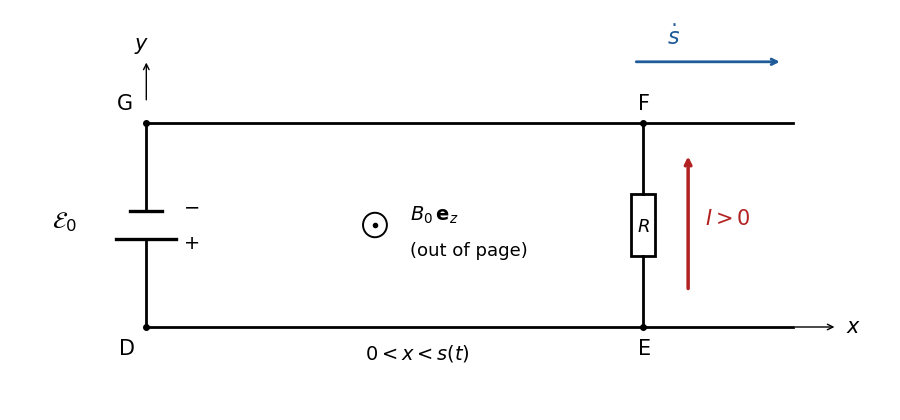
Sliding-bar circuit with positive current upward and magnetic field out of the page
. The Lorentz force on the current-carrying bar isThere is no friction force along the rails. The battery part accelerates the bar rightward for positive , whereas the induced-current part is the opposing force .
For , Newton's second law givesDefine the exponential relaxation time and terminal velocity . Solving the first-order equation for and then integrating givesBoth prescribed initial values hold. The current approaches zero as the bar approaches terminal velocity. If , there is no magnetic force and instead , ; the constant current is .
For and , and . The instantaneous Joule heating isHence the energy dissipated up to time and its infinite-time value areThe remaining kinetic energy is , so kinetic energy plus dissipated heat equals the initial kinetic energy at every time. The magnetic field redirects charge motion, and the circuit transfers mechanical energy to heat through the electric forces; there is no battery input in this case. If , no current is induced, no energy is dissipated, and all the initial kinetic energy remains.
For motion to the right in , , the induced current is clockwise. Its own magnetic field points into the page inside the circuit, opposing the increase in external flux, as required by Lenz's law. As that current changes, its changing flux also produces an electromotive force opposing the change in current: the circuit has inductance.
Consequently the algebraic current law used in parts (i)-(iv) must be replaced by a dynamical circuit equation that includes the derivative of the self-flux. The induced current cannot in general adjust instantaneously to the bar velocity. Energy is temporarily stored in the self-field and can later return to the motion or be dissipated; the simple exponential braking law can change. Self-field forces and changes of inductance with circuit geometry may also matter. The magnetic self-field changes the transient dynamics but does not create energy: mechanical energy, magnetic-field energy and Joule heat must be included in the conservation balance. A quantitative answer would require the circuit's inductance and its dependence on .
Use the standard ideal-fluid assumptions of incompressible flow, inviscid flow, gravity , and no surface tension. Irrotational flow gives in each layer, and incompressibility gives Laplace equationThe rigid-wall boundary conditions are at and at . At the moving interface, each fluid has the same normal velocity as the interface:The dynamic condition is continuity of pressure, at . Bernoulli equation in each fluid reads . Choosing the potential gauges to subtract a common reference pressure, the interface condition becomesTangential velocities need not agree across an inviscid interface.
Linearize about the flat interface at rest, , . Both potentials still satisfy Laplace equation, now on the fixed strips and , with the same rigid-wall conditions. Discarding products of perturbations and evaluating the interface conditions at givesFor a normal mode proportional to , the vertical profiles satisfy , the interface velocity is , and the wall-normal derivatives vanish. Smallness of the amplitude relative to wavelength and layer depths justifies this linearization.
Articles were limited to the first 100 out of 121 total.
Articles by others on the same topic
There are currently no matching articles.