The complex structure splits the complexified cotangent bundle into its and parts. Thus the space of smooth differential forms of type (p, q) isHere denotes smooth sections of a vector bundle; exterior multiplication identifies the displayed bundle with a subbundle of the complexified exterior algebra. In holomorphic coordinates, such a differential form of type (p, q) has the expressionwhere the coefficients are smooth and both multi-indices are increasing. Negative bidegrees, or bidegrees exceeding the complex dimension, give the zero space.
On a complex manifold, the exterior derivative has just two type components, . The conjugate Dolbeault operator and the Dolbeault operator are, respectively,Keeping the differentiating factor at the front fixes the signs. These definitions are intrinsic because holomorphic coordinate changes preserve type. The two operators are the type projections of the exterior derivative, raising and , respectively.
For a holomorphic map , its differential is a complex-linear map, so the pullback of a differential form sends covectors to covectors and covectors to covectors. In coordinates on ,The pullback of a differential form commutes with the wedge product of differential forms, so it preserves the counts of these factors. ConsequentlyIt also commutes separately with the Dolbeault operator and the conjugate Dolbeault operator, because it commutes with and preserves type.
The assertion requires . As printed, it also includes , where the nonzero constant function is closed but cannot be the exterior derivative of a negative-degree form. The zero constant is harmless; below we prove the intended positive-degree result.
Set , let , and letThe polydisc is preserved by these dilations. The radial homotopy operator isHere is the interior product of a differential form. For a smooth -form, its pulled-back contraction is , so the integral and its coefficient derivatives converge at zero. The identity for a pullback of a differential form along the radial flow and Cartan's magic formula giveIntegrating yields . The final pullback vanishes in positive degree; since , we have .
Each is a holomorphic map, so its pullback of a differential form preserves bidegree. Contracting with the part of lowers by one, and contracting with its part lowers by one. Therefore the primitive has precisely the permitted types:This is a type-preserving refinement of the Poincaré lemma; when one index is zero, the corresponding negative-degree summand is simply absent.
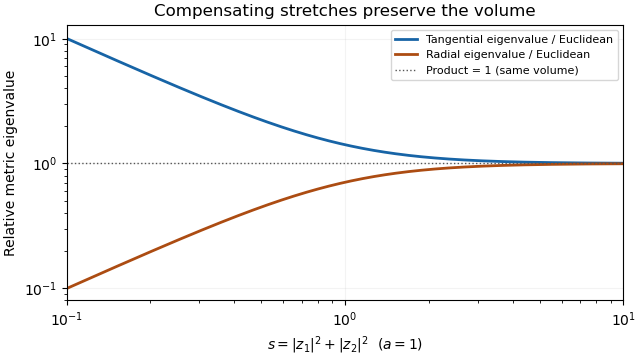
Use a radial geometric Kähler potential. Write and . The coefficient Hermitian matrix of isIts eigenvalues are in the complex tangential direction and in the complex radial direction. A Kähler metric is positive precisely when both are positive. The standard form has coefficient matrix , so equality of the Riemannian volume forms is the conditionIndeed, the volume form is and its coefficient is proportional to . Multiplying the determinant equation by gives , so we can takeAn explicit antiderivative isIt is smooth for . Its two eigenvalues areThe form is real and closed because it is of a real function, so it is a Kähler metric on the punctured space. Since , neither eigenvalue equals , and the metric differs from the Euclidean one. The radial and tangential stretches compensate exactly, preserving the volume form:This is a radial Kähler metric with Euclidean volume in complex dimension two.

Articles by others on the same topic
There are currently no matching articles.